Terrorism in Boston: Why Speculation and Sensitivity Matter

In the wake of the bombing attack on the Boston Massacre yesterday, one quote by the late Fred Rogers went viral. It said:

When I was a boy and I would see scary things in the news, my mother would say to me,
“Look for the helpers. You will always find people who are helping.” To this day, especially in times of disaster, I remember my mother’s words, and I am always comforted by realizing that there are still so many helpers—so many caring people in this world.

Continue reading

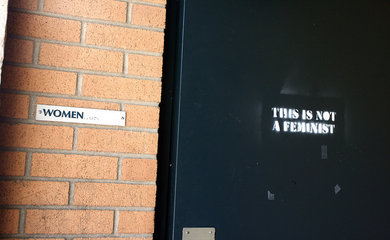
FemFuture? A Few Reasons to Ignore “Online Feminism”

A new report just released by firm Valenti Martin Media called #FemFuture: Online Revolution recently defined Online Feminism as a movement that centers on “[h]umor, pop culture, fashion, and the punchy, sassy writing, tweeting and memes that online feminists deploy.”

But the movement that refers to itself as “Online Feminism” is actually a clique of 10 or 12 millennial-to-late-gen-X white, class-privileged women based in New York City.  Between them, they run—or helped found—all of what those in the know refer to as the Big Feminist Blogs: feministe, feministing and Pandagon. Their politics are centrist or just slightly left-of-center. That is, they are mainstream, but for the fact that they focus on rather arbitrarily defined “women’s issues.”

From here on out, I will refer to this movement as Mainstream American Feminism or, for shorthand, Mainstream Feminism. As you might imagine, it alienates a lot of women who consider themselves feminists. It’s not that there’s anything wrong with fashion or “sassy writing,” but the exclusive focus on these things gives the impression that this is a shallow movement without room for serious problems women face, like institutionalized racism, domestic violence, poverty and any number of other oppressive forces. And it ensures that a small handful of feminists continue to dominate the online feminist discussion, which is actually far broader than the institution known as Mainstream Feminism acknowledges.

It would be one thing if most of the world’s women and girls were simply ignored by
Mainstream Feminism. To be sure, the movement’s silences can be deadly, but sometimes it seems as if Mainstream Feminism goes out of its way to dismiss and scold its critics. Here are just three things that have gone down in the past six or seven weeks. Surely there are more, but these were some of the more egregious and most discussed examples:

February 24, 2013: On Oscar night, The Onion tweeted that nine-year-old African-American nominee Quvenzhané Wallis was a “cunt.” Mainstream Feminists pride themselves on critical analysis of pop culture, but they completely ignored a sexist, sexualized insult against a black girl child. You might give them a pass for being unaware of what happened, except we all know they were live-tweeting the Oscars and following The Onion that night. So, it seems more likely they were ignoring it, hoping none of their troublesome detractors would notice and ask them to respond.

No Mainstream Feminist could be bothered to write as much as a blog post decrying Wallis’ treatment. They couldn’t even manage to link someone else’s fantastic
piece
explaining why so many women of color found the tweet hurtful and offensive.

March 7, 2013: Feministe editor Jill Filipovic penned a piece in the The Guardian instructing women not to change their names after marriage because (1) it’s un-feminist and (2) makes you harder to track down on Facebook. Never mind any of the complexities of name-changing or the absurdity of telling women that the truly feminist thing to do is keep your father’s last name—or, frankly, the absurdity of involving yourself in a personal decision like this at all.

It’s a simplistic thesis that garnered lots of page views and insulted a lot of women. Women who critiqued the piece were quickly shot down by Filipovic’s compatriots and accused of being “haters” (Did I mention that Mainstream Feminism is super emotionally mature?). Then, when blogs Flyover Feminism and Are Women Human? hosted a series of brilliant—and much more interesting—first-person responses about the variety of ways we approach naming, neither Filipovic nor her friends responded.

Entire Month of March: Facebook COO Sheryl Sandberg wrote a book called Lean In that advocates for advancing the status of women through corporate culture. And mainstream feminism has no place for people who ask questions like, “Hm, are we so sure a culture that promotes wealth accumulation for the already wealthy is really where we want to center our feminism?” No less than Katha Pollitt, Joan Walsh, Jessica ValentiJill Filipovic, Michelle Goldberg and Linda Hirschman converged to shout down the few women who dared ask this question or worse, openly critique Sandberg’s corporate feminist message.

They were particularly nasty with the excellent Melissa Gira Grant, whose writing on sex
workers actually centers women outside the margins of mainstream feminism. Grant argued, “Women and our social movements do not need a better boss but a more powerful base, from which we can lead on our own terms.” Rather than engaging this point, they attacked her on the basis that it’s “sexist” to critique a successful woman. For focusing on the working class women, women of color and many others who are left out of Sandberg’s vision, Grant was accused of “skirting feminist self-parody.”

In some ways, the Sandberg firestorm provided a great chance for mainstream feminists to clarify their corporate vision for all to see. It gave us a pretty clear picture of what this movement values. And it came in handy just in time for the launch of the #FemFuture report.

There are so many things wrong with this report that I can’t possibly begin to summarize them here. It leaves out a lot of people: online feminists outside the United States, early online feminist writers and educators, feminist sex workers, queer feminists, feminists of color, trans feminists, feminists with disabilities and many more. Moreover, it fails to acknowledge the fact that many do not see their online work and real-life activism as separate entities. I could go on, but really, they left out everyone but themselves, save a side box reserved for trans women and a few name-drops for women of color and earlier online feminist writers.

One of the less discussed features of #FemFuture is its endorsement of feminism as a Sandberg-like corporate feminist movement. There is business-speak all over the report. Its Executive Summary refers to Mainstream Feminists as “movers and shakers.” It wants to provide “innovative” solutions for the problems facing Mainstream Feminism. Toward the end, the report lists more corporate sponsorships as part of its strategy moving forward. It explains:

Online feminists need to recognize that our skills are useful, not just to each other, but also to corporations who have the financial resources to pay for this unique expertise. We need to establish and foster these cross-sector partnerships where corporations hire us to help them create blogging platforms, video, photo-sharing and other digital media that we have mastered. We understand that not every corporation’s mission and operations would fit within the ethical and political framework that many online feminists demand of our partners, but there is still potential here for mutual benefit.

This is exactly what Gira Grant described as Sandberg’s trickle-down feminism, all over again. It’s not that women shouldn’t make money, but that profit-making within the context of a political movement entrenches the Mainstream Feminist hierarchy—and dilutes the movement until its vision mirrors that of the corporation.

I’m just so very tired of these conversations. I’ve been watching these things happen for so many years that I can’t even feel angry about all the people they’re ignoring. The thing that offends me most nowadays is how small-minded it is, how hard it works to make feminism seem “cool” to the masses, how facile its conclusions have become and how bland we have to make ourselves to fit in. How we have to be willing to cast ourselves as “sassy movers and shakers” and how we’re encouraged to treat activism as business. I’m tired of calling out the same ten people every few weeks, and watching people pour themselves into educating these women as if anything is going to change.

I’m tired because Mainstream Feminism is so ridiculously, laughably shallow. So, I’m not
having this conversation on their terms anymore. I’m done with dialogue. Actually, I’ve been done with that for some time. In a time of increased disparity between wealthy and poor, I could not possibly give two shits what they think about anything that matters. They’ve demonstrated time and again that they don’t spend much time thinking about anything that matters.

When I decided to start writing for pay, I took pains to distance myself from mainstream online feminism. Thanks to lots of blog-reading, I’d figured out by then that the movement is often insular, anti-intellectual, exclusionary and extremely averse to constructive criticism. I also discovered that it has the very same argument practically every other month. It goes like this:

A Mainstream Feminist will write something either hostile to or ignorant of differently situated women – that is, women who are not white, upper-middle class, able-bodied, cisgendered and/or heterosexual like they are. Women from the rightly offended community offer constructive criticism. The Mainstream Feminist dismisses the whole thing as a “kerfluffle” or something similarly trivial, and all of her famous feminist friends rally to put the critics in their place. They depict their Mainstream Feminist friend as a besieged and silenced voice. And on and on it goes.

I never wanted any part of this. I’m not merely tired of it. No, I’m aggressively bored by it. I’ve been watching it happen online since about 2006. So, I mostly write about things these mainstream feminists don’t care about: Poverty, education, religion, politics in the South and other assorted things. Obviously these things are relevant to feminism, but they don’t fall under the rubric of Approved Topics for Feminist Bloggers.

A brief primer for future reference: The Approved list includes fashion for white women,
abortion rights for white women, the sex lives of white women and popular culture for and
about white women. Mainstream feminists also tend to frame the whole of feminist discussions about sexuality as defenses of heterosexual hookup culture. And on another note, they often converge around supporting Very Powerful Women—including those who may not have actually advanced feminism, like Margaret Thatcher—based on thin “glass ceiling” analyses. If you’re not sure whether a post you’re reading counts as mainstream online feminism, look for cloying, cutesy, fake compound words with the word “lady.” Seeing words like “ladyboss,” ladyparts” or “ladybusiness”? Mainstream Feminism for sure.

None of this is new. But over the past several weeks, Mainstream American Feminism has been even more aggressively exclusionary and petty than usual. So, fuck it. It’s getting hard to keep ignoring them. I’ve deliberately cast them as a monolith here because they more and more frequently act and move as one. They champion the voices of each other, the ridiculously privileged white women they revere and people who can get them on MSNBC—and callously dismiss the voices of their detractors.

Oh, hey, was this “punchy” and “sassy” enough for you?

UPDATE: Just wanted to note that I draw a distinction between Mainstream Feminism as such, and the report. I do not intend to give the impression that any group of marginalized women often left out of Mainstream Feminism has a uniform position on #FemFuture or this group of people. Also, it’s important to point out that several women of color attended the convening and had ideas included in the report. Judging from online reactions, some felt “name-dropped and watered down,” but others did not. Even so, the report was written by Valenti and Martin, and is not, in my opinion, altogether different in kind from anything I have watched this movement do over the past eight years. But again, I do not want to erase anyone here, and I apologize for not recognizing that I might inadvertently be doing so in advance.

France Made the Right Call about Mali: And Other Things the Leftist Narrative Misses this Time

I probably wouldn’t have admitted this 11 years ago as an undergraduate anti-war activist: The French government made the right call in sending troops to Northern Mali. But I wouldn’t have acknowledged it then for myriad reasons, like educational gaps, shortsighted groupthink, leftist naïveté and self-righteous paternalism. And I would have been wrong.

Like other true believers, leftwing activists are sometimes willing to sacrifice people to ideological purity. And this is one of those times.

At socialist website Liberation, Eugene Puryear penned a column with the headline, “Oppose the Neocolonial French Intervention in Mali!” And likeminded magazine Socialist Alternative insists that French involvement will “amplify the chaos.” Both nod to the history of colonialism in the area without much detail or explanation, as if colonial history is an explanation in itself.

Even the moderate left has jumped on the bandwagon. At Democracy Now!, Emira Woods of the Institute for Policy Studies provides a misleading account of the conflict. Her argument rests on three key points, all of which must be addressed: They’re plausible—and dangerous—because there’s a kernel of truth in them.

First, she implies that the al-Qaeda in the Islamic Maghreb (AQIB) is not a significant player in the region, contesting the dominant narrative in both Western and African media outlets. Sure, she recognizes there are a few extremist elements in the area, but she implies that they’re pretty inconsequential. Here’s what’s true about that assertion: AQIB is not the only group that opposes Mali’s government in Bamako. But that doesn’t mean it doesn’t matter.

In fact, there are three main opposition groups linked to Islamist extremism: AQIM, Ansar Dine and MUJWA. Andrew Lebovich of the New American Foundation provides helpful context in his new series at Jihadica: AQIM, which became an affiliate of al-Qaeda in 2007, is the wealthiest extremist group in the area. Lebovich says the group has accumulated “an estimated tens of millions of dollars in ransom payments (more, according to some sources)—money reportedly bolstered by income from cigarette smuggling and taxes from the region’s growing drug trade.” Mokhtar Belmokhtar, one of the men believed to be leading the rebellion in Northern Mali, has an extensive history with AQIB, and the group has controlled Timbuktu since April, making them a key player in the unfolding conflict.

The other militant groups, Ansar Dine (Defenders of the Faith) and the Movement for Unity and Jihad in West Africa (MUJWA), originated in and around Northern Mali. They assisted AQIB in its April bid for control of Northern Mali and set up what they called the Independent State of Azawad. There, they imposed a draconian version of Sharia law that brought stoning and amputation to Northern Mali. More than 200,000 people were displaced by April. Meanwhile, they began destroying Timbuktu’s ancient relics, targeting the city’s more than 700,000 ancient manuscripts across 60 libraries.

Woods’ second erroneous claim is that the conflict is just an innocent bid for self-determination by the longsuffering people of Northern Mali. The involvement of three militant Islamist groups belies this claim, but again, there is an ounce of truth in it. That’s because the al-Qaeda backed assault on Northern Mali was originally backed by Tuareg separatists in the north who have been fighting oppressive policies from Bamako for decades.

Called the National Movement for the Liberation of Azawad (MNLA), the group turned to al-Qaeda in 2012 for assistance with their independence bid. They started out as the primary resistance force in Mali, but were sidelined by the wealthier Islamist groups.

But things are always more complicated than that, and it’s impossible to suggest that the Islamists and the Tuareg separatists are two completely distinct constituencies. There is more overlap than that. Ansar Dine, for example, is a predominantly Tuareg group. More than the other two Islamist groups, it stresses Tuareg liberation in rhetoric that links self-determination with Islamist nationalism.

The MNLA itself is divided. When Islamist groups established dominance in April, tension between mainstream the MNLA and Islamist groups erupted. In June, the MNLA organized a military assault on the Islamist rebels—for that, the Islamist groups doled out harsh punishment against the Tuareg rebels, alleging Sharia violation.

This may have started with a relatively innocent bid for self-determination by a long-marginalized minority group, but it has since ballooned into something altogether different. Now it’s an unmitigated mess.

Finally, Woods’ third misstatement: She insists that French involvement is a self-interested bid for control of the region’s uranium.

This is one of those moments in which two seemingly opposed things are both true: France is self-interested, and it’s also right to intervene. Once in a while self-interest converges with the right thing to do.

France hopes to stamp out the growth of al-Qaeda to prevent it from gaining influence in the region and within its own borders, and it has an economic stake in the future of Mali—namely in the country’s uranium reserves. These are points of fact, but again, they do not negate the case for intervention.

Of course France isn’t motivated by pure compassion in Mali, one of their former colonial holdings. Sometimes true believing interventionists like Samantha Power and Anne-Marie Slaughter overstate the humanitarian component of missions like this one—and forget that postcolonial context matters. There is a humanitarian crisis in Mali, but pundits like Power and Slaughter are suspiciously reluctant to address anything else. They’re beholden to another dogma: Interventionism in service of the international human rights regime. But their short-sightedness doesn’t mean that interventionism is always wrong.

The left is not wrong to insist that meddling will always carry neocolonial undertones. It’s not that there’s nothing problematic about the intervention. But policymaking requires countries to weigh a range of bad options, and decide which one is least bad. They do this in an international system marked by disparities in power and wealth—and haunted by memories of past violence and oppression, including a colonial system that lasted into the late twentieth century in parts of Africa.

The rise of al-Qaeda in Mali is not only a threat to French and Malian security interests. It’s also a problem for which France is partly to blame. Colonial powers drew Mali’s map—indeed, they drew Africa’s map—with no regard for existing groups such as the Tuareg, who are dispersed throughout Northern and West Africa. The people of Mali divided by cultural and ethnic distinctions that were long exploited by French colonial rulers bent on establishing economic dominance. Their strategy? Fomenting and exacerbating existing political and cultural divisions in the country.

It’s not that Mali’s diverse groups lived in pastoral harmony before colonialism—and indeed, suggesting this would amount to romantic orientalism. But colonialism made the divisions more entrenched. The French pursued this tactic not only in Mali, but throughout their Northern and West African holdings. They also have a long history of propping up repressive dictators in the region.

At Al Jazeera English, historian Mark Levine provides a helpful history of the emergence of radical Islamist groups in Northern Africa and the Sahel. He suggests that the current Islamist groups in Northern Mali were born of postcolonial pushback against repressive governance in Algeria.

That vexed history complicates policy decisions to this day. The French supported Ben Ali against the 2011 democratic uprising that led to his ouster in Tunisia. Then, irrespective of the need for intervention in Libya, the 2012 ouster of Gaddafi sent the former dictator’s cache of weapons across borders to Tuareg and al-Qaeda-linked opposition groups in Northern Mali. Now al-Qaeda is trying to take Bamako.

And that’s just the abridged account of the chaos the French government helped unleash in Northern Mali recently. France arguably owes it to Mali to help right some of the damage it’s done. This mission won’t fix everything. It won’t rectify Mali’s history of Tuareg repression. It won’t serve a democratic uprising in Mali. It won’t convince the government in Bamako to consider democratic reforms. It’s a simple mission, absent the triumphalism of past French engagement on the continent: Stop al-Qaeda and its extremist allies.

Over and over, in every media outlet in the world, the people of Mali have expressed near unanimous support for the French mission. When we insist that they’ve all got it wrong, we treat Malians with the same paternalism we think we’re fighting. We want them to fit into our nice leftist understanding of the world, in which there are clear “good guys” and “bad guys,” and power is a top-down, easily traceable construct.

But there is no post-postcolonial world coming. International actors, like people, learn to figure out what works best in a world that gives us not purity, but troubling possibilities. No one is innocent.

Again, people in Mali almost uniformly support French intervention at this moment. It’s a fraught and deeply disturbing solution, and already there are signs that it’s going to be harder than France realized.

But trust that the people squawking about paternalism are surely among the most egregious offenders right now. Are Malians adults who can make informed decisions about their own country? Or are they the children of colonial imagination? Too many on the left—a left that I have always identified with—have chosen the latter. This is where we part ways. People are more important than dogma in any moral rendering recognizable to me.

Blessed Are Those Who Mourn: Reflections In the Aftermath of the Connecticut School Shooting

“In the beginning was the Word, and the Word was with God, and the Word was God. He was in the beginning with God. All things came into being through him, and without him not one thing came into being. What has come into being in him was life, and the life was the light of all people. The light shines in the darkness, and the darkness did not overcome it.”

John 1: 1-5, New Revised Standard Version

Continue reading

New York Times Concern Troll Nick Kristof Reminds Us All about the True Meaning of Christmas

Professional concern troll and New York Times mansplainer Nicholas Kristof touched off a firestorm last Friday when he warned of a new way in which teh poors are profiting on the backs of Big Welfare. He brought the chilling news that devious destitute parents are once again up to no good. That’s right – this time the “welfare queens” are willfully pushing their children toward academic failure, all so they can continue living the high life on the backs of their children, collecting that monthly government disability check instead of contributing to society like good Americans.

Continue reading

FEMA Is Already Being Privatized and Other Under-Reported Facts About Hurricane Sandy

If you live in the United States, you almost certainly know that a big hurricane-turned-post- tropical-cyclone called Sandy hit the East Coast earlier this week. Unprecedented in size and scope, the hybrid storm, popularly dubbed a “Frankenstorm,” caused damage from North Carolina and all the way up through parts of Eastern Canada. More than 8.2 million people in the US lost power. Electricity is slowly being restored, and at this writing, the death toll has reached 55.

Continue reading

The Foreign Policy Context Neither POTUS Candidate Addressed – And Won’t Cover in the October 22 Debate Either

Last night, US presidential candidates President Barack Obama and former Massachusetts Governor Mitt Romney took the stage in a town hall style debate in which self-described “undecided voters” posed questions about both domestic and foreign policy. The debate was predictably dominated by domestic concerns like the economy and job shortage, though the candidates did spar about the country’s relationship to China as well as the Obama administration’s response to the Benghazi attacks.

Continue reading

Jerry Sandusky Deserved Those 442 Years

Former Penn State assistant football coach and serial child rapist Jerry Sandusky was sentenced yesterday by a judge in Bellefonte, Pennsylvania to between 30 and 60 years in prison. I don’t often find myself on the side of harsher prison sentencing, but this is one of those times at which I do.

Continue reading

“Won’t Back Down”: One More Ode to Privatized Life in Late Capitalism

Hollywood’s latest ode to the “empowering” nature of privatizing the public is called “Won’t Back Down.” The drama, which stars a host of fabulous actors known for portraying strong women – Viola Davis, Maggie Gyllenhaal and Holly Hunter – opens Friday in theaters throughout the United States.

In a nutshell, the film functions as a powerful propaganda piece on behalf of the neoliberal, or market-driven, education reform movement in the United States, which is usually – and misleadingly –called only “education reform.” It pursues neoliberal aims under the guise of ideas that resonate with parents, like “school choice,” which implies spending public money on private school vouchers and privately managed charter schools and forcing parents to choose from a “marketplace” of schooling options. The end game? Replacing traditional public schools with private and charter institutions over time.

Continue reading

On the Year of the Semiautomatic Firearm: Guns in 2012 America

So, where will next week’s public shooting(s) happen, America?

Or should I be asking about tomorrow? This afternoon perhaps? What precisely is going on these days?

I spent several hours yesterday looking for a timeline that includes every attack we’ve seen since mid-July. I couldn’t find one. I can’t figure out why. Are we certain – or uncertain – in our conviction that these are all isolated incidents? Arrogant or afraid?

Continue reading