Recovering From an Obama Hangover in Palestine

What just happened?

First, President Barack Obama landed in Tel Aviv—he stepped onto the tarmac, said “Shalom” and the crowd went wild. Israeli Defense Forces (IDF) soldiers saluted him and religious leaders greeted him. “It’s good to be back in the land of Israel,” he continued, in Hebrew.

Continue reading

A Non-Zionist Jewishness? Judith Butler’s Parting Ways

Judith Butler, Parting Ways: Jewishness and the Critique of Zionism. Columbia UP, 2013

Having made her name in the early 90s with Gender Trouble, a densely-written look at the ways in which gender is culturally performed, the American cultural theorist Judith Butler has over the last decade turned her eye towards ethics and violence. 2004’s Precarious Life began her evolution with an in-depth meditation on the ethical resources of the Judaism in which she was raised, with her analysis of the Iraq war and the charge of anti-Semitism levelled at critics of the state of Israel.

Continue reading

Not a Security Threat: How Israel Restricts Entry to the Occupied Territories

“What is the purpose of your stay in Israel?”

For outsiders, the Israeli occupation of Palestine starts at Ben Gurion Airport.

If you are Israeli, welcome home. Go through customs, get your luggage and be on your way to Tel Aviv, Jerusalem, Haifa or any number of Jewish settlements that you might call home. If you are Palestinian and live in the West Bank, you are probably not here. Even though it is only a 45 minute taxi ride to Jerusalem and from there an even shorter bus ride to Ramallah, Ben Gurion Airport is in Tel Aviv and Tel Aviv is in Israel—to be here, you need a travel permit from the Israeli authorities, which is difficult to obtain.

Continue reading

Attacks in Sinai Lead to Complete Closure of Gaza

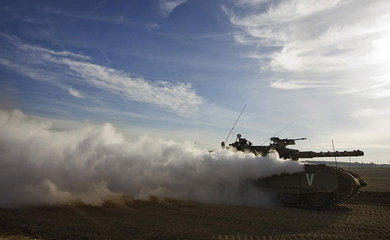
On Sunday, 35 militants attacked a border post with automatic gunfire and grenades in the Sinai Peninsula—killing 16 Egyptian soldiers, and injuring seven others. After attacking the soldiers, the militants hijacked two Israeli armored tanks, which were then destroyed—one exploding, and the other targeted by Israeli fire—killing eight of the militants as they tried to infiltrate the Israeli border.

It is suspected that the militants are Islamist and Salafi jihadists from Gaza and Sinai—though their exact identities are still unknown. Certain sources claim that the militants hijacked the armored vehicles to abduct an Israeli soldier. Some claim that the smuggling operations between besieged Gaza and Sinai are the structural cause for frequent bouts of regional violence. Still others claim that the militants were deliberately trying to incite war between Egypt and Israel.

Continue reading

Gaza’s Fuel Crisis

If someone were to have a heart attack in Gaza, the ambulances might not come. Due to the current fuel crisis in Gaza, one third of the ambulances have completely run out of fuel—the other two-thirds are relying solely on the fuel in their tanks.

Over the past year, Gazans have routinely smuggled fuel in from Egypt through underground tunnels that run between the two countries. These tunnels have long served as an economic lifeline for Gaza, importing black-market goods that would be otherwise banned due Israel’s blockade on Gaza—a blockade that bans the import of “anything that could be construed as a weapon.” On this list is everything ranging from pipes—making repairing factories and sewage treatment plants difficult, fertilizer—which makes farming and food production difficult, and of course, diesel and petrol.

Continue reading

Khader Adnan: Dying To Live

Khader Adnan is a 33 year-old Palestinian baker and master’s candidate in economics at Birzeit University. He lives in Arrabeh—a small village in the Occupied West Bank, just outside of Jenin with his wife and two—soon to be three—children. On December 17th, 2011 at 3:30 in the morning, Israeli Authorities raided his home, arresting Adnan in front of his family and taking him away to be interrogated, and later detained for alleged involvement with the Islamic Jihad.

Continue reading

After UNESCO Votes for Palestinian Statehood, US Withdraws Funding: Why?

Yesterday, the United Nations Educational, Scientific and Cultural Organization (UNESCO) voted to recognize Palestine as an independent state. The vote follows PLO Chairman Mahmoud Abbas’ wildly popular September bid for UN membership and state recognition. The vote undermines US stalling tactics to keep the issue from coming to a vote in the UN Security Council. In response, the US withdrew the $80 million it had committed to UNESCO for this fiscal year.

Continue reading

What Would Palestinian Statehood Change?

I remember the first time I visited the United Nations.

I walked through the courtyard, marveling at every flag of every nation majestically poised against the backdrop of the beautiful, glass building. It felt like a poetic symbol of world peace—the peaceful presence of every country, and the fragile yet powerful construction of the building itself as well as its literal transparency. I reflected on world conflicts, radically hoping that with this drive of dedication and unity, they could be solved. I started looking for the Palestinian flag. I saw it for a moment, its red triangle dramatically cutting through the black upper band, uniting it with its characteristic white and green. I smiled, but then realized that there was star in the center of the triangle, meaning that it was Jordan, not Palestine. I kept looking. No matter what combination of the green, black, red, and white that denote the many Arab countries represented at the United Nations, Palestine was nowhere to be found.

Later, I learned that Palestine was not recognized by the United Nations.  “The United Nations Security Council does not formally recognize Palestine,” a tour guide told me. “Although Palestine is permitted to send a representative to the United Nations as an observer, Palestine itself does not have a vote on any resolution.”

To me, this perfectly epitomized the Palestinian plight—observing and living under occupation—consequences of decisions made by others—with no control of their own political destiny.

Continue reading

Under pressure from Israel, Greece blocks the Gaza Flotilla 2.0

“Funny, I thought that all this would happen in the middle of the night and it would be done by masked Israeli soldiers,” tweeted Joseph Dana, The Nation Magazine’s correspondent aboard the US Boat to Gaza.

Little could anyone predict that it would actually be the Greek Coast Guard that stopped the boat and demand its return to Piraeus Port in Athens.

Flotilla 2.0, as it is beginning to be called across the Internet, finally left Greece this afternoon after a tumultuous week of delayed departure due to multiple investigations for suspected chemical weapons, a (semi-successful) mechanical sabotage performed by deep sea divers, and the violent riots against austerity measures that erupted throughout the streets of Athens.

Thirty minutes after its long-awaited departure, the boat was stopped by the Greek Coast Guard. Not the Israeli Coast Guard. The Greeks. Commandos pointed weapons at the passengers. Greek commandos, not Israeli commandos.  The Greek government then announced that all ships were officially banned from sailing to Gaza.

Continue reading