

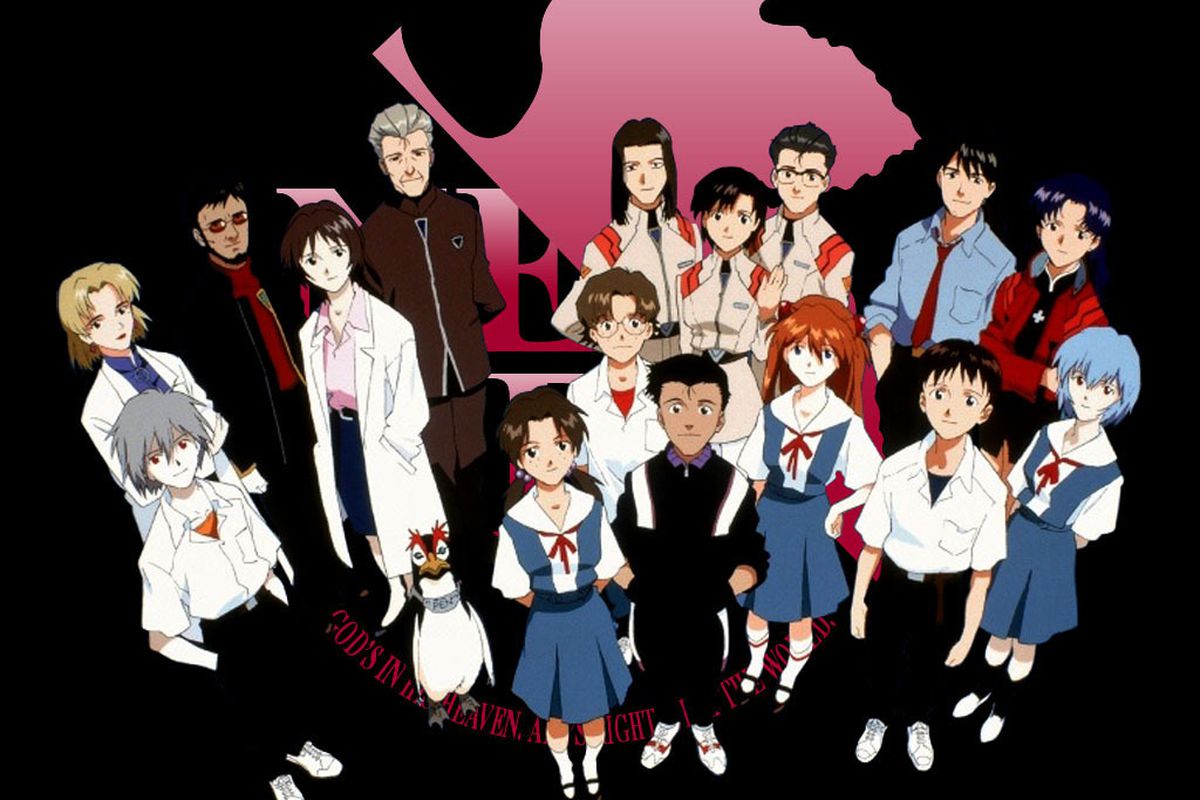
I’ll just start out by saying I don’t think Neon Genesis Evangelion is a particularly good show overall. It’s a legendary series, and it deserves most of the credit it gets since its fingerprints are still being felt all over the anime landscape, and has constant merchandise and media being produced even 25 years after the anime’s original run. That run is also quite the complicated mess. Neon Genesis Evangelion is a show that has a lot of great ideas that gives up on its plot roughly half way through, with incredibly problematic issues. But despite all of that, the show also captures the despair, frustration and anger that defines depression in a powerful and sobering way.
The show has been out of print in North America for many years, but has returned via Netflix with a shiny new English dub (which some people have mixed feelings about). The anime’s return came with much publicity due to its reputation. If you’re not familiar with the plot, it’s a near post-apocalyptic story where an event called the Second Event has wiped out most of humanity and brought civilization as we know it to breaking point. The remains of humanity are under assault by beings called Angels and the only defense against them is the Evas, a series of mechs that can only be piloted by a certain group of teenagers. The Evas aren’t your typical giant robots and are as monstrous and terrifying as the enemies they face at times, leading to some gruesome and unexpected scenes.
The main character is Shinji Ikari, who is thrust into the conflict by his father, Gendo, who abandoned his son long ago. Through the 26 episodes of the show, Shinji and those around him have their lives turned into a living hell. Whether through physical pain, psychological torture or mental angst, no one ends up having much of a good time.
Neon Genesis Evangelion wasn’t the first mecha (giant robot) anime to explore themes of how war and combat affect youth, but it turns things up to such an intense degree it lingers in ways something like Gundam never has. It’s something I’m doubtful we’ll ever see again, at least in the mainstream, due to how raw and rough the show can get.
It also has a host of problems, some really big problems.
There’s a lot in Evangelion that’s a precursor to current anime, and one of the unfortunate ones is its sexualization of minors. While some scenes are well done, like an awkward first kiss between two of the teenage pilots, there’s a lot of camera leering on underage girls, panty shots and unnecessary nudity.
Its treatment of women, in general, gets pretty terrible. One of the best female characters the series introduces, Misato, goes from one of the more interesting and capable characters to a sex-addicted mess and maybe even a pedophile, depending on how far you want to stretch a certain scene in the ending film, End of Evangelion.
While, from a narrative standpoint, Evangelion falls apart about three fourths of the way through and never really recovers, what it becomes after is maybe why it’s remembered as well as it is. The latter half of the series, roughly episode 19 or so, becomes a guttural scream of raw, terrible depression.
It is well documented that the series creator and director, Hideaki Anno, fell into a deep depression during the series, which often led to very late scripts, missed deadlines and verbal fights between him and the rest of the staff. The show, in many ways, became a therapy session for the artist. Characters morph from individuals with defining traits to those traits themselves. Shinji goes from being a young man suffering from depression to depression itself. Asuka, another Eva pilot, goes from an abandoned girl suffering from anger issues to anger itself. A scene from End of Evangelion, where she fights off multiple enemies in a fit of raw rage, makes her seem like the emotion personified against some glorious animation.
That makes the back half of Eva incredibly frustrating from a plot perspective, because we must revisit character development as characters backslide constantly into their flaws, and things become so unclear it’s hard to tell what is and isn’t really happening. None more than Shinji, who gets to a point where any degree of development or happiness is wiped totally away. His despair is like a wheel; no matter how many times he faces his feelings of sadness, abandonment and shame, it comes back around. In the 26 episodes of the original show, we revisit that arc three or more times in roughly the same way, even if through increasingly vague and surreal terms.
Neon Genesis Evangelion perfectly captures that overwhelming feeling of frustrating depression. When those suffering from depression get in those states, it can feel like a pit that you can’t get out of. Issues you once thought you’d passed find their way back into your head, pulling you down. Pulling you back over and over until there seems to be no way out, no way forward, until you just want to scream and say to hell with it all.
That’s how End of Evangelion feels: like a nasty, self-hating piece of work that solely exists to destroy anything left of what had come before. There’s a theory that Anno created the film as a middle finger to fans who sent the studio death threats after disliking the show’s original ending, but there’s nothing to support that and there’s storyboarding that predates the film showing similar scenes suggesting it was always planned in some form (the show basically ran out of budget, leading to an experimental final two episodes that did not go over well with many).
It always felt like a natural end to the strange hybrid giant robot anime/therapy session the show became to me. Someone who tired of the struggle and had, for all intents, just given up. In that way, End of Evangelion is also startlingly beautiful in its animation, music and intensity that has to be seen to believed, despite its violent and, frankly, vile plot contents.
In the end, Neon Genesis Evangelion isn’t a good show. It has a lot of amazing ideas throughout, but is ultimately swallowed by its own themes and is muddied with a lot of problematic material. But because of that, it’s unique. It creates a world in which the end of civilization is slowly but surely creeping toward its inhabitants and, I believe unintentionally, its narrative is driven to a breaking point and is overwhelmed in a mishmash of robots, anger, sadness and hopelessness. It may not be a good show, but it’s worth watching if for no other reason that there’s nothing in the world out there like it, which may very well be for the best.
I have a couple of problems with this article.
You make the claim near the opening of your article that “the show gives up on its plot roughly halfway through” yet nowhere in the article ( at least as far as I can tell ) do you go into why you believe this. While the story is told very subtly. the motivations of all the major players are all laid out by the end and their actions in pursuit of those motivations are logical which leaves me confused by this complaint.
Later you put forward the notion that the way NGE treats its female characters is “pretty terrible” based on the sexualization of the characters, referencing Misato specifically. I take issue with this position for a few reasons. Firstly, the sexualization of the characters is primarily done in order to serve a narrative or thematic purpose. A good example of this is how Shinji had sexualized both Rei and Asuka in his mind after watching them from afar but upon trying to deepen his relationship with the two in pursuit of his goal he realizes that they are more than just an object to be desired.
With Rei, this comes in the form of her utter non-nonchalance at Shinji seeing her in the nude with the only thing on her mind being retrieving Gendo’s glasses, an object she cherished due to it being a reminder of one of the few moments where someone expressed concern for her ( which makes the fact that Gendo only views her as an expendable tool who he only showed kindness to because she reminded him of his dead wife all the more tragic when we learn this later on ). Rei’s reaction to Shinji makes him realize that she’s her own person with her own feelings. This makes the next episode where Rei jumps in the way of a beam that would have killed Shinji and Shinji, in a mirror of the scene with Gendo, burns his hands in order to free Rei all the more profound as Rei realizes Shinji did this for no other reason then that he cares for her, unlike Gendo, who only did it because she reminds him of someone he actually cared about. This sets her on the beginning of her path to viewing herself as a person which we ultimately see realized in the End of Evangelion movie.
With Asuka, there is a moment in one of the episodes where Misato has left them alone for the night with Asuka teasing Shinji at first before acting coy and standoffish. Later in the night, Shinji awakens to find Asuka lying next to him. He leans in to kiss her but just before he does so Asuka cries out “Mother” in her sleep as she whimpers and cries. Shinji immediately backs away berating himself and calling himself a child. We find out later that the reason Asuka tends to tease Shinji in a sexual manner is twofold. Firstly, she desires attention from those around her because of her abandonment issues caused by her mother and father. Secondly, in doing so, she’s seeking a form of comfort from those around her which makes the scene where Asuka and Shinji kiss ( which you rightly praised ) that much more meaningful and sad since Shinji, because of his own emotional trauma, is unable to provide her with the comfort she so desperately needs. The fact that she learns Kaji has had sex with Misato later is a betrayal that only shakes her confidence further.
As for Misato, we learn that the careless and charismatic persona she adopted when she first met Shinji is a facade and that she is actually a deeply vulnerable individual who’s insecurities mirror Shinji’s own. The reason she adopts this facade is in order to avoid true emotional connection. Anno himself confirms this:
“…a woman, twenty-nine, who lives life so lightly as to barely allow the possibility of human touch. She protects herself by keeping relationships on the surface, and by running away.” – Hideaki Anno.
This was ultimately the reason she broke up with Kaji in the first place as she cared deeply for him and he reminded her of her father and was afraid to be abandoned again. Sex is what broke down those barriers and allowed her to express her true vulnerable self to Kaji and, to a lesser extent, Shinji in End of Evangelion. One could argue that the implication of Misato’s statement in EoE about “doing the rest later” referrs to overcoming their respective trauma through connection. Either way, it’s made clear that the exchange between Shinji and Misato is a metaphor for overcoming his fears and entering into adulthood. Whether she used the incentive of sex as a way to get Shinji to do so or not is irrelevant imo. The message of the scene supersedes it.
I also don’t agree with your take that the characters “backslide” or that the series throws away their character development. I think the series is intentional about putting the characters into situations and causing things to happen to them that will force them into crisis mode. The problem with your interpretation I feel is that you seem to think they’re retreading the same ground but the point of each of those instances with Shinji that you mentioned is not to have him face his problems and overcome them. It’s to show that Shinji is unwilling to face his issues but that his unwillingness to do so is causes him suffering and depression. The same goes for the rest of the characters. It’s only at the end of the series that Shinji and all the rest of the characters fully face their trauma and manage to overcome it which is the entire point of the show. I feel like you missed that point which is honestly a shame. I hope if you ever end up re-watching the series you’ll be able to see that Evangelion is ultimately a hopeful story that puts forth the thesis that we CAN overcome our past traumas and achieve happiness.