
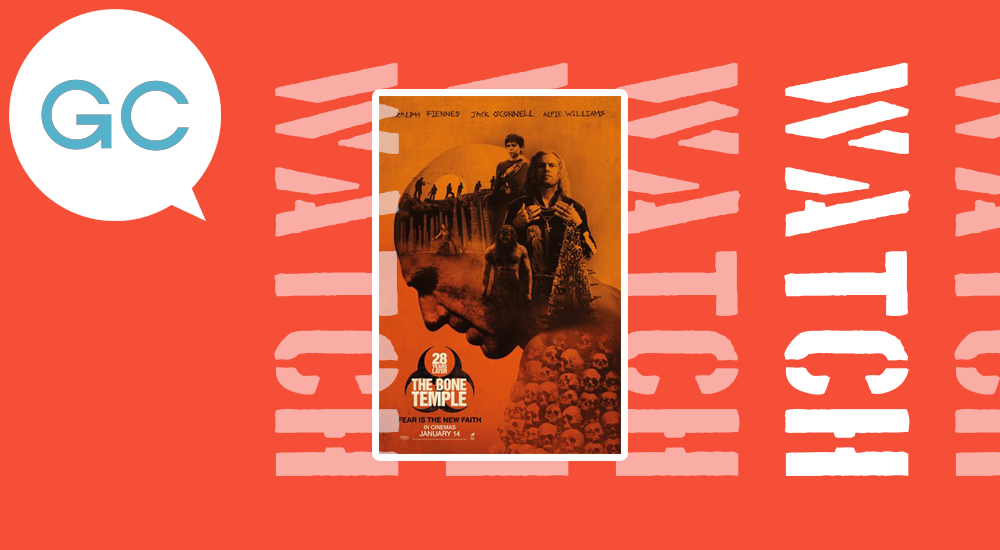
Of all the good films that recently hit streaming, 28 Years Later: The Bone Temple, which is now on Netflix, is probably the most overlooked.
Now, obviously, hardcore fans of Alex Garland and Danny Boyle’s Rage Virus universe did not sleep on The Bone Temple.
Except for me, of course. I chickened out when it came to seeing it in the theater.
Seeing it on Netflix means that I can fast forward through a scene in which people are getting skinned alive. I’m not big on torture, and while I’m not saying The Bone Temple is gratuitous, sometimes the fast forward option is just better.
Especially considering the lunatic news cycle we have all found ourselves in since at least 2020.
All that aside, The Bone Temple, directed by Nia DaCosta, is a great follow-up to 28 Years Later. DaCosta is the director who brought us the terrific 2021 remake of Candyman, and she brings a similar, hard-nosed, unsparing energy to the writing of Alex Garland.
28 Years Later – itself a follow-up of 28 Days Later, one of modern horror’s most enduring classics – is, in many ways, an art film. The Bone Temple, on the other hand, is more like an elegant and twisted campfire story.
28 Years Later experimented with surrealism, awing and confusing the audience. It was a bloody, starry acid trip, a fever dream. The Bone Temple is a more grounded story that brings some long-awaited answers to how the Rage virus has evolved – and how it can be mitigated, if not cured.
If you’re not a big horror fan and all of this is confusing to you, it’s fine. You don’t even have to watch the original 28 Days Later to get into The Bone Temple, although I do recommend sitting down for 28 Years.
This sequel is wonderfully anchored by Ralph Fiennes, reprising his role as the slightly crazy, obviously genius Dr. Ian Kelson, the man who makes memorials to the dead and, at the same time, is trying to understand the virus that essentially wiped out Britain decades ago.
A lot of actors would have portrayed Kelson as pure camp – and his incredible turn cosplaying as Satan to the epic sounds of Iron Maiden toward the end of the film is a great example of the evolution of this franchise and of modern horror in general – but Fiennes knows how to find a tender middle ground between silliness and tragedy.
We also have a great performance by Chi Lewis-Parry as Samson, the Alpha zombie who becomes addicted to Kelson’s morphine darts. This is a development that leads both the good doctor and Samson on a surreal and, for a brutal, unforgiving kind of horror movie, heart-warming journey.
Samson could have been ridiculous. Enormous, jacked, naked, and hung Alpha zombies are hard to pull off (pun entirely mine, I am a child). But under DaCosta’s precise direction, and with Garland’s wonderful script, this plotline becomes a dark and redemptive fairy tale.
Then of course we have the Jimmies. Inspired by late entertainer and deranged sex offender Jimmy Savile, they are a murderous Satanic cult led by the self-appointed Lord Jimmy Crystal, played by a terrifying Jack O’Connell. This part of the story is a bit harder for Americans to get, but you don’t really need to know the story of Savile to be sufficiently chilled by the Jimmies (and yes, it was a part of the barn scene is the one I had to fast forward through, in case you want to be on the lookout).
The hero of the previous film, young Spike, gets a bit lost and muddled once he is stuck with the Jimmies and there has been some criticism of how his narrative unfolds in relation to the rest, but we are dealing with a planned trilogy.
The Bone Temple didn’t do well in the theaters, but there are indicators that we will get our already much-anticipated conclusion after all – and I am guessing/hoping this character will play a major part. Alfie Williams is perfectly cast as Spike, a boy working to become a man in a land of monsters, and I can’t imagine the trilogy ending without him.
The Bone Temple is a bold followup to an already completely bonkers 28 Years Later, and it deserves a watch, and a re-watch, particularly because it manages to be both incredibly disturbing and fun.
It’s hard for a filmmaker to walk that line. DaCosta is fantastic at taking the subject matter seriously and poking grim fun at it all at once, though.
Both she and Garland have affection for these characters, and yet they also remember that they are just human – even if they’re psychotic, like Jimmy Crystal, or infected, like Samson.
I really hope that The Bone Temple’s recent arrival to Netflix will help more viewers discover this gem. Even if it did give me a nightmare or two. Or perhaps exactly because it did.
As for that ending – if it hasn’t been spoiled for you yet, good. I am not saying anything on the subject.
But if you remember where this crazy, poetic franchise began, you might cheer like I did.