
This month over at Five Books For I’ve been looking at crime novels – not detective fiction exactly, and not quite thrillers either, but stories centred on the crime itself and, often, the psychology behind it.
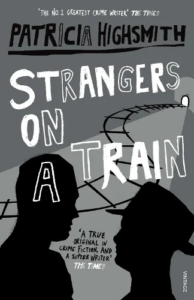 Strangers on a Train by Patricia Highsmith is precisely that kind of story. On the surface, it’s a simple, almost gleefully perverse premise: two men meet on a train, chat about their problems, and one suggests a radical solution: a murder swap.
Each kills someone the other wants gone, so neither can be implicated: simple, terrifying, and utterly compulsive.
Highsmith’s genius is in the slow, steady tightening of tension. Guy Haines, an architect, is principled yet vulnerable; Charles Anthony Bruno, the other passenger, is charismatic, charming, and, if we’re honest, completely unhinged.
The novel lets you sit inside their heads, lingering on their thoughts, doubts, and obsessions. It’s the kind of psychological tension that creeps under your skin rather than slapping you in the face. As a reader, you don’t just follow the plot – you feel the moral quagmire, the unease of recognising that ordinary people can be drawn into extraordinary evil.
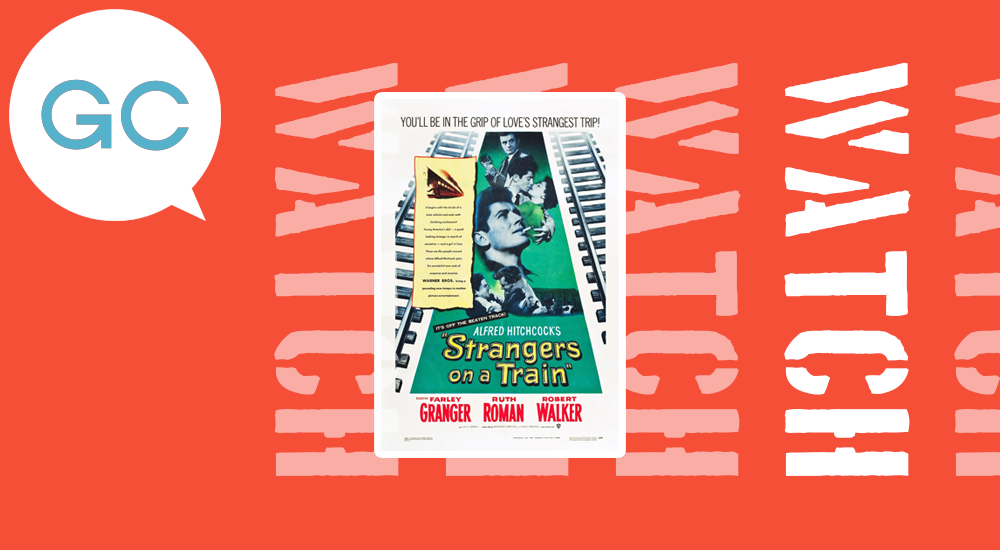
Then there’s Hitchcock. His 1951 adaptation doesn’t just retell the story but rather reimagines it, making some quite significant changes to the plot.
However, the two versions share enough of a core that watching the film after reading the book is like stepping into a room you’ve already explored in words and finding it lit in a new, almost cruelly perfect way.
Where Highsmith luxuriates in interiority, Hitchcock externalises it: every glance, gesture, and shadow counts. The opening train ride isn’t just a meeting of two strangers; it’s a claustrophobic stage for psychological warfare. You can feel the collision of chance and choice in the way the camera frames the men, isolating them from the world outside.
As for Bruno, in the book, he’s magnetic in that frightening, seductive way that makes you shiver even as you’re drawn in.
In the film, Hitchcock dials down the charm and leans hard into repulsion.
Robert Walker as Bruno is physically unsettling, almost grotesque in his intensity. He leans, he stares, he invades space in a way that makes you recoil. The menace is more immediate: less of a dark fascination and more like a raw, almost tangible threat.
The effect is fascinating: the novel makes you both fear and understand Bruno; the film makes you flinch, which changes the dynamic entirely. You’re less entranced and more viscerally aware of danger.
The characters, too, are treated differently, though always compellingly. Highsmith allows Guy’s moral wrestling to dominate, making Bruno’s menace something you live with internally. In Hitchcock, the tension becomes almost a dance. Farley Granger’s tense, anxious Guy contrasts perfectly with Walker’s Bruno. You can watch the suspense unfold on their faces, in their movements, in the spaces between them.
A key difference between the two versions is the sense of morality, and, most dramatically, the ending.
Highsmith refuses easy answers. Guy is trapped, complicit in ways he cannot fully anticipate, and the novel refuses to offer neat justice. The book closes with ambiguity, leaving a lingering discomfort: chance, choice, and consequence are messy, unresolved, and morally complex.
Hitchcock, working under Hollywood conventions, opts for a more conventional resolution: the climactic confrontation is structured as suspenseful spectacle, and justice is served in a visually dramatic way.
For readers familiar with the novel, this is a surprise – the story feels sharper, punchier, almost cinematic in a way that the novel deliberately resists.
Yet even with that tidy ending, Hitchcock preserves the tension and dread, proving that you can be both thrilling and morally unsettling at the same time.
Reading the book and watching the film together is like seeing two sides of the same coin
Hitchcock also has a lot of fun with space. The novel’s tension comes from human psychology, whereas in the film Hitchcock turns the world itself into a stage for anxiety. A tennis match, a carnival ride, a grand monument – each becomes an instrument of suspense, not just a setting. Highsmith writes dread; Hitchcock frames it. Where she writes obsession, he visualises it. The result is two complementary experiences of the same story: one cerebral, one visceral, both unforgettable.
What’s particularly fascinating is how this story exists in a liminal space of crime fiction. It isn’t a detective story, and it isn’t a conventional thriller. The crimes are intellectual exercises, a moral experiment more than a plot device. And that’s precisely what makes it so unnerving: the focus isn’t on how to catch the murderer, but on the terrifying ease with which a casual conversation can turn into complicity, and on the darkness lurking in ordinary choices.
Reading the book and watching the film together is like seeing two sides of the same coin. Highsmith’s prose lets you inhabit Guy’s guilt, Bruno’s allure and the potential chaos of a single chance encounter. Hitchcock turns that unease into a physical experience: suspense that you can feel. Together, they form a dialogue about medium, perspective, and the mechanics of dread.
The adaptation doesn’t replace the book but rather it illuminates it, showing you things words alone cannot.
I found that after reading the book, the story stayed with me a long time, perhaps because of the ambiguity of the ending. Equally, the movie lingers too, particularly the lead performances.
Both versions share a fascination with the darkness beneath civility, the way ordinary people stumble into moral compromise, and the way chance can have catastrophic consequences.
Both are – individually and together – masterclasses in suspense.
There’s a lesson here about adaptations, too. A great adaptation doesn’t need to be a copy; it’s better when it’s a conversation. It doesn’t simply translate the story from page to screen; it reframes it, highlights nuances, and amplifies what’s already there. Strangers on a Train shows how novel and film can exist side by side, each enriching the other.
So, if you’re looking for a crime novel that’s less about deduction and more about the deliciously uncomfortable question of what people are capable of, Strangers on a Train is a perfect choice.
Read it for Highsmith’s sly moral intelligence. Watch it for Hitchcock’s masterful visual tension and that slightly repulsive, wholly unforgettable Bruno.
Together, they’re a reminder that crime fiction can be cerebral and cinematic, subtle and spectacular, horrifying and thrilling all at once.