
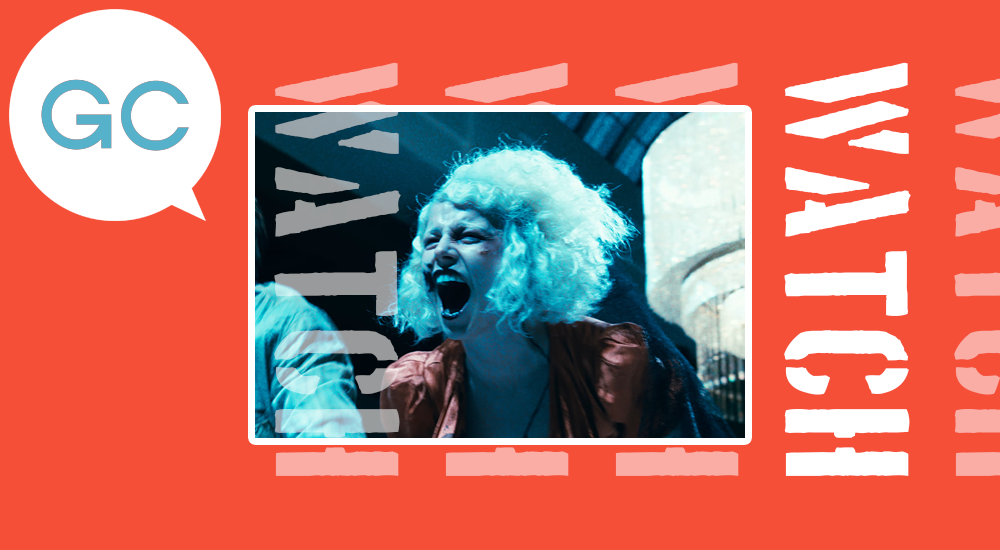
Mary Wollstonecraft Shelley is bound like a demon behind the screen, expressionistic but held hostage to misfortune just the same. She could be possessed by Carl Theodor Dreyer’s The Passion of Joan of Arc, the emotional suffering etched in black and white across her face. Brain cancer consumed her at the age of 53 but Mary wont rest, won’t cease until she can “find some way of getting this tumour, this dream, this story out of my head.”
Cinema is a medium that likes to think it can transcend death, surpass time, right wrongs. Jessie Buckley (Oscar (un) bound) as Mary rotates and bedazzles in her close-up phantom zone, her talent no longer containable in her own dimension, finally awoken by female rage, turbo charged by the Trumpian accelerant, ready to cascade across the centuries like a feminist firestorm of retribution.
Mary’s English accent feels like the origin story of Dorothy Parker’s affected, clipped mid-Atlantic brogue, her pithy, withering barbs reminiscent of Jennifer Jason Leigh’s monochrome monologues in Mrs Parker and the Vicious Circle. Vicious indeed.
Mary’s consciousness reaches across time and space, spiteful and urgent to a cinematic Chicago in 1936 before possessing gangster’s squeeze Ida, a lost soul sailing on the seas of fate and at the table of a bunch of goons employed by crime boss Lupino.
Ida’s awakening is both rude and abrupt, a tirade of intellectual abuse spewing forth from her body as it jerks and convulses much to the chagrin of her erstwhile companions. Mary, through Ida, is omniscient and let’s all and sundry know just how reprehensible Lupino is.
Lupino’s face says it all. This cannot stand.
How quickly abuse follows lust; Ida is belted and punched by men until she is crunched and mangled down the stairs in callous slow motion, a woman at their summit, a corpse at their base.
The alternate world of The Bride!, much like Kim Newman’s Anno Dracula series of books, imagines a world where literary characters rub shoulders with reality. Soft shoeing his way out of myth like a serrated Fred Astaire, Frankenstein’s monster ventures forth, erudite and dignified like that other Victorian monster Joseph Merrick. His sad eyes twinkle like his borrowed toes; Frank’s a fan of fictional musical movie star Ronnie Reed and imagines himself up on the silver screen with his hero, or better yet, replacing him. But he needs a dance partner, a Ginger Rogers.
Frank charges scientist Dr. Cornelia Euphronius to create him a life partner from a dead body. Those ruby slippers covered in earth point to Ida.
Like any sequel, two monsters are better than one – and what was that quote about Ginger Rogers?
“Ginger Rogers did everything that Fred Astaire did. She just did it backwards and in high heels.”
What emerges from Ida’s resurrection as The Bride! is less a love story than a jailbreak. The men who presumed ownership of her body, gangsters, scientists, even the monster who commissions her, quickly discover that the reanimated woman has no intention of fulfilling the role they wrote for her.
Mary’s consciousness lingers inside Ida like a furious ghostwriter, revising the script of womanhood in real time. The Bride! learns to move through the world with a new grammar: rage as punctuation, autonomy as the sentence.
The film revels in the discordant discomfort this produces. Men stare at her as if the corpse has come back wrong, which of course it has.
What was meant to be an obedient partner becomes a walking editorial note on patriarchy’s entitlement.
Jessie Buckley’s Mary doesn’t haunt Ida; she radicalises her. The Bride!’s growing agency turns every interaction into a miniature revolution. When she walks into rooms once designed to contain or exhibit her, bars, laboratories, backrooms of criminal hideouts, the atmosphere congeals like a bloody scab.
The men who haunt these misogynistic spaces expect spectacle, titillation, perhaps horror. Instead, they are confronted with a woman who has read the footnotes of history and found them inexcusable.
The film frames her awakening not as purity but as volatility, a tempest of accumulated female anger stretching from Shelley’s 19th-century frustrations to the atrocity of Trump’s Epstein administration killing 170 Iranian school girls with an illegal missile strike.
In that sense The Bride! becomes a sly corrective to the original Frankenstein mythos. If Mary Shelley’s novel asked what responsibilities creators have to their creations, this film pushes further: what happens when the creation refuses both creator and narrative? The Bride! doesn’t simply dance with Frank’s monster like a macabre Ginger Rogers; she steals the choreography. The high heels are still there, but now they are weapons, punctuation marks striking the floor with each step forward.
By the uneven climax, The Bride! feels less like a gothic romance and more like a SCUM manifesto leaflet on a baroque scale, a reminder that the true horror in these stories was never the monster stitched together from corpses, but the centuries spent insisting that women remain quietly, obediently dead.