

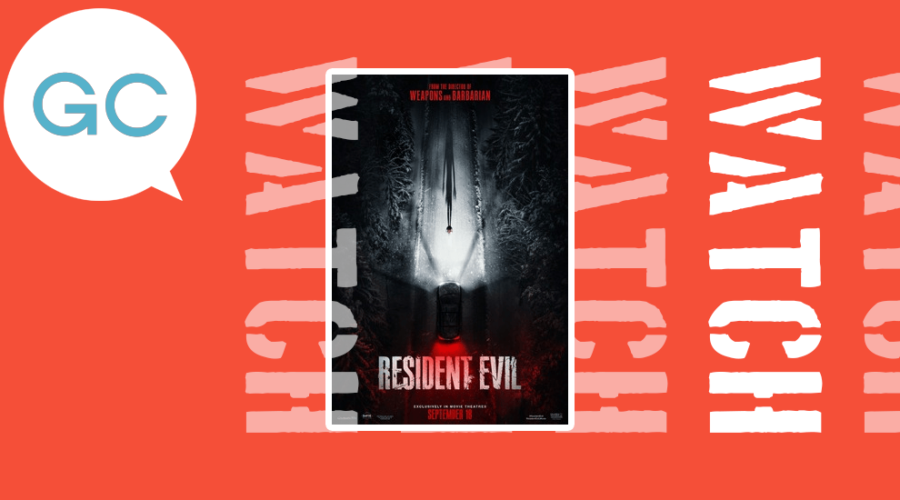
I really like video games, and I really like movies and TV shows based on video games, and I like it when those adaptations are not contemptuous of gaming.
Some film versions take the video game format as a particular challenge that needs to be overcome by the director. This can produce great results! (Think the first season of The Last of Us)
Zach Cregger’s Resident Evil is not that kind of adaptation; it embraces the video game format.
The claustrophobic POV shots are some of the best things about his latest film – genuinely unnerving, and frequently beautiful, or else beautiful in an exquisitely gory way.
Cregger is a fan of the Resident Evil franchise and he also sprinkles satisfying Easter eggs throughout his take on it.
There is the Green Herb, which can be used for healing in the games, peeking up in an abandoned car. There are the genuinely funny moments with padlocks – which can be super annoying in the games. There is a shiny typewriter – a nod to how players can save progress.
I personally can’t really play a single one of the games through to the end – they’re too scary for me, I’ll be the first to admit it – but I like their lore, and I like a director who can pay homage to the lore.
Cregger’s other horror films, Barbarian and especially Weapons, are already modern horror classics, twisty and full of societal commentary. He has taken a much more straightforward approach with Resident Evil, which sees a hapless organ courier Bryan, played endearingly by Austin Abrams, stumble into a shapeshifting monster nightmare after the evil Umbrella Corporation accidentally unleashes hell in the fictional Raccoon City.

For people who wanted a caustic, or maybe even excessively highbrow take on the franchise, Resident Evil will be a disappointment. This movie is just a lot of fun, imbued with the language of nightmare, and a love for that very particular process of grabbing your controller and splattering monsters.
There are definitely some emotional moments, such as when Bryan realizes he might never make it back to his pregnant girlfriend, and that his first reaction to her pregnancy was not the correct one. There are also genuine, grisly scares. Overall, though, this Resident Evil is a gore-spattered roller-coaster ride, a self-aware take that manages to not be snide.
The themes of nihilism and despair are recurring ones in the game franchise. Other film adaptations have all embraced it a little too much. I’ll never forget Milla Jovovich in the first film adaptation of 2002, but while her performance was terrific, the actual film built around her was not. It lacked heart. Not even a smarmy and forever underrated James Purefoy could save it, and nor could all of the creative ways in which the characters died. I never bothered watching any of the sequels all the way through. They bored me.
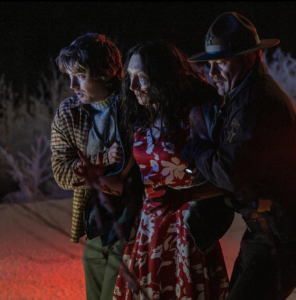 The new Resident Evil is lovingly crafted, provides surreal but enjoyable shifts in tone, and is otherwise a joy to watch. Austin Abrams is a perfect Bryan – pissed off, terrified, vulnerable, funny, as relatable as a guy trapped in a monster-verse can be.
The other actors have small roles – Bryan is the hero and the stand-in for every gamer in the audience – but Paul Walter Hauser is especially terrific as Carl, an Umbrella Corporation employee who’s a coward as much as he’s a jerk.
The way Paul fills every frame allotted to him is extremely satisfying, and his performance underscores just how good Cregger is at tonal shifts.
Isolation is another great theme of the games, and Cregger wholeheartedly embraces it. Even when he’s around ostensibly normal people, gearing up for one last courier run to doomed Raccoon City, Bryan is isolated and unmoored.
His job is important, but not recognized. His disappointed girlfriend is emotionally distant on the phone.
Then the stakes go up on a snowy, lonely road. And again at a cozy but seemingly abandoned farmhouse. By the time we get to Raccoon City it’s already scarred by chaos, but there’s also something jarring about the glimpses of normality – the warmly glowing windows in residential buildings in particular (just don’t look up at what may be crawling along the roofs).
Cregger’s visual language is masterful and chilling, and in Resident Evil, he takes this language to big budget heights.
I often talk about how horror is the most innovative genre in modern film, which remains true.
Sometimes, though, you don’t really need to innovate as much as embrace the strange chaos. And laugh at yourself along the way. When you’re not screaming.