

“The man who worries about what will next be happening to him loses this moment in dread of the next, and poisons the next with pre-judgement”
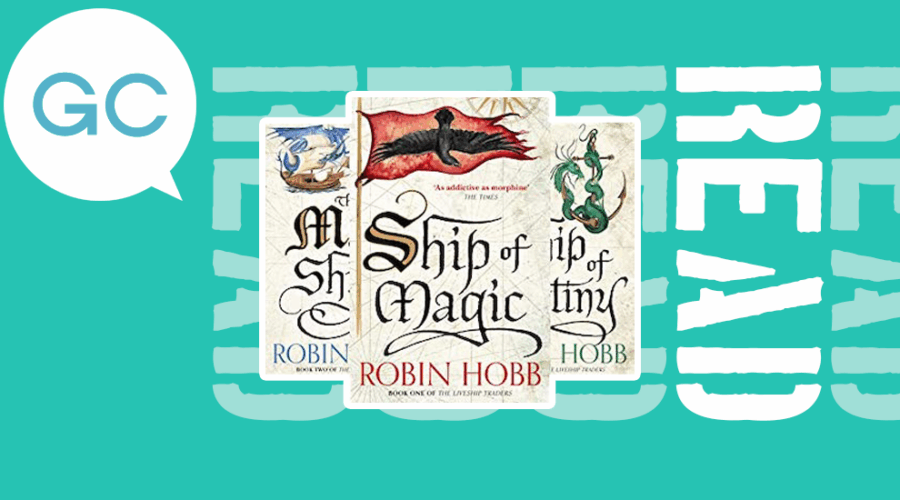
These are the words of guidance priest Berandol offers to Wintrow, a young boy studying for the Sa priesthood, in the first chapter of Robin Hobb’s Ship of Magic – one of The Liveship Traders trilogy of fantasy novels by the author – and they are subsequently the words that kept me from putting this 880-page brick of a book down.
 I found myself continuously looking back on their full conversation, which honestly reminded me of the spiritual podcasts I like to listen to when I’m going through a tough time, wanting to remind myself of the words.
But why? This piece of advice isn’t unique, I’ve heard variations of it all my life, and the setting in which it’s been given has nothing to do with me whatsoever – I mean, I am not studying for a priesthood nor am I a 13-year-old boy about to be shipped away on a magic ship to face the trials and tribulations of The Liveship Traders trilogy.
And surely, if I’m already in a place to be taking advice from fictional characters, wouldn’t I respond best to advice given to characters I relate to?
But maybe that relatable distance is exactly why it did stick.
Because the context was so far removed from me that, in relating to it, I was forced to accept its truth.
Almost everybody has heard that overthinking the future only brings you more harm than good, or that your future is made up of your current actions (as I read in a conversation between Malta Vestritt and Amber the beadmaker in The Mad Ship, Book Two), and I have usually heard these words from my family or friends or from people I admire.
What makes reading this advice in a fantasy novel so poignant for me is that it reminds us that all the best advice is universal.
If it can be applied in any situation, from me feeling anxious about my final year at university to Wintrow feeling anxious in a world outside the realm of possibility of my own, where there are magic ships and dragons (oops spoiler), then it is consistent.
And what is truth if not, for one, consistent?
Keeping an element of truth is paramount to the fantasy novel and its reader. And having that wisdom manifest itself through the human logic of the characters, their actions, and their plotlines, allows us to remain invested. We are quite selfish in that way. We want to know how we could and would act in such a world, and I don’t think we would be very interested in reading about a world where we can’t identify any element of the human condition – arguably, a book of such content would not be possible as, evidently, the human imagination is limited by the limits of being human.
What I am trying to say is that the simplicity of some of the advice in Hobb’s The Liveship Traders can demonstrate how fantasy novels, by their nature as extremely imaginative and unrealistic, can help us identify key truths in our own world through that very contrast of their impossibility and consistency.
Ultimately, they can function as more elaborate and entertaining thought experiments on the nature of morality, justice, love, or whatever else the author intends to explore.
Fantasy novels can take it a step further by bringing us to the limits of our belief systems, creating worlds that balance themselves in between a series of truths and untruths
The connection between fiction and philosophy in that regard is not new. It is not a secret that the greatest fiction novels often centre themselves around a question, often one that is deeply uncomfortable, revealing, or simply unanswerable.
But fantasy novels can take it a step further by bringing us to the limits of our belief systems, creating worlds that balance themselves in between a series of truths and untruths, that we can still situate ourselves within. Even being able to take advice from them.
This is, I think, a general sign that a fantasy novel or series is doing a good job: when its words of wisdom stick with the reader. And, not being an avid reader of fantasy myself, it has been a hallmark of deciding which of them I want to commit to and which I do not.
My list, so far, is short. In my exploration of fantasy (outside of the YA novels I read during my teenage, and slightly just out of teenage, years) I have decided to keep going with the works of Robin Hobb, Ursula K. le Guin, and – I have a feeling – Octavia E. Butler, precisely because they utilise imagination and impossibility to approach questions of humanity, morality, justice, love, etc.
And they do so in such a way that compels the reader to question their judgements and realities. They philosophise.
So, in the lifetime commitment that is growing a personal collection of wise words to look back on in hard, anxious times – one that is continuously tested, discarded, re-started and revolutionised – perhaps the scope of sources we draw on may be wider than we think. They don’t have to be from fantasy novels, or any novel for that matter, but they might just come from any work of imagination, creation, and curiosity.