

The Netherlands had a right wing government for less than a year, and the administration was not very effective on any of the urgent issues and threats facing our time.
But it did manage to achieve one thing: an enormous spending cut on Dutch public television. Dutch public television was forced by politicians to cut its budget by more than 150 million Euros a year (of a total of almost 1 billion).
The government is using these cuts to put pressure on Public Broadcasting to reform the broadcast system. But it feels, to many, like the targeting of what extreme right politicians call ‘the hobby of the leftist elite’.
It is hard to explain the Dutch broadcast system to anyone, even in the Netherlands, as it is based on a tradition of pillarization where every religion or social movement had its own broadcast organization. These clubs, some of which have merged together, have the strangest acronyms (such as KRO/NCRV being Catholic Radio Broadcaster/Dutch Christian Radio Society).
To organize all these different broadcasters, one super broadcaster was created that handles all finances and broadcast services. To have good, fresh reform on this incredibly complicated and entangled structure might not be a bad idea, but politics left it to the broadcast organizations to make the choices. However, as it is hard for organizations to cut into their own flesh, these cuts resulted in the termination of many cultural and journalistic productions. Some of these were truly the gems of Dutch TV, many made by freelance journalists, crew and filmmakers.
Our message is that, like a railway line or a bridge, public broadcasting is a crucial part of the Netherlands’ critical infrastructure.
Organizations of filmmakers and journalists began taking action to fight for what we are calling a Public Broadcasting Emergency Package. Our message is that, like a railway line or a bridge, public broadcasting is a crucial part of the Netherlands’ critical infrastructure.
You always need reliable information, especially in times of crisis. News, background information, and investigative journalism are the foundations for a good understanding of the world. In times of war, disasters, or major crises, it’s crucial that everyone doesn’t just tell their own story, but that a shared reality exists.
Without that shared map, confusion, mistrust, and panic arise.
 An emergency package isn’t just meant for survival, but also for sustenance. Public broadcasting provides energy in the form of culture, relaxation, and entertainment.
Stories, music, humor, and imagination recharge people, offer comfort, and keep society mentally resilient. Even in difficult times, people need to be able to recharge their batteries.
The Netherlands has its own cultural identity. Public broadcasting contributes daily to this shared identity by telling stories that reflect the entire country: from city to village, from majority to minority. By sharing norms, values, and experiences, public broadcasting helps people connect with each other. Without this cultural cohesion, a society becomes vulnerable from within.
Stories, music, humor, and imagination recharge people, offer comfort, and keep society mentally resilient
We also tried to emphasize that public broadcasting in the Netherlands costs almost €3.52 per month per resident, making it one of the cheapest public broadcasters in Europe. That’s €7.96 per household per month, or €42.24 per year per Dutch citizen. In Belgium, it’s €51 and, in Germany, €103. The European average is €50. Public broadcasting costs represent 0.10% of GDP in the Netherlands, while the EBU average is 0.14%. By comparison, the United Kingdom has 0.28% and Germany 0.26%. (Source: EBU MIS 2024 – Funding of Public Service Media)
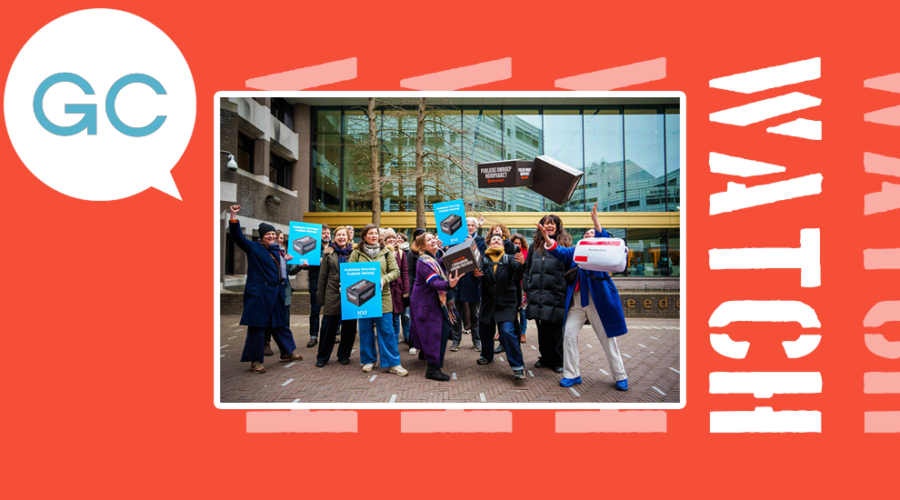
We went to our House of Parliament and offered literal survival boxes to members of different political parties and had a huge page advertisement in the largest newspapers. The debate on this media budget was followed by many media freelancers in the public gallery.
Our action seems to have had some success. We have just heard that the new government plans to reduce the proposed cuts by 50 million Euros.
Hopefully our broadcasters will start the necessary reforms and find savings in cutting bureaucracy and management so that content will be spared.
Read Global Comment’s review of Suzanne Raes’ film Where Dragons Live.
Images: Freek van den Bergh