

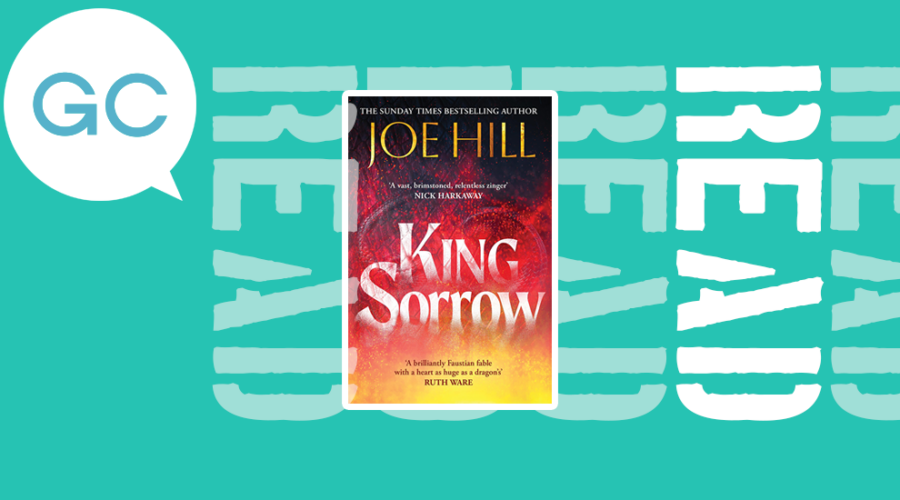
People say that writing a big, fat novel is hard. As a person who is currently writing a big, fat novel – I tend to agree.
However, as writer Junot Díaz once observed, the novel can take a lot of punishment. Poetry and short stories cannot. Every awkward clause, every superfluous word, is going to drag your work down.
 So when I finally approached reading Joe Hill’s giant horror epic King Sorrow – published in late 2025 and currently being adapted as a TV series, though we don’t know at what studio yet (I recently saw a rumor that Warner Brothers bought it, but it was just a rumor) – I expected parts that some parts would drag. Some of the biting commentary on Reddit made it seem so.
That’s besides the fact that I am late to the whole Joe Hill party as a reader. By the time I started glomming on to his work, it was widely known that Hill is Stephen King’s son, writing under a pen name. The fact that Hill chose the pen name in order to succeed on his own merits as a writer of horror somehow didn’t placate me at the time, struggling as I was with my own work.
You know what? I was wrong. I was wrong, and I regret it. I should have started reading Joe Hill sooner. He’s a wonderful horror craftsman. And his latest epic doesn’t drag at all. If anything, it roars by.
King Sorrow is a book that is Arthurian in nature. It’s not just because the main protagonists are named Arthur and Gwen, and a giant, murderous, Cockney-sounding dragon stalks its pages.
It’s not even because the Sword of Strange Hangings makes a late, but startling, appearance in the book.
I was wrong. I was wrong, and I regret it
Arthurian myth is rooted in doom and defiance. “Yes, you may die for your principles, but it will not be the end.” This begins when a spontaneous act of charity by young Arthur, a Maine college student, backfires horribly. He lends the wrong person his hoodie while visiting his mother in prison, and suddenly all hell breaks loose.
Arthur stands on principle and inadvertently seals his doom.
Arthur also has a group of friends on campus who want to help him out. Their interactions and adventures, especially as told in the first few parts of the book, are shrouded in the kind of hoodoo that is reminiscent of Donna Tartt’s Secret History – though their stories are less elegant, and also less bitingly cynical.
Unfortunately for Arthur, Gwen, and the rest of the group, they get a little too carried away with a magic ritual that is meant to help Arthur out of his predicament, and summon King Sorrow, an ancient, bloodthirsty dragon.
Like any creature borne of the long dark, King Sorrow has a legalistic mind. The group doesn’t quite read the fine print with him, and are thrust into a terrible bargain – nominate a victim for King Sorrow to devour every Easter, or be devoured themselves.
No bargain with a clever monster is easy. Simply offering deranged killers and dangerous psychopaths to King Sorrow still backfires in dramatic ways. What to do with this bargain – and how to get out of it, or not get out of it – consumes much of the philosophy of the book.
King Sorrow is a highly political work, weaving American foreign policy and the rise of outrage culture into a tale of a beast his clients come to ruefully refer to as their giant iguana. The politics would be too jarring if this wasn’t a dark, tragic work about the vulnerability of human goodness.
Ultimately, it’s not just King Sorrow who emerges as a terrifying villain. His human counterparts can be even more villainous. You might say that this is a predictable trope, and I would normally agree, but the trap the characters are in, a trap that opens its maw right on schedule every year, delivers such a sense of urgency that it balances out any “of course” moments
I will not say much about the ending, except that it’s both expected and unexpected. It left me wanting more, and not wanting more. Not because I was exhausted by the plot, but because its possibilities of bargains with ancient dragons become much darker at the close of the novel.
This is exciting to consider in light of when King Sorrow hopefully makes it to our TV screens. There is a lot of meat to this story, and there is hope that it can progress beyond where Joe Hill has left us on the page. I hope those TV industry rumors keep trickling in. King Sorrow is a work that could – and should – inspire many seasons, and many more mythical rabbit holes to fall into.