

It is remarkably arrogant to tell an artist what her work is supposed to represent, especially when she has – very clearly – stated otherwise. A work of art may evoke thoughts, feelings or imagery for us as we view it, but if an artist says she wasn’t painting vulvas, then she wasn’t painting vulvas.
Such was the position of Georgia O’Keeffe, whose bold, colourful paintings of flowers have provoked many a comparison to sexual anatomy.
Were these paintings intended to subtly celebrate vulvas? Were they to subvert the male-dominated art world? Were they a covert expression of her own suspected (though never confirmed) sexual relationships with women?
O’Keeffe’s flowers were not vulvas
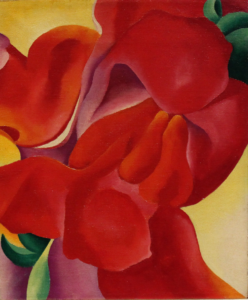 We may want to think they are all of those things. But if O’Keeffe herself said they are not accurate interpretations – they are simply flowers – then who are we to contradict her?
There’s no indication that these denials were based on any prudishness on her part – the intimate photographs her husband Alfred Stieglitz took of her suggest this is not a trait of hers.
O’Keeffe was simply doing what she often did, and painting natural objects from the world around her.
It just happens to be the case that a lot of natural objects do resemble human genitals – sometimes jarringly so, as anyone who follows the @ecoerotica Instagram account knows.
One of the most celebrated American painters of the twentieth century, O’Keeffe is also, arguably, one of the most persistently misread. She is quoted in The Poetry of Things by Elizabeth Hutton Turner, on people seeing sexual imagery in her flower paintings:
“you hung all your own associations with flowers on my flower and you write about my flower as if I think and see what you think and see of the flower — and I don’t.”
People ascribe to her work the motivations they want her to have, instead of the motivations she actually had. The interpretation of art may be all about what a piece of work means to the viewer – but it is another thing entirely to tell the artist she’s wrong about what she intended to make.
“Female artist”
“The men liked to put me down as the best woman painter. I think I’m one of the best painters”
Georgia O’Keeffe had a career as an incredibly talented and impressive artist, consistently battling attempts to put her in a gender-based box.
It was important to her to succeed as an artist, not as a sub-category of artist, and she unquestionably did so.
So when Judy Chicago, a feminist artist, was creating a collaborative artwork of intricate place settings celebrating remarkable women, the documentary Georgia O’Keeffe: The Brightness of Light explains that O’Keeffe – despite being honoured there – refused the invitation to attend The Dinner Party.
For Chicago, O’Keeffe was the epitome of feminism: a woman who had succeeded and excelled.
For O’Keeffe, however, her gender was of little relevance to her work. She had spent a lifetime trying to downplay its importance, so why would she attend an event dedicated to highlighting it?
We see what we want to see
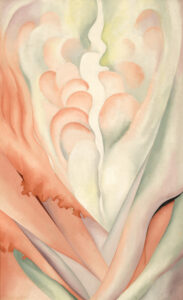 When we look at one of O’Keeffe’s paintings, we may want to see a celebration of female sexuality in all its glory. When we think of her life’s work, we may want to see her as a trailblazing representative of feminist success.
And if we can take inspiration from that, that can be a wonderful thing. Artists cannot control the meaning we take from observing their work, and what a painting or book or film or piece of music communicates to us does not have to match what the artist had in mind when they created it.
But to impose our own viewpoints onto her very intention itself is presumptuous and dismissive of her perspectives about her own life and work.
That is where it becomes offensive.
We don’t tend to tell male artists that we know better than they do about what they meant by their brush strokes or their charcoal marks, and we should be very reluctant to do so with women.
O’Keeffe spent enough of her life challenging misinterpretations that these misjudgements, and their corrections, clearly mattered to her.
It is not our place to tell her she is wrong.
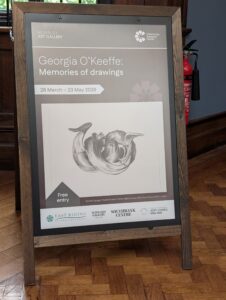 I watched Georgia O’Keeffe: The Brightness of Light as part of the Georgia O’Keeffe Memories of Drawings touring exhibition in Beverley Art Gallery, where it is on display until 23rd May. From 5th June to 25th July 2026, it will be exhibited at Williamson Art Gallery & Museum, Birkenhead.
Further reviews of this exhibition will be published on Global Comment’s social media in the coming days. Follow us on Instagram to be the first to see them.
Images:

_by_Georgia_O%27Keeffe.png)
