

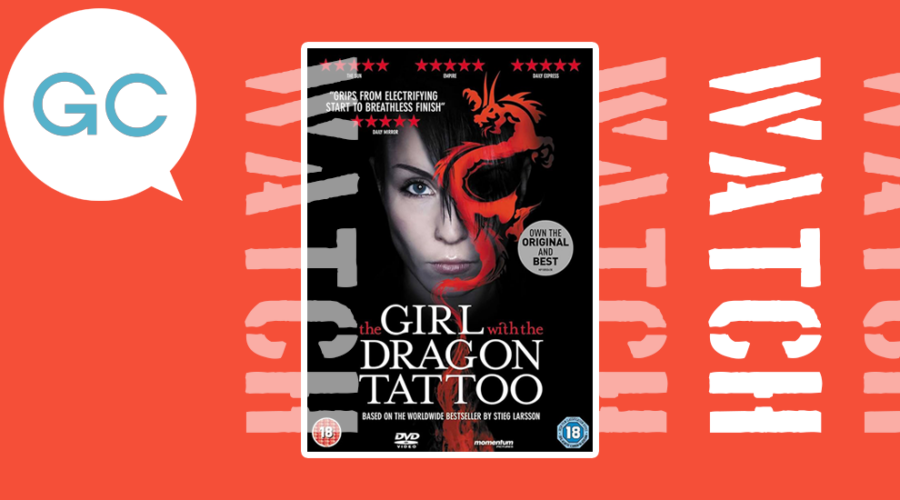
This month over at Five Books For, we’ve been talking about trilogies. One of the things I love about a trilogy is that they have depth, and extra time with your favourite characters, but they don’t involve the same level of commitment as a long series (especially helpful if you’re someone who likes to remember all the details when you’re reading the newest installment).
When I thought about trilogies that have been adapted, The Girl With The Dragon Tattoo – the first book in the Millennium Trilogy by Stieg Larsson – immediately sprang to mind.
The Millennium Trilogy is a blend of thriller and crime fiction; yes, there’s a detective of sorts, a famous anti-hero (or rather, anti-heroine) and a tremendous amount of violence, but it’s also about systems and how power protects itself.
David Fincher’s 2011 adaptation of The Girl with the Dragon Tattoo arrived with a slightly unusual burden: it was neither the first screen version, nor the most obvious candidate for reinvention, but it was the one that tried to translate the trilogy’s cold precision into something more stylised, controlled, and cinematic.
The result is a film that feels less like a straightforward adaptation and more like a re-interpretation of tone. There are Swedish films versions of all three books in the trilogy which I understand are excellent; however, I haven’t watched them yet so for today we’ll stick with Fincher.
The books: cold sharp edges
 The Millennium trilogy begins with a decades-old disappearance. In The Girl With The Dragon Tattoo, journalist Mikael Blomkvist is hired to investigate the fate of a young woman from a powerful Swedish industrial family, a case that has become less of a missing person inquiry and more of a ritualised family myth.
What initially looks like a closed historical mystery quickly opens into something far more unsettling: a network of violence, corruption, and carefully maintained silence.
While Blomkvist is our main detective, we also meet Lisbeth Salander, one of modern crime fiction’s most distinctive protagonists. Brilliant, guarded, and operating on the fringes of society, she becomes both an ally and a counterpoint to Blomkvist’s more conventional investigative instincts. Their partnership is not built on warmth or trust, but rather on necessity, which gives us two different kinds of intelligence circling the same hidden structures from opposite directions.
Across the course of the trilogy, Larsson expands the scope from a single case to a broader critique of systems that allow abuse to persist unchallenged. What makes the books compelling is not just the plotting, the pace or the stakes, but the sense that every answer uncovered unearths another layer of institutional failure.
This is detective fiction that feels genuinely investigative – less about solving puzzles and more about exposing the architecture that enables certain crimes to take place at all.
The tone in particular is a strength; the prose is functional rather than ornate, which suits the material: this is a world where clarity is more disturbing than ambiguity. The tension builds not through elaborate twists alone (although there are plenty of those) but through accumulation – of detail, of implication, of the sense that the civilised surface of society is thinner than it looks.
The film: controlled bleakness
David Fincher’s adaptation of The Girl With The Dragon Tattoo is, in many ways, exactly what you would expect from him: precise, cool, meticulously composed, and quietly relentless. Where the novel accumulates through procedural density, the film really leans into atmosphere and visual control. Everything feels damp, metallic, and slightly removed from warmth, as though the entire story is being observed through glass.
Daniel Craig’s Mikael Blomkvist is deliberately understated – competent, decent, slightly worn down by professional and personal compromise. Rooney Mara’s Lisbeth Salander is the more striking transformation: sharp, withdrawn, unpredictable in a way that never feels performative. Her performance is central to the film’s success; rather than trying to humanise Lisbeth in a sentimental way, it instead respects her refusal to be easily readable.
One of the film’s most effective elements is its music. Trent Reznor and Atticus Ross deliver a score that feels less like accompaniment and more like environmental pressure. It is cold, mechanical, and rhythmic in a way that mirrors the investigative process itself. There are moments where the score seems to sit just beneath the surface of scenes rather than on top of them, giving the film a constant low hum of unease. It’s effective, perhaps because it avoids traditional emotional cues and instead builds atmosphere through restraint and repetition.
Fincher also understands the value of pacing in a story like this. The investigation unfolds with deliberate care, allowing clues to feel discovered rather than delivered. There is a satisfaction in how the film handles information – not rushing, not over-explaining, but trusting the viewer to assemble connections at the same pace as the characters.
The most significant issue with the adaptation though is structural rather than tonal. In condensing a dense novel into a single film, a great deal of complexity is inevitably lost. The result is a narrative that sometimes feels streamlined to the point of flattening some of the political and procedural textures that gave the book its weight. Some of the societal critique is softened, and some of the character motivations become more functional than fully explored.
While it is present in the source material, the adaptation renders it in a way that feels, at least to me, unnecessarily explicit
A more difficult point of contention is the handling of sexual violence in the film. While it is present in the source material, the adaptation renders it in a way that feels, at least to me, unnecessarily explicit. The scene in question is framed with a level of visual insistence that risks tipping from narrative necessity into voyeurism. I saw the film in the cinema and I had to close my eyes for the duration; at least at home you can fast forward.
It’s not that the film ignores the brutality of the world it depicts – instead, at this particular moment, it lingers in a way that feels far more graphic than is required to understand its emotional or narrative impact. Given Lisbeth’s broader arc, to me this feels like a misjudgement in both tone and emphasis.
There is also the broader question of simplification. The film does a competent job of maintaining narrative clarity, but in doing so it inevitably smooths some of the novel’s rougher, more uncomfortable edges. The Millennium books are not neat, and part of their power lies in their refusal to resolve cleanly into satisfaction. The film, by contrast, leans slightly more towards coherence and closure, even when the material arguably resists it.
Final thoughts
For me, Fincher’s The Girl With The Dragon Tattoo works best when understood not as a definitive adaptation, but as a translation – one that prioritises mood, precision, and sensory control over textual fidelity. It captures the coldness of Larsson’s world exceptionally well, even if it simplifies some of its structural and thematic density along the way.
This is definitely one occasion where I’d recommend reading before watching; the books are a taut, suspenseful, adrenaline-filled read, well worth your time. The film is worth watching too, but it’s better considered as an accompaniment than as a standalone in its own right.