

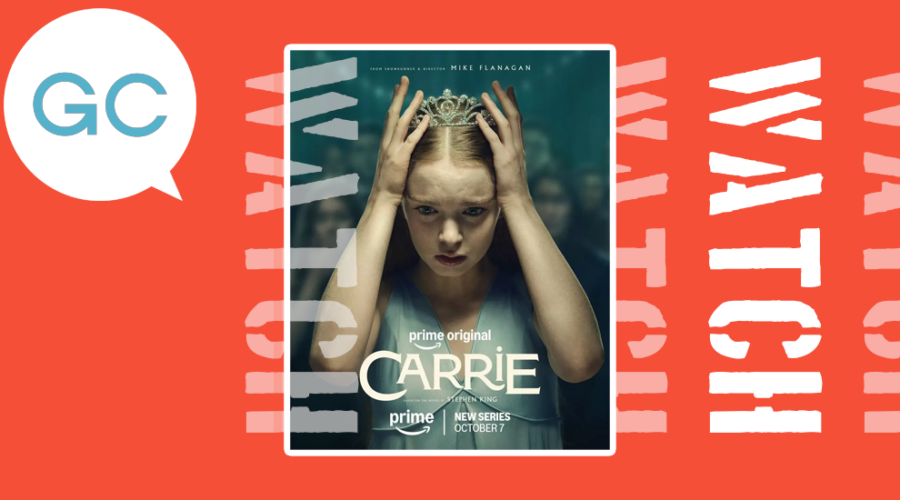
Now that I’ve had time to process Mike Flanagan’s Carrie – and time to read some of the angrier responses to the liberties Flanagan has taken with Stephen King’s original source material – I have to say this Prime show is very, very good.
It’s my hope that Flanagan will be greenlit by Prime to do at least one more season, ideally two more. Not just because the season finale of this “Carrie” is so open-ended, and leaves the viewer with many possibilities to explore – but because Flanagan’s approach here is pitch perfect, hopeful and ghastly, and this is a director who deserves to finally sit down and build a greater story arc.
Flanagan’s best projects are self-contained mini-series. Among them, The Haunting of Hill House and Midnight Mass are my favorites.
There is plenty of reason to keep these tightly packed, terrifying, and emotional narratives short. I can’t imagine Hill House going to another season, the heart of it is so perfectly contained. And Midnight Mass is so singularly perfect in its tragedy, and sad redemption, that to extend it is to likely ruin it.
Flanagan has bitten off much more with Carrie. It’s my belief that he can chew it.
To get the obvious complaints out of the way first – no, the eponymous heroine of Carrie is not the same girl that Stephen King envisioned.
One of the chief criticisms about screen adaptations of the book have to do with the fact that the heroine is always pretty, for one thing. The medium is what it is. Audiences are drawn to the travails of a beautiful young woman, in this case played admirably by Summer H. Howell, not to the “frog among swans” that King had in mind.
There is a conversation here to be had about the writer’s eye and the director’s eye, but as a writer myself, and having worked for years in the theater, I’m a bit tired of having it.
I don’t even think it’s an issue of sexism per se, as people always like to claim – we interact with the written word differently. Tolkien’s humble Frodo is also different from Peter Jackson’s very good-looking Frodo, as you know. So who cares if this new Carrie is pretty?
What’s more interesting is Flanagan’s social commentary. The new Carrie is set in the world of smartphones, social media, dead-eyed influencers, conspiracy theories, collective online outrage, angry public school parents, and other bitterly familiar modern problems.
Flanagan has bitten off much more with Carrie. It’s my belief that he can chew it.
Behind the newness, though, are the same old evils, the same outlines of villagers stalking the night with their pitchforks.
I like that Flanagan has updated the story, but I also think the update is not the point. The ancient impulse to isolate and bully a group member we perceive to be weak has been with us all along. Just as the idea that the mask of weakness is sometimes deceptive. Sometimes, your weakness is only in your head.
I also like Flanagan’s approach to the arch villain of the story, Chris Hargensen. Both in Stephen King’s original, and in the famous 1976 movie adaptation, Chris is just a grinning sociopath who dies an impersonal death.
In Flanagan’s hands, Chris has a backstory involving a shitty father slowly coming undone financially, and a mother who cannot stand up to him, preferring to retreat into a new family with her boyfriend.
Don’t get me wrong, Chris is still hateful. And even her final attempt to say “I’m sorry” to Carrie in the end doesn’t elicit much sympathy.
But Chris has also become more real, more tangible and interesting. Flanagan has done the difficult job of neither redeeming Chris nor keeping her frozen as a caricature of every mean girl you have ever known.
It’s the same with Carrie’s mother, played by Flanagan favorite Samantha Sloyan. She’s still a terrible parent. She also has genuine love for her daughter, and this is wonderfully and delicately portrayed, making the series finale all the more ghastly.
Flanagan has done a great job of exploring mercurial female friendship with his Carrie, friendship that longs to be free of social constraints. His heroine finds that friendship – she just does so at a terrible price. The scene of Carrie dancing down the street of the ruined, burning town with her friend Emaline is one of the best sequences Flanagan has committed to the screen (and just in case you’re not familiar with his game, that man has given us a lot of great sequences).
I have no idea how the story will hold up going forward, a Carrie who actually lives to tell her tale, and discovers a world of other powerful and dangerous women, is a great and risky departure.
But the risk is worth it. Mike Flanagan and his stars are worth it. Here’s hoping for a green light.