

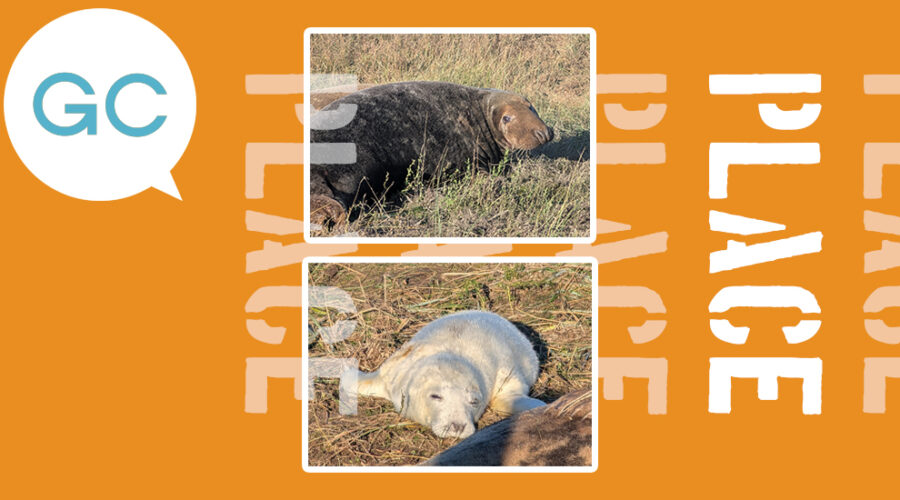
Donna Nook is a seal colony on the Lincolnshire coast in the north of England, where from November onwards, hundreds of grey seals come inland to give birth and mate, before heading back out to sea for the rest of the year.
Grey seals return to the same site every year and were gloriously abundant this week. The way seals move on land is known as galumphing (after Lewis Carroll’s Jabberwocky poem), and is one way to differentiate them from sealions, which move in a way that’s closer to walking on their flippers.
Galumphing has a way of either looking both incredibly suave and incredibly awkward, and I was absolutely charmed by seeing these great animals in motion.
It was also fascinating to see the seal pups, some so new that their umbilical cords were still attached, learning to function. Seeing babies learning to galumph was comical yet impressive; they are left to their own devices at around 3 weeks, so they do not have long to work out how their bodies work.
Scattered around the reserve I kept seeing big red blobs, and it took me a while to work out that what I was seeing was placentas, which does make sense given the ever-increasing number of seal pups being born every day.
The afterbirth kept the noisy gulls well fed, and were a strangely visceral reminder of the reality of what these seals are there to do. We see the pups (many visitors and volunteers were desperate to see a birth in action), but it’s easy to forget the process that has to happen to get them there.
Managed by the Lincolnshire Wildlife Trust, Donna Nook nature reserve is close to a Royal Air Force base, also called Donna Nook, which meant there were periods of disconcertingly loud helicopter whirrings overhead during my visit. However, the seals themselves did not seem at all discombobulated by the intrusion.
They were also remarkably comfortable with the proximity of people, sometimes just a metre or two away. A volunteer assured me that if the seals were unhappy with being close to the public, they would move away (or, like one known as Grumpy Mum, make enough of a racket to ensure that an area was cordoned off until she felt better, in order to reduce the risk of her panicking and abandoning her pup). And there was plenty of space for the animals, which are gigantic up close, so they could and would roll around elsewhere if they preferred.
As is often the case with nature reserves that specialise in one particular kind of animal, I was pleased to see that other creatures were also thriving. A noisy curlew and some little egrets were particular highlights for me.
Disabled access at Donna Nook was mixed, but I managed roughly ok. There is level access to the nature reserve from one of the car parks (which thankfully I managed to park in before it got busy), then a very noisy and bumpy wooden ramp (similar to the one at Rutland Water) to the site.
The path along the nature reserve was muddy and somewhat bumpy, while the surfacing of the car park was pebbled (under a gravel grid) and a little difficult on wheels. For me, it was manageable, but people who need smoother ground may struggle.
I would highly recommend a visit to Donna Nook if you are in the area (or even if you’re not), and this is the time of year to go. You will be surprised by how close you are to the grey seals, and you will marvel at the ways they move, communicate, get arsey, and flop around in an enviably carefree way.
This being the coast in the north of England in November, my trip to Donna Nook was also characterised by being absolutely bloody freezing, so do wrap up warm and take a big flask of tea if you go. The nature reserve is free to enter, though some of the car parks charge a fee and donations to the Wildlife Trust are encouraged.
Images: Philippa Willitts