

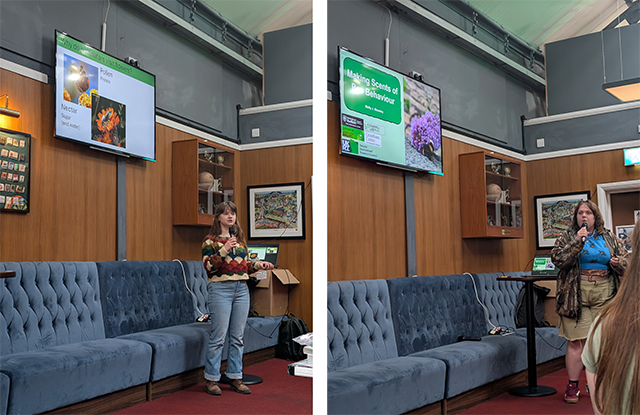
Earlier this year, a friend and I went to an evening of talks about urban pollinators. Now that may be precisely what floats your boat or it may not appeal to you at all, but over the course of an evening, PhD researchers Stephanie Glendinning (left below) and Molly Moseley (right) explained their research in a way that was designed to make sense to the general public.
Normally, there’s no way I’d go to a science lecture. I haven’t studied science since I was 16 and I would feel intimidated and assume there’s no way I would understand it.
But call it Pints of Science, host it in a pub, and promise that the audience will not be assumed to be academics, and you might just get me there.
My friend and I still talk about the fascinating things we learned that night. Then, last week, we went to a different university outreach event.
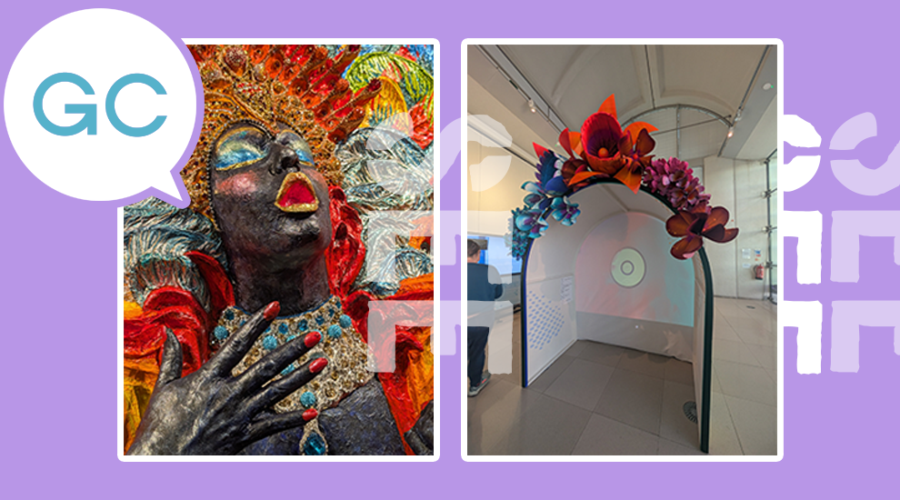
This time, it was an art exhibition that was part of Festival of the Mind, where researchers pair up with artists to find creative ways to explain and demonstrate what they are exploring.
 Public-facing university events like this can be a brilliant tool to bridge the gap between what academics are doing in their under-funded ivory towers, and the rest of the world. We see that someone in a lab every day is actually trying to solve a specific societal problem, or learn how medical students study anatomy, or find out that pollen is unusually fascinating.
Academics are doing complex, specialised work, but it often has real-world applications.
When universities are considered some kind of separate, parallel world, it is easy to overlook that.
And when it’s presented in a gallery you might already go to, or a pub you might already frequent, it doesn’t feel so much like stepping into an unknown and intimidating world.
Another University of Sheffield event I thoroughly enjoyed recently was a talk about the Rope Women exhibition by Rebecca Truman, a former circus performer who founded an all-women aerial performance troupe called “Skinning the Cat”, before retiring and becoming a sculptor.
I tend to love anything where gender boundaries are challenged and the idea of women putting up rigging, then flinging themselves around in the air – and not needing no man – is exciting.
Truman’s art is vivid and exuberant, and tells a story that is both fascinating and sad.
I live in Sheffield, a city in the north of England, so the three examples I’m talking about all relate to the University of Sheffield. But academic institutions around the world are increasingly seeing the benefits of not keeping the public at arms’ length and, instead, engaging with us and trying to build goodwill, enthusiasm and passion for the subjects their staff are working so hard on.
Universities benefit from this outreach, so do academics, and so do the public. Here’s how:
The public
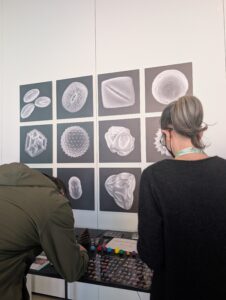 At Festival of the Mind, I learned new things in a way that didn’t feel like I was back at school. Academics were at pains to explain things clearly, and I could appreciate new perspectives on things I already knew a little about (e.g. conversations about sexuality in older people) and find out about things I’d never thought about before (e.g. how to get pottery to change colour under lights).
Like at Pints of Science, I didn’t feel at all patronised or like I was out of my depth, which increased my confidence and enabled me to ask questions and participate more fully.
University outreach events, when done well, give us access to knowledge that is not only incredibly specialised, but also often cutting edge – brand new research findings, and brand new discoveries.
This is a remarkable thing to just be able to wander into (for free!), and I’ve started taking advantage of it whenever I can.
Increased knowledge can even change the way we inhabit the world. I look for a particular kind of bee in a particular park because of one talk; I think more carefully about how things connect; and it can help us to change our behaviour or feel empowered to participate more fully in our local communities.
There’s a lot to be said for engaging in events that are not only entertaining but also have substance. And in an ever-more digital age, there’s something refreshing about meeting new people face to face and looking at art that’s in front of your face.
Academics
For academics who thrive in niche dialogue with fellow specialists, explaining research to lay people can feel strangely intimidating.
 But they say the best way to learn is to teach, and explaining a topic in accessible language, or using visual art or quizzes, can help to distil research down to its true centre.
Working with people who see the world in a very different way, such as visual artists, can also be an incredibly expansive way to explore a subject. Creative collaborations help academics and researchers to notice when they use jargon, get rid of it, and explain data and findings to someone with a very different lens.
Communication is vital for the successful dissemination of research findings, so working with creatives or speaking directly to the public (i.e. talking to non-specialists) can really help an academic to improve their storytelling and communication.
Journalists are sometimes told to think of readers asking “Why should I care?” when writing a story, and academics can benefit from the same question. Over the course of an evening event or a week-long exhibition, the researcher’s answer to that unspoken question will distil into a more and more coherent and accessible form.
At the same time, explaining why your software does this thing, or why you asked that question, to others can even – if you’re burning out and tired of your subject – reignite your enthusiasm for it.
It reminds you why you cared enough to start in the first place, which is never a bad thing.
Finally, installations, talks, displays and exhibitions look great on an academic CV and in funding applications. In an incredibly competitive environment, this can really work in a researcher’s favour.
Universities
When I was a student, the city seemed to be divided into “townies” and “bloody students”, and ne’er the twain shall meet. Universities may try to participate in wider society but can be thought of as elite and untouchable.
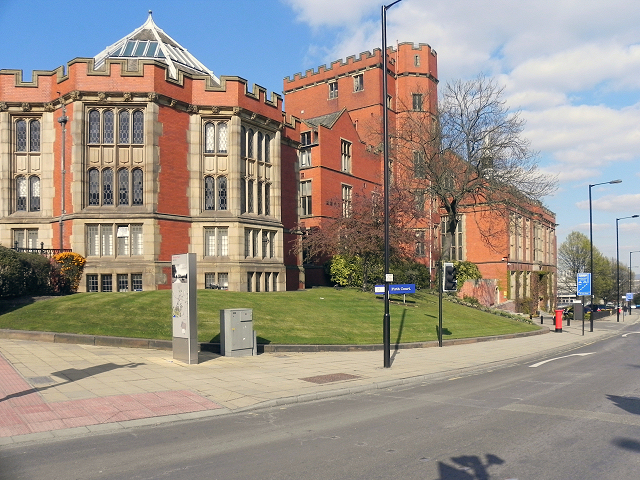
Outreach events help to break down some of this “town and gown” divide, especially when they are intentionally held outside of the university estate itself.
The public funding of research can also feel more justified when a university has a visible presence and demonstrates the value of its work. It increases trust and reminds both funders and non-academics that knowledge is valuable, it benefits the whole community, and it is not a separate, dusty endeavour kept secret in a locked room.
At their best, university outreach programmes may even inspire minds both young and old to engage more directly in academia themselves.
Maybe a kid never thought they could go to university, but they see an academic who looks or sounds just like them, or they discover that their favourite special interest is something they could eventually do for a job.
Or maybe someone later in life, who never thought of themselves as clever enough or who never had the opportunity to study, will have a conversation that inspires them to look into continuing education.
Which, after all, should be entirely what learning should be about. Knowledge, inspiration, and fascination.
Images: Philippa Willitts, David Dixon
