

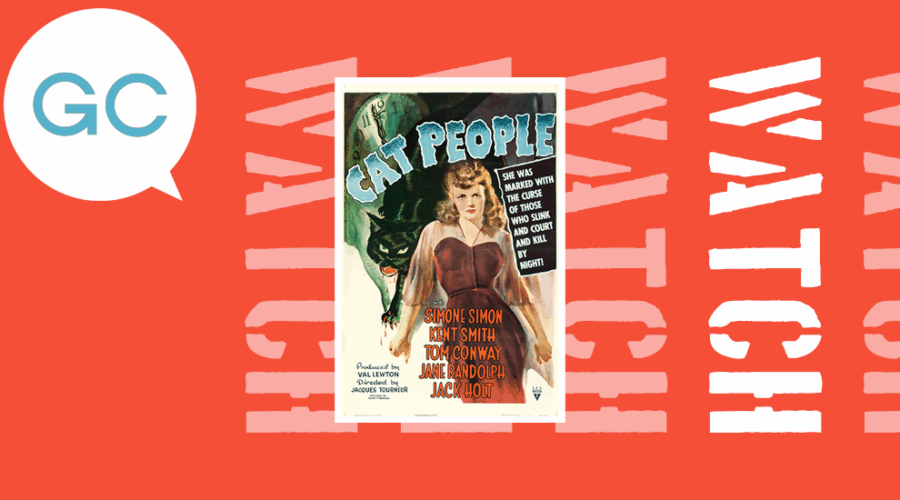
Jacques Tourneur’s Cat People (1942) is a supernatural horror film about a young Serbian woman, Irena (Simone Simon), who believes, based on the lore of the area she grew up in, that she’ll turn into a panther if she experiences sexual arousal.
So she does everything she can to avoid this fate and to avoid causing harm or danger to those she loves.
Irena marries the bland, oblivious Oliver (Kent Smith) but can’t consummate the marriage, terrified of what might happen in bed. Oliver sends Irena to a psychiatrist and seeks comfort in his coworker Alice (Jane Randolph). Irena begins stalking Alice – in feline form – through shadowy streets and in a particularly memorable swimming pool scene.
Cat People has legendary status among many fans of supernatural horror, especially those who like to trace the stages the genre has gone through to become what it is today.
But there is one element of the film and story that many have missed: it’s one of the most transparent lesbian tales Hollywood produced in the 1940s.
Cat People is deeply lesbian coded
This is one queer-coded film! From start to finish, the messaging is clear, if you know where to look.
Irena cannot and will not sleep with her husband. She frames this failure as a curse, a monstrosity, something wrong with her essential nature. She is convinced there is something unnatural and harmful inside her.
Sound familiar?
For a closeted queer woman in 1942, married because that’s what women did, but unable or unwilling to perform heterosexual intimacy, this would have resonated. Irena is marked again and again through this film as “other”, and her therapy sessions with the condescending Dr. Judd, discussing why she can’t be a proper wife, mirror the homophobic and misogynist “treatment” lesbians faced from the psychiatric profession.
But a core aspect of why Cat People is so profoundly lesbian coded is more blatant: we just need to watch where the film’s erotic energy actually lies.
Irena has zero sexual chemistry with Oliver. Their courtship looks like two children politely playing house.
But her scenes focused on other women are, I would say, where Tourneur’s vision comes alive. Where Irena’s passions are stirred – in good ways and bad.
The swimming pool sequence is perhaps the most sexually charged moment in the entire film, and it’s between two women. The panther circles, watches, obsesses over Alice with an intensity that’s supposedly about jealousy but feels far more complicated.
Another scene worth mentioning is when Irena is in a restaurant and is spotted by a woman (whose looks are being criticised by the men), who approaches and calls her “my sister” – “moya sestra”. This moment, for any lesbian who has got used to all manner of secret codes and indications that act as a form of recognition, is remarkably familiar. It’s a connection between outsiders.
The Hays Code and Cat People
While directors were very limited in what they could show in terms of a woman desiring another woman, they could show a woman who couldn’t be touched, couldn’t have sex, and believed herself cursed and monstrous because of her desires
The Hays Code, or the Motion Picture Production Code, was a set of regulations placed on Hollywood films that meant, amongst other things, that homosexuality couldn’t be shown on screen. So, from the 1930s, no movie was allowed to lower moral standards, which included wide-ranging rules that religions should never be ridiculed, criminals could not be treated sympathetically, and inter-racial relationships were an absolute no-no.
So while directors were very limited in what they could show in terms of a woman desiring another woman, they could show a woman who couldn’t be touched, couldn’t have sex, and believed herself cursed and monstrous because of her desires.
Horror became the perfect cover. The film could explore what it meant to be a woman who couldn’t force herself into heterosexual sex, because it told the story with shadows and snarling panthers rather than women embracing.
Shape shifting is not the beast in the film. The beast is living a life that is so inauthentic, so harmful to your psyche, just because the world tells you you must. The beast is the inner conflict of trying to do the culturally sanctioned thing while despising the idea. The beast is the danger and obsession that can cause.
Dr Judd in Cat People
The film may frame her sexuality as monstrous, but it reserves its most violent catharsis for the man who believed he had the right to take without asking
Dr Judd, the arrogant psychiatrist who sneers at Irena and dismisses her fears, ends up abusing his position and kissing her against her will. Essentially, this is sexual assault dressed up as therapy, and Irena responds as the panther she always knew she could become.
The fact that Irena transforms and kills him feels righteous. The film may frame her sexuality as monstrous, but it reserves its most violent catharsis for the man who believed he had the right to take without asking.
Judd in Cat People represents every authority figure who pathologised women’s sexual refusal, every doctor who treated queerness as an illness requiring conversion.
His death demonstrates a form of revenge in which those who are forced to repress their true nature finally get their claws out.
Gender roles in Cat People
Female desire might be framed as monstrous, but it’s powerful, which is more than you can say about the film’s leering, whimpering men.
While giving this film a lot of leeway for the time in which it was made, it is also worth pointing out that Cat People falls into the trope of treating female sexuality as lethal.
When Irena’s desire awakens (and in Cat People, it always seems to be awoken more by Alice than by Irena’s tedious husband), it risks turning her into something that kills. This is women’s sexuality as 1940s (and 2020s…) America feared it: uncontrollable, violent, impossible to domesticate. Alice, by contrast, is unthreatening (and sympathetic) precisely because she’s desexualized.
Dr. Judd thinks he can master Irena’s dangerous sexuality by abusing his authority and gets torn apart for his arrogance. The film also kills off the sexual woman and gives the bland man his inoffensive prize, but there’s a subversive pleasure in watching just how completely Irena’s power overwhelms every man who tries to control her.
Female desire might be framed as monstrous, but it’s powerful, which is more than you can say about the film’s leering, whimpering men.
The ending, in which Oliver acknowledges that Irena had been right all along, feels like Irena’s Cassandra moment; the woman who was destined to tell the truth and have nobody believe her.
A film that did its best under cultural limitations
Cat People had to play by 1942’s rules, which meant coding its queer story in genre disguise and punishing its sexual woman with death – god forbid Irena has a happy ending.
But viewers over the years have not been fooled. The Sapphic symbolism always showed through, if you knew where to look.