


Bempton Cliffs is a nature reserve in the north of England that is managed by the RSPB, a charity for the conservation of birds and nature.
Having previously visited their Old Moor reserve, I was intrigued to see how the two compared, and found that a very different setting leads to a very different atmosphere.
 Looking over the North Sea, Bempton Cliffs is renowned for its seabirds; it is the only mainland seabird colony in England, with “eight key species of seabird inhabiting the cliff face through the spring and summer months: Gannet, Puffin, Kittiwake, Razorbill, Guillemot, Fulmar, Herring Gull and Shag”.
I have heard many people talk about Bempton Cliffs’ puffin sightings in the summer months, but had never made it there myself.
However, refusing to be intimidated by the prospect of what the temperatures might be like on the East Yorkshire coast in November, I ventured to the nature reserve last weekend.
I wanted to see some dramatic cliffs and gaze out to the sea, and Bempton Cliffs is the perfect site for this. There had been a recent sighting of the rare Pallas’s Warbler in the vicinity, so birders of all stripes were enthusiastically pacing the nature reserve’s paths.
However, I headed straight to the cliffs themselves.
They were what I was there for.
Words like “breathtaking” are, of course, overused, but this is an area of such natural beauty that it is impossible not to be taken aback by the views. I heard one visitor talking of his disappointment that the bird he had hoped to see wasn’t there, which made me glad I hadn’t gone with a checklist of hopeful sightings.
Thankfully, for me, staring out at a moody sea above such shockingly beautiful white cliffs could never have felt disappointing. It was astounding.
At one point, excited chatter led me to join a small group at a viewing area, where a charming RSPB volunteer had spotted a number of bottlenose dolphins in the sea.
Not knowing whether this was a common occurrence or not, I heard from regular visitors that they had never seen them before, and we all spent some time watching, and counting, these creatures from far, far above.
The charming RSPB volunteer deserves further mention, because he was a joy. Happy to share his knowledge without being patronising, and lovely to chat to, his passion for the site, for the organisation, for the things he could see, and for the natural world helped to make my visit to Bempton Cliffs really special. I was thrilled to find that, in videoing the dolphins, I had captured his voice reporting his findings through his walkie-talkie.
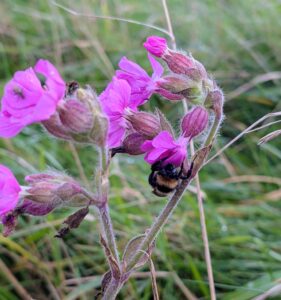 Bempton Cliffs is, above all, a nature reserve, and even in November there were signs of life.
There was still the odd flower in bloom, and even an incredibly tenacious buff-tailed bumblebee that was somehow still around. I may not know my birdsong, but the Merlin app detected the calls of skylarks, jackdaws, horned larks and a great crested grebe, the latter two of which it determines to be rare.
I appreciated the clear and informative information displays around the site, telling me about what we might see, and about the seabirds in particular. I’m somebody who tends to consider herself enthusiastic but not knowledgeable, so I’m always happy to learn new things.
Unsettlingly for such a beautiful, natural site, there were points in the day when gunshots pierced the air, scattering the seabirds far and wide and making me – and others – jump.
The RSPB tells me that the nature reserve is surrounded by farmland owned by private farmers, who sometimes have shoots, so that would almost certainly explain the disturbances.
Not at all the fault of the RSPB, but these were something of a distraction at times and the wildlife clearly doesn’t appreciate it, either.
Disabled access at Bempton Cliffs
On arrival at Bempton Cliffs, I asked for an accessibility map but was told that they no longer give them out, to avoid littering. Given that there was – understandably – no phone signal, I couldn’t download the one available on their website either, so approached the whole site with a “let’s give it a go” attitude.
Mostly, this worked well. The visitor centre, shop and café were level access, many of the paths were wide and smooth, and there were accessible spots on the viewing platforms designed for wheelchair users to look through.
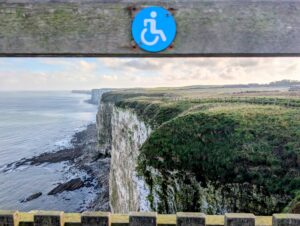
But I felt the lack of map-based guidance when I embarked on one path that admittedly did look more “I think I can just about manage that” than the ones I had started out on.
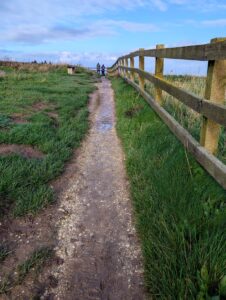 It had by far the best view of the cliffs (rather than the wider path further away from the cliff edge) so I wanted to give it a try.
I ended up with my wheels stuck in mud and unable to move either forwards or backwards. I could hear people discussing whether or not to offer me help, but nobody did and I was too embarrassed to ask.
Eventually I got myself out, but this could probably have been avoided – ideally by making the path with the best views accessible, but if that’s not possible, at least to signpost areas to avoid or make accessibility maps available to disabled visitors.
After that, I didn’t venture onto some of the other more questionable paths, so was sad to not be able to explore the full site in the way a non-disabled person would have been able to.
Should you visit RSPB Bempton Cliffs?
I will definitely be heading back to Bempton Cliffs during puffin season, and hopefully when the wind is less bracing, and found it a glorious example of what the north of England has to offer in terms of natural beauty.
The enthusiastic volunteer and the very welcome hot chocolate in the café afterwards were the icing on the cake, but the cliffs and the North Sea are the star of the show, and the site’s international visitors are evidence of its geological, as well as ornithological and natural-world points of interest.
Ultimately, Bempton Cliffs is a beautiful place with a lot to offer. I didn’t see the Pallas’s Warbler (not that I would know one, to be fair), and Merlin didn’t detect it either, but Bempton Cliffs’ Instagram account (which I highly recommend you follow for its gorgeous photography) was happy to report that it had been spotted.
And while I’d never heard of that bird before Saturday, and will probably never hear of it again, I, too, am happy that some of those keen visitors with their long lenses and expensive binoculars might have spotted a once-in-a-lifetime visitor.