

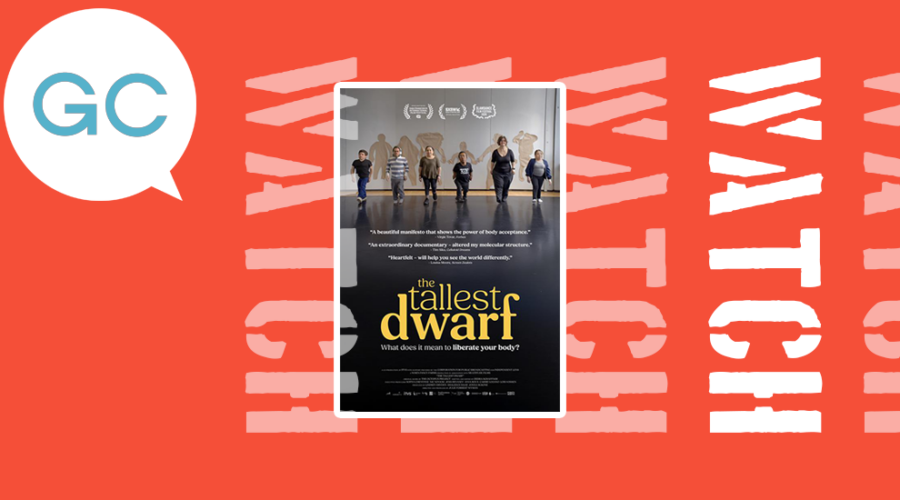
The title of Julie Forrest Wyman’s The Tallest Dwarf is a reference to the filmmaker and performer herself, who grew up questioning why her body didn’t share the proportions of those of her classmates. To which her loving parents, who gamely appear throughout the thought-provoking film, always reassured, “It doesn’t matter what you look like.” (Which is different from, “You have a big butt and it is fantastic!” as Wyman confesses to her older sister, whose own body never attracted outsized scrutiny.)
But of course looks matter in every society, particularly today, a time when both Big Tech and Big Pharma are hard-selling, and lucratively profiting from, solutions to problems we never even knew we had.
One such “problem” in non-existent need of a solution appears to be Little People, a community Wyman feels connected to and also apart from, as the rumors of “partial dwarfism” on her father’s side have never been genetically confirmed (at least not until we’re well into the doc).
So to learn more about the dwarf identity she longs for but fears she’s too tall to claim, the dogged director embarks on a multi-pronged investigation that easily segues from her own family history, to that of the colorful and truly problematic dwarf archive, chockfull of depictions of circus performers whose bodies, not skills, were put on display.
And also to a convention for the Little People of America (founded in 1957 by actor Billy Barty) where, to Wyman’s grateful surprise, she’s welcomed with open arms. There, she meets charismatic folks such as Sofiya Cheyenne, a multidisciplinary artist like herself, and Mark Povinelli, a film, TV and voice actor frustrated that his scene partners are allowed extreme closeups while he’s confined to wide shots, his small stature purposely emphasized in every frame.
By the time Wyman teams up with the Dwarf Artist Coalition, her search for belonging has turned into a heartfelt collaborative mission to take back the Little People narrative through the power of cinema. (To that end, the film opens with extreme closeups of serene faces.)
Unfortunately, the undertaking likewise includes confronting the existential threat that’s loomed large ever since the University of California, San Francisco’s Hormone Research Laboratory developed HGH (human growth hormone) back in the 70s, paving the way for the biotech industry. Indeed, today, pituitary dwarfism, the “canary in the coal mine,” can be “treated.”
Put less euphemistically, pituitary dwarfs are now being eliminated from humanity, which portends a horrifying dystopian future for a proud dwarf mom like Rebecca, whose husband and two kids are also seemingly well-adjusted Little People.
“We don’t see our lives as conditions. We see them as cultures,” she stresses.
But Rebecca is fully aware as well that time is running out, as the majority of children born with dwarfism actually have parents of average height – making them easy targets for a pharmaceutical industry that relies on scare tactics to move products. In fact, one Big Pharma rep at a conference uses an ominous tone when pointing out that a young Little Person will always be the size of a third-grader if they forego early intervention. (To which a no-nonsense dwarf later advises, “Get a stool.”)
Though Sofiya counters that the real “problem” with Little People was perhaps best diagnosed by Hollywood legend Billy Barty, whose career spanned a whopping seven decades – they “steal the stage,” take up too much attention.
“And I agree with him!” she then adds with a laugh. “But that’s not my problem. That’s everyone else’s problem.”