

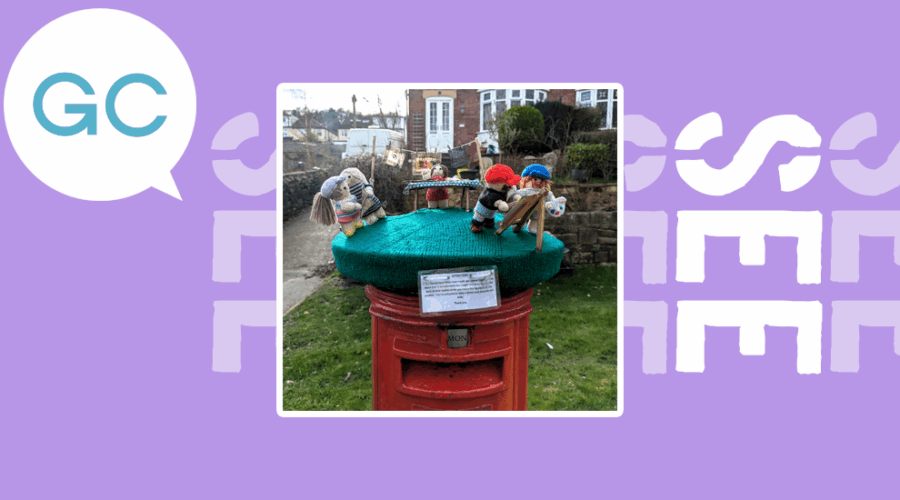
There’s something wonderfully subversive about waking up one morning to find your neighbourhood postbox wearing a cosy hat, or discovering that the bike rack outside the library has been transformed into a rainbow-wrapped sculpture.
This is the world of yarn bombing, which combines traditional craft with guerrilla art in a really magical way. Thanks to yarn bombers, public spaces get a colourful makeover.
Yarn bombing is pretty much what it sounds like: people cover public objects with knitted or crocheted material.
But when you look closer, it’s so much more than just putting sweaters on trees. If we allow it to be (let’s!), it is a movement that’s redefining what counts as art, who gets to claim public space, and how we think about “women’s crafts”.
Reclaiming the streets
Unlike what people might accuse traditional graffiti of, yarn bombing doesn’t damage anything.
It’s temporary, it’s textile, and it’s charming.
It’s also disarming. How can you be mad about guerrilla art when it’s made and presented in this way? Its gentleness is part of its power; yarn bombers are reclaiming public with warmth, colour, and whimsy. And my goodness, in these times, we need as much whimsy as we can muster.
For the artists involved, it’s a form of self-expression that exists outside gallery walls and gatekeepers.
You don’t need permission, you don’t need credentials, and you don’t need to explain yourself to a curator. You just need wool, knitting needles or crochet hooks, and something to express.
Some yarn bombers work alone in the night like textile ninjas. Others organise community projects that bring neighbours together to collectively transform their shared spaces. Some create works that celebrate the area, such as this on a postbox outside Sheffield’s Heeley City Farm.
Others are focused on the time of year, or a cause, or they are just based on whatever motivates the creator at the time.
Making it pretty
In a world of concrete and steel, of utilitarian design and functionality, yarn bombing asks: why shouldn’t a lamppost be cheerful? Why can’t a parking meter wear a hat?
So these installations aren’t just about colour – though they do that well – they are also about adding personality, humour, and playfulness to spaces that were not designed with joy in mind.
When you encounter a yarn-bombed bench or a crocheted covering on a statue, something shifts. You may well get out your phone to take a picture, you may marvel at the skill involved, you may just keep rushing by but with a little smile on your face.
With these unexpected visions in our towns and cities, the familiar becomes strange and delightful.
You’re reminded that your environment isn’t fixed, that creativity can pop up anywhere, and that someone cared enough to spend hours making something beautiful for strangers to stumble upon.
You may also see it and start to wonder if you have any skills that could also bring a smile to your neighbours’ faces on their rush to the bus stop in the morning. Or what you’d make if you knew how. It prompts creativity, and it makes us feel, just for a moment maybe, like not only are we part of our community, we can also contribute to it.
An unexpected explosion of wool on a bollard is a gift. It doesn’t ask anything from us, but it may prompt us to ponder a sense of place regardless.
Elevating under-valued crafts
Here’s where yarn bombing becomes quietly revolutionary: knitting and crochet have long been dismissed as “just” crafts, as hobbies for grandmothers, as domestic time-fillers rather than serious artistic pursuits.
This dismissal isn’t accidental, it’s tied directly to these crafts being associated with women and domestic spaces. The under-valuing of women’s work is a feature, not a bug.
While painting and sculpture were elevated to “fine art,” textile work was relegated to the craft fayre and the village hall.
Yarn bombing forces us to question this imposed hierarchy. By taking these techniques out of living rooms and into public view, by making them bold and impossible to ignore, yarn bombers are demonstrating that knitting and crochet are art, are creative expression, and that these skills passed down through generations of women deserve recognition and respect. They are technical and intricate, and they are beautiful and funny. What about any of that is not “real” art?
This thing so long dismissed as quaint? Yarn bombers make their technical talents visible. This medium traditionally considered small and domestic? Yarn bombers use it to transform cityscapes.
These hands aren’t “just” clicking knitting needles. They’re making statements.
Momentary, beautiful
The beauty of yarn bombing is that it’s accessible to many. You don’t need expensive materials or specialised training.
While knitting and crochet are perhaps less likely to be passed down through generations these days, YouTube tutorials are teaching them to many people. People who then use these traditional skills in decidedly untraditional ways.
One especially delicious factor of these installations that I find particularly inspiring is that, in an age of digital overload, there’s something powerful about art that’s made slowly, by hand, stitch by stitch. That may be a feature in their community for weeks, or may be stolen or vandalised overnight.
The joy is in the making, and the sharing, and the letting go.
Each yarn bomb represents hours of work, of fingers on wool, of someone caring enough about beauty and public space to invest that kind of time and effort. To trust that people will appreciate and enjoy it.
So next time you see a tree trunk wrapped in stripes or a bollard wearing a tiny knitted cap, take a moment.
Someone made that.
Someone wanted to share a bit of warmth and whimsy with you.
And in doing so, they’re part of a quiet revolution that’s redefining public art, celebrating undervalued crafts, and proving that you can change, and participate in, the world that surrounds you.
Image: Philippa Willitts