The bishops are playing politics here, and it’s the sisters who are staying steady with their orders’ commitment to doing the work they understand themselves to have been divinely assigned.
Working to eradicate poverty! Promoting better healthcare! The Catholic Church has been responsible for some atrocious things over the centuries, but working towards economic justice and helping sick people are two of those things towards which the average person would generally direct a great big thumbs up. In fact, the Leadership Conference of the Women Religious, a body to which about four in five of the United States’ Catholic nuns belong, is admirably dedicated to these very matters. The Vatican, however, has just come out with a condemnation of these foci.
Yes, I was rather taken aback myself.

Last night made it clear that, even if Romney remains the frontrunner, we will need to start thinking about the possibility that Santorum could secure the nomination.
When I heard yesterday that Sarah Palin was already talking about a potential presidential bid in 2016, I saw the writing on the wall: The Republican establishment isn’t even pretending to care about 2012 anymore. That an Obama win seems certain despite Obama’s middling approval ratings is an embarrassment to the Republican Party, to be sure. The people in the trenches care, certainly, but the Party bigwigs? Not so much.

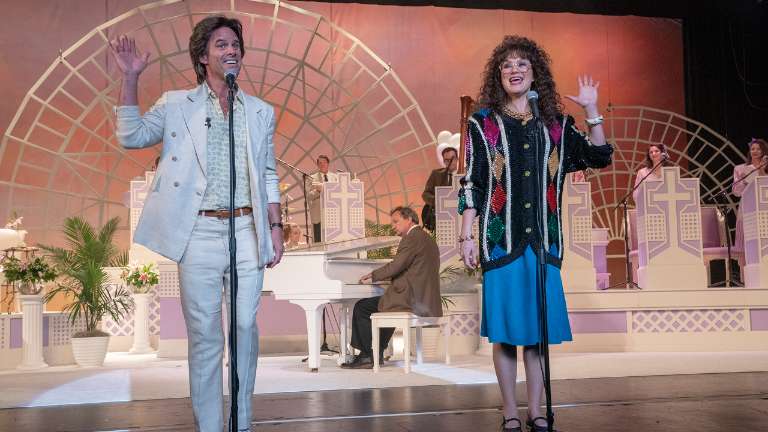
The only thing bigger than their hair is their love for the Lord.
G.C.B. brings viewers deep into the heart of white, wealthy, evangelical Plano, Texas. Amanda Vaughn (Leslie Bibb) is slinking back to town after her husband careered off a cliff with his dick in his mistress’ mouth, and not one of the GCBs—Good Christian Bitches—is going to let her forget it. In true catty tradition of always kicking a bitch while she’s down, Carlene Cockburn (Kristin Chenowith), no angel herself although she does have a formidable knowledge of Bible verses, is determined to get revenge for Amanda’s high school sins, large and small.

Despite the beautiful images of symbolic unity of Muslims and Christian Egyptian citizens, the current forces of power in Egypt—whether they are the media, military police, or transitional government leaders—still exhibit shameless racism against the Coptic minority.
One of the most striking and moving images from the Egyptian Revolution was a line of Coptic Christians, linking arms and protecting the Muslims from the military police during their call to prayer. On Sunday, many Muslims joined thousands of Christians to march against last week’s violent attack on a Coptic Church in the southern town of Aswan—a telling symbol of the systematic, institutionalized racism against the Coptic minority in Egypt.
Egyptians watched in shock and horror as the peaceful march of 10,000 Egyptians—many united in religious solidarity–became a violent confrontation with the military police, escalating into a massacre brutally killing at least twenty-six and leaving over five hundred injured.

By creating an image of absolute Evil, numerous groups have been able to define themselves as only and ever Good – an idea has been used to justify great evil itself.
The Quest For the Historical Satan, Miguel A. De La Torre and Albert Hernandez, Fortress 2011.
It’s a familiar image to most people in (post) Christian societies – the red, pitchforked Satan. but how did we get such an image, and what does it mean for the way we perceive political and religious enemies? In their fascinating book The Quest for the Historical Satan, theologians Miguel De La Torre and Albert Hernandez trace the development of the idea of Satan and its many multifarious, nefarious uses.

“Social movements are usually at their most extreme in the beginning—and become more rational over time. But the Reconstructionist venom just multiplies.”
Frank Schaeffer, son of the late Francis Schaeffer was raised to follow in his father’s footsteps as a luminary of the Christian Right in the United States. He spent his early years in the rarefied world of L’Abri, the mission his parents founded in Switzerland in 1955. In the late 1970s, he helped found the “pro-life” movement in the US with his father and the late C. Everett Koop, who became Reagan’s Surgeon General. During the 1980s, he worked with R.J. Rushdoony, the father of Christian Reconstructionism or Dominionism.
Schaeffer became disillusioned with fundamentalism during the 1980s and ultimately renounced his former beliefs. Over the past several decades, he has worked to explain Reconstructionism to the secular public. In his new book, Sex, Mom and God: How the Bible’s Strange Take on Sex Led to Crazy Politics—and How I Learned to Love Women (and Jesus) Anyway, Schaeffer discusses the anti-feminist politics that came out of his family’s religion. A recent media firestorm casts doubt on the mere existence of Reconstructionism, but my recent talk with Schaeffer suggests reinforces the sense that the movement remains politically important.

We are dealing with a strain of American thought that appropriates religion for the purposes of oppressing women, and has developed a specific rhetoric to cover up this fact. Michele Bachmann follows it, and has allowed it to shape her career.
The 2012 American election is a long way away. And yet, feminists are already tired of pointing out that people have been sexist in their treatment of Michele Bachmann. The relationship of feminists to right-wing women is a thankless one; although these women’s policies are unacceptable, it’s still no fun to learn how quickly men will fall back on the “bitch,” “crazy” or “bimbo” rhetoric when threatened. Anyone who recalls the Sarah Palin Death March of 2008 can tell you that. And now, here we are again, with Bachmann: No, it is not relevant to Michele Bachmann’s campaigns that she suffers migraines. Yes, framing her with “crazy eyes” on the cover of Newsweek is appealing to the idea that women who want power are pathological, and is a stunningly cheap way of manipulating the discourse. Yes, her husband’s anti-gay policies are an appropriate subject of discussion; no, saying that he “acts gay,” and using hateful stereotypes to make jokes about it, is not okay.
But, when it comes to the latest instance of “sexist” rhetoric against Bachmann — Byron York’s choice to ask her, at the Iowa GOP debate, whether she would be faithful to her stated policy of being “submissive to her husband” as President — it’s hard to work up any righteous indignation. You could, if pressed, make the point that male candidates are rarely questioned about their marriages during the debates. But marriage, sex, and family can be used against any politician: See “Billary,” John Edwards’ infidelities, Larry Craig’s restroom incident, Dick Cheney’s daughter Mary, etc., etc., ad infinitum. And Bachmann’s open adherence to an extremist form of the Christian religion does indeed shape her policies. She is not shy about pointing this out. But in this instance, her belief in the evangelical doctrine of “wifely submission” could, in fact, mean that someone other than the elected President would hold the position of ultimate authority within the White House, without having to be elected himself. This question is supremely relevant to Bachmann’s candidacy. And it does effectively demonstrate that she is unfit for the position she seeks.

Dancing Theology in Fetish Boots is an intriguing collection of mismatched elements that sheds new light on sexuality, gender and race in religious locations.
Lisa Isherwood and Mark Jordan, Dancing Theology in Fetish Boots: Essays in Honour of Marcella Althaus-Reid, SCM Press, 2010.
Argentinian theologian Marcella Althaus-Reid was a pioneer in the field of queer theology. In her books Indecent Theology and The Queer God (both on Routledge), she insistently queried the sexual and gender suppositions of Christianity and theology. In particular, she relentlessly pushed the liberation theology of Latin America, demanding that its vision of social justice for the poor expand to include–even centre–women and GLBT people and the multiplicity of desires and practices involved in sexual subcultures. In the striking introduction to Indecent Theology, she asked if theology had space for female vendors on the streets of Buenos Aires, who sell lemons without wearing underwear. Theologians, she suggests, must remember their own bodies, their own desires: “The Argentinian theologian would then like to take off her underwear to write theology with feminist honestly, not forgetting what it is to be a woman when dealing with theological and political categories.”
Sadly, Althaus-Reid died of breast cancer in 2009, leaving behind not only those two important books, but writing and editing numerous innovative books on feminist, body, liberation, queer and transgender theologies in partnership with Lisa Isherwood on SCM. Fittingly then, Isherwood has, with Harvard theologian Mark Jordan, assembled a collection entitled Dancing Theology in Fetish Boots on that press that not only pays homage to Althaus-Reid’s legacy, but extends it.

Jokes about the Rapture express a deeper anxiety about the decidedly apocalyptic times we live in, expressing some of the often unacknowledged uncertainty about the sustainability of our current system of living.
For those who have been living under a rock (or worse, been offline), the world is supposed to end today. More accurately, a group of fringe evangelical Christians in California led by Harold Camping have taken to the airwaves on their Family Radio Network to proclaim the imminent arrival of the Rapture on May 21st–the removal of faithful believers of Christ from the earth and the cataclysmic beginning of the destruction of the Earth.
As Christian beliefs go, the Rapture’s a pretty marginal doctrine restricted to evangelicals, accepted neither by the Catholic, Orthodox or mainline Protestant groups. Even for those evangelicals that do believe in the Rapture, the vast majority will think of Thessalonian 5:1-2 – “Now, brothers and sisters, about times and dates we do not need to write to you, for you know very well that the day of the Lord will come like a thief in the night.” Most Christians know better to set dates for the return of Christ, though many have tried before. The failure of Jesus to show up for one such date set by the Millerite movement in the United States in 1844 was called “the Great Disappointment” for good reason. As the great holy text Battlestar Galactica once put it, “all of this has happened before, and will happen again.”
So this is not a widely accepted or particularly credible form of religious belief, it’s pretty safe to say most people do not believe the world is ending at 6pm tonight. What is more astonishing is the degree with which this apocalyptic story has been taken up by atheists, dominating the news for the past few weeks. Mother Jones reports that Channing’s PR person has fielded 400 interview requests in the past few weeks; bucket lists and music playlists to soundtrack the apocalypse have been posted, and as I write now, the trending topics on Twitter include #rapture #iftheworldendsonSaturday #Harold Camping and a nostalgic apocalyptic throwback in the form of #Y2K. Most of it is mocking, with a sense of incredulity that someone could honestly believe in the end of the world. So why all the fuss?

“Do you fill the time with negative nervousness or with reverence, mindfulness and joy?” Witmer asks.
Denison Witmer’s music is thoughtful and understated and lends itself to rainy days and quiet contemplation. A multi-instrumentalist whose folk music sounds more otherworldly—and less roots-based—than what you’ve heard in the past, Witmer writes songs at once approachable and elusive. His lyrics can be deceptively straightforward at times, only developing more complex layers several listens in.
Witmer’s new album, The Ones Who Wait, to be released on April 26, is no exception. Witmer says that the new album came together somewhat more organically than those past, as he grieved his father’s death and adjusted to collaborator Devin Greenwood’s move to New York City. Though he told me he normally draws themes out of songs he’s created over a period of time, this album came to revolve thematically around the loss of his father without advanced planning. “In some ways,” Witmer says, “this was better for the album because it gave me a sense of pause. I let it show me the direction it was taking rather than the other way around.”
Witmer says that this affected his musical decisions as well. Though he usually writes careful first drafts with a clear sense of which instruments should be used and how the recording should sound, he chose to “[do] a lot of different things with these songs.” The aim was surrender to the creative process without being “too hung up on what we would do with the songs.” Instead, he says, “we worried about that later.” This allowed for a more thoughtful process in which ideas could be tried and tested, and creative possibilities explored more fully.
Global Comment © 2012 | Design & Developed by : Slate