“Americans don’t care about foreign policy.” It’s a truism that has shaped presidential campaign rhetoric for both the Democrats and Republicans this year. It is also why, we are told, international news often gets sidelined in favor of the latest socialite news involving, say, Kim Kardashian. And if international policy news isn’t great for the news industry, then it probably doesn’t produce votes either. The result is that we are saturated with 24 hour news coverage – and lots of political rhetoric – that reinforces the truism that Americans just don’t care.
Tag Archives: climate change
Foodpocalypse Now: how climate change will affect food production
Global temperatures are rising, and they’re bringing global food prices along with them. The last year has seen massive flooding in Pakistan and Australia, alongside devastating drought in China and the Horn of Africa. Particularly in the Global South, localized food crises have accompanied these meteorological calamities. These “extreme” events are consistent with the reality of a warming planet. As the balance of Earth’s thermal energy increases, so does the range of meteorological possibilities. The news wires serve as a reminder that not all of these possibilities end well. What, then, is the future of agriculture and food security in a world of rapid climatic change and heightened meteorological extremes?
The first step to imagining the future of agriculture is to admit that the current industrial paradigm is part of the problem. The latter half of the twentieth century saw a massive consolidation of agricultural concerns, not just in terms of bank accounts, but also in farm fields. We are growing few crops on fewer farms than at any time in modern history. As fields have become larger, the ruthless, fossil-fueled efficiency of the Green Revolution has become standard. In many parts of the world, governments have encouraged growing crops in locations, densities, and varieties not supported by local water supplies, leading to declining water tables and soil salinization.
Under this industrial model, rapid shifts in climate coupled with increasingly frequent extreme weather will create plenty of opportunities for widely dispersing, environmentally tolerant pests to threaten our crops. Weeds are the future, and thanks to the marvels of modern genetic engineering, these weeds may be tougher than they’ve ever been. The status quo is unsustainable.
Climate Change, Consumerism and the Working Class
I am volunteering for an environmental justice organization in a large northern city. This group works on environmental health issues with the city’s poor, mostly African-Americans and Puerto Ricans, and has started focusing on how climate change will affect working-class people. Rising temperatures will lead to any number of problems for the economically disadvantaged, including air pollution, higher rates of asthma, greater populations of cockroaches and other unwanted insects, rising food prices, a greater percentage of income spent on energy, and increased mortality rates for people who do not have access to air conditioning.
Climate change has proven difficult to explain to people; scientists’ unwillingness to declare anything a certainty combines with climate change’s complexity to leave people confused. My organization went to its constituents and tried to explain climate change to them. The organizers messaged this campaign in an interesting way: openly attacking the environmental movement’s framing of the issue. They created buttons that featured a crossed-out polar bear. They repeatedly told the attendees that climate change was about people, not bears. And yet, when the question and answer session began, the overwhelming response was, “Why should I care about bears?” Continue reading
Tony Abbott and the Liberals: Truthiness Down Under
The American satiric comedian Stephen Colbert famously introduced the word “truthiness” into the contemporary English lexicon. Dictionary Merriam Webster named it their Word of Year in 2006, supplying us with two definitions:
1. truth that comes from the gut, not books
2. the quality of preferring concepts or facts one wishes to be true, rather than concepts of facts known to be true.
As Colbert explained in a rare-out-of-character interview, truthiness is a “What I say is right, and [nothing] anyone else says could possibly be true. It’s not only that I feel it to be true, but that I feel it to be true. There’s not only an emotional quality, but there’s a selfish quality.”
Although truthiness has been most strongly associated with former US President George W. Bush, recently the art of truthiness has undergone a revival in Australia with Opposition Leader Tony Abbott. Continue reading
Tamsin Omond: Not 4 Sale, not well organized either
“There’s this thing, it’s called Government, and it’s got a hell of a lot of resources and it’s got a lot of people making very important decisions… but those people and those decisions seem cut off of the people they make those decisions on behalf of. I think there’s a space to move into that bridges the gap between grass roots democracy and actual democracy.” – Tamsin Omond
A coach to Sunderland, racing along Finchley Road. It’s a sunny day, and I’m lapping up the unseasonably warm weather just a few days after my last visit to this part of London. I turn, looking out of the window, and see a blur of orange; the office of The Commons, a new political party formed with the aim of getting Tamsin Omond elected as MP. Continue reading
Climate change: Copenhagen may be our last chance
The chances of a meaningful climate agreement coming out of the UN conference in Copenhagen seem increasingly remote. Obviously, getting the world’s nations to agree on anything provides a challenge. But convincing them to agree on something that is not only the 21st century’s greatest problem, but will force their economies and consumption levels to contract, is nigh well impossible.
The United States has played an obstructionist role in climate change for two decades. Its refusal to sign on to Kyoto helped doom meaningful progress on climate change internationally while hurting the world’s perception of the U.S. The supposed debate over whether climate change is actually happening has been perpetrated largely by the mainstream media’s desire to portray two sides to every issue, allowing crackpots and extremists to sow doubt into the minds of the American public. Continue reading
Climate change: the road to hell is paved with… well, you know
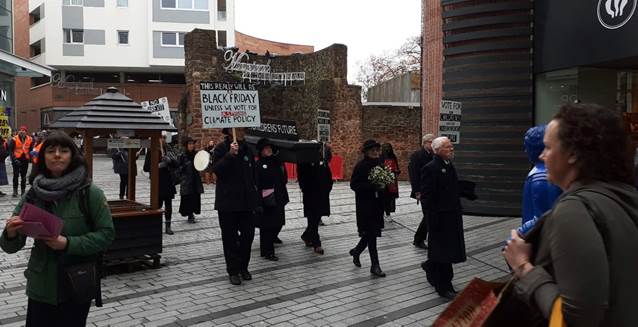
The 350 protests of October 24 have passed, and in the weeks that follow, we must remember why they occurred in the first place. This action sought to bring attention to the fact that carbon dioxide levels in the atmosphere are skyrocketing and leading to rapid climate change. Historically, carbon dioxide has made up 350 or less parts per million of the atmosphere. These levels were essential for creating life on Earth as we know it. Through industrialization, transportation, agribusiness, and the burning of fossil fuels, we have sprung past those historic totals in recent years and today have reached levels of 390 parts per million and rising.
This situation has rightfully alarmed people around the world. Led by the environmental activist and writer Bill McKibben, the 350 movement took off. Protests took place in many nations, protests that included people in areas of great conflict like Israel and Palestine working together to save the world’s climate and perhaps the human race. This movement has done great work in bringing the world’s attention to climate change.
There is much more to be done. Political will for action on climate change in the United States remains minimal. Rightfully or not, China, India, and other developing world nations claim they need polluting industrial development to reach international prominence. Certainly, these are challenging issues the environmental movement and world at large needs to address. The 350 day of action was a great start and hopefully, we can keep the pressure on nations to act.
However, for all the good environmental activists are doing, they are also engaging in some lazy thinking when it comes to action. Continue reading