


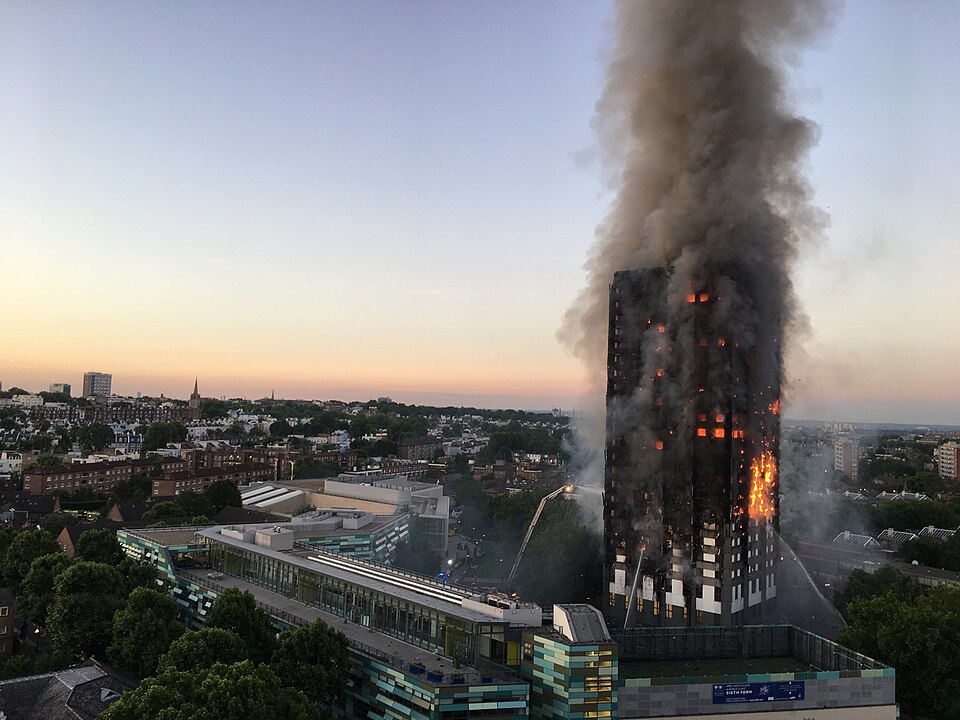
When Grenfell Tower burned down in a mass of out-of-control flames in June 2017 in London, firefighters had never seen anything like it. Questions were asked about how this had been allowed to happen, what had gone wrong, and how the 72 people who died in the fire – and all those traumatised by the night’s events – had been faced with so much danger.
I wrote about it for Global Comment the following day, and again a year later. Since then, a massive inquiry has taken place, though criminal investigations are still ongoing.
It was quickly identified that the cladding on the side of the building, which many say was installed to make the concrete block look more palatable to richer neighbours, had been the culprit. Unsafely constructed, it failed fire safety tests but was put on this high-rise block regardless.
How did the Grenfell tragedy happen? Who was to blame?
The film Grenfell: Uncovered, which I saw at Sheffield DocFest this year (and is now streaming on Netflix), asks and answers questions about how on earth a catastrophe like the fire at Grenfell can ever happen. It expertly ties together the multitude of systemic failures that left hundreds of people in danger and dozens dead.
From the decision to choose this deadly cladding to save a mere £5,000, to the “stay put” policy that meant the London Fire Brigade told residents not to evacuate and the company selling cladding it knew risked being highly flammable on high-rise blocks, Grenfell: Uncovered speaks to a range of experts who make the technical details and the systemic issues understandable for a lay audience.
Scientists and housing experts’ interviews are interspersed with stories of survivors, and of people who died in the fire, never losing sight of the fact that this was, above all, a human tragedy.
One of the most surprising moments of the documentary for me was former Prime Minister Theresa May admitting that her behaviour the day after the fire – visiting emergency services and avoiding residents and community members – exacerbated an existing sense of mistrust among people who had been repeatedly let down by figures of authority. The surprising bit was that a politician, albeit a former one, admitted fault.
The film shows us firefighters who describe talking to people as they died, clips from the inquiry that are anywhere from devastating to rage-inducing, and many, many testimonies from experts, all sharing the myriad ways in which residents of this massive tower block were let down, again and again.
They were rarely let down by individuals; nearly always by structures and systems that were working against them.
Having followed as much of the inquiry as I could, I wasn’t sure a documentary into the Grenfell fire would tell me a whole lot I didn’t know.
I was wrong. Grenfell: Uncovered is informative, but it’s also devastating, it’s moving, and it is a call to action. Until we understand how multiple structures fail particular groups of people repeatedly (41% of the disabled people who lived in Grenfell Tower died that night), and in intersecting ways, we can’t change them.
And until we care enough about people to actually make those changes, horrors like Grenfell are allowed to occur.
What happened at Grenfell Tower was the result of a litany of failures. It’s hard to conclude who is the most odious – the cladding company that refused to speak to the inquiry? The former government minister who complained about the inquiry getting in the way of his appointments and got the number of casualties wrong?
Ultimately, while there are failures of people in this tragedy, Grenfell: Uncovered shows us that the bigger issue was more about failures of institutions, of humanity, and of care. And until we address these, improvements to the lives of those without an excess of power will be scarce.
Image: Natalie Oxford
.jpg)