

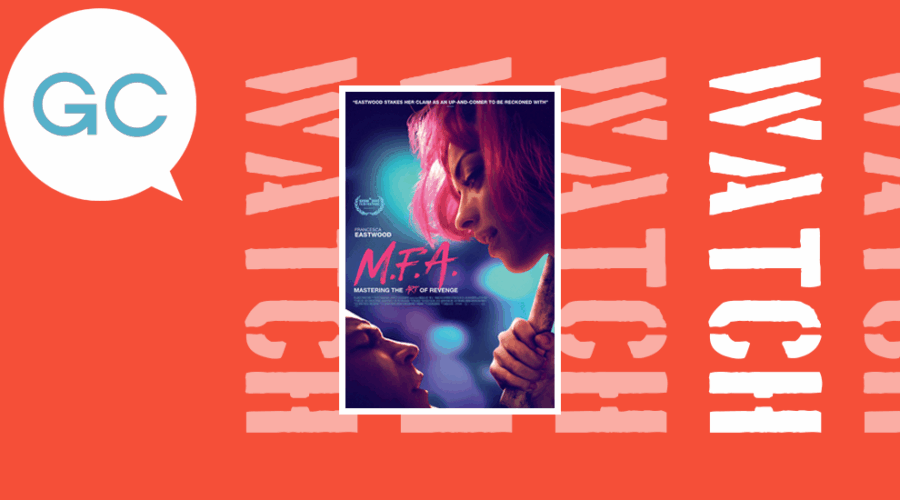
Natalia Leite’s M.F.A. (2017) is a rape-revenge thriller that looks at campus sexual assault, victim blaming, and the drastic actions powerlessness can provoke.
The film follows Noelle (Francesca Eastwood), a shy art student who is raped by a classmate at a party. As is often the case in both film and real life, the institutional response proves utterly inadequate, and she accidentally kills her rapist when she confronts him about what he did. As you do.
Frustrated by what she then learns about how other survivors are treated (and, crucially, how their attackers are treated), she finds and targets other rapists, documenting her actions as part of her thesis project.
Having had her artwork criticised early in the film by her art student peers as lacking depth and not conveying emotions, Noelle channels the overwhelming rage and impotence she is feeling into increasingly visceral creations.
We see her move from lacking in confidence, to being brutalised, to devastation, through to – somehow, and somewhat implausibly – a femme-fatale serial killer vigilante.
It’s an odd progression, but not an altogether unpleasant one to watch.
M.F.A. engages directly with conversations (and misconceptions) about consent, institutional failure, and trauma. I felt Noelle’s frustration at attending a survivors’ group whose inadequate and underwhelming solutions to this endemic form of violence against women and girls appear to be nail varnish and a hashtag.
I, too, have felt that frustration and disappointment, while also not knowing what an effective solution would be.
Maybe a hashtag is better than nothing, but it’s a really shitty way to try and resolve male violence.
Natalia Leite makes us sit uncomfortably with Noelle’s predicament, including the dismissals from authority figures and friends and the social consequences survivors face when we speak up. This was like a depressingly realistic portrayal of what many experience when they try to get help.
This approach gives the film’s an authentic emotional weight and helps to set the scene for why Noelle might feel she has no other way forward than the violence she goes on to perpetrate.
It takes sexual assault seriously, depicting both societal and institutional betrayal with painful accuracy
Francesca Eastwood is convincing, embodying Noelle’s transformation from withdrawn wallflower to this strangely methodical avenger whose conviction in what she is doing seems unsettlingly clear. Eastwood captures the character’s early fragility and her later sense of purpose, so Noelle’s journey does feel grounded even as the plot gets perhaps a bit carried away with itself.
I decided to stop trying to believe the faintly ridiculous storyline and allowed myself to just enjoy the drama as it played out, which made the film markedly more watchable. If you can suspend your disbelief and go along for the ride instead of analysing what, and why, and how, the schadenfreude of seeing misogynists getting what’s coming to them in M.F.A. can feel cathartic.
I am quite a fan of a film that unapologetically hammers its point home, but M.F.A. may lack the nuance and tone to make it a truly satisfying watch. It doesn’t have the tongue in cheek of Teeth, or the cold brutality of Hard Candy, so M.F.A. falls somewhat short in being a particularly engaging rape-revenge thriller – a genre whose material I am apparently far too familiar with.
In terms of whether M.F.A. is a feminist film, the answer is complicated. The violence, both when perpetrated against and by Noelle, is unglamorous. I question whether we truly needed to see an extended sequence of her sexual assault, but it is at least far less gratuitous than many portrayals of rape on screen. Thank heavens for small mercies.
This film clearly centres feminist concerns. It takes sexual assault seriously, depicting both societal and institutional betrayal with painful accuracy.
In addition, Noelle’s rage is not portrayed as hysterical or an overreaction – in the circumstances, we see her hopelessness and helplessness in a system designed to protect perpetrators, and what that leads to in her behaviour, as absolutely comprehensible and not too far from rational.
The film challenges rape culture, toxic masculinity, and the systems that protect perpetrators.
But what we see in M.F.A. falls a little flat in that nothing is actually resolved. Nothing is fixed. Noelle does what she needs to do and perpetrators will keep perpetrating regardless.
Resorting to violence may have been the only option she could see open to her, but what could other solutions (albeit perhaps less-effective-in-a-movie ones) actually be?
We can’t all become vigilante serial killers. Nor should we. It would be nice if alternative futures could be imagined in these formats sometimes. Though they may, admittedly, not be a great pull at the box office. Maybe I’m asking too much from a form of entertainment, even one that is tackling an endemic and brutal plague.
M.F.A. is ultimately about the rage, helplessness, and desire for justice that arise when systems fail survivors. It’s more interested in exploring these contradictions than resolving them, which is either a strength or a frustration, depending on what you want as a viewer.
M.F.A. is more an effective look at the barriers survivors face than it is a brilliant thriller, but that makes it interesting in its own right
Questions about what justice could actually look like or what effective support and community can do may be tamer, but will we get to the point where we tire of vulnerable women becoming superheroes rather than just being able to live without being raped in the first place?
The film does at least dare to challenge the conventional narrative that this is a problem for women to fix, which is refreshing. But god, I’m so tired.
M.F.A. is imperfect in many ways, but it’s a film that does deserve credit for tackling this subject matter in a way that poses more questions than thrillers often allow.
If you can allow yourself to be credulous and not ask too many questions about the likelihood of this series of events spawning from Noelle’s original assault, then there is drama and there is suspense and there is the satisfaction of seeing some awful people suffer.
It’s at once too neatly packaged and too messy, and it hovers over the line of slightly formulaic cliches a bit too much for my liking.
If anything, M.F.A. is more an effective look at the barriers survivors face than it is a brilliant thriller, but that makes it interesting in its own right. So while this film doesn’t entirely escape the cliches of revenge narratives, it does at least push against them thoughtfully enough to warrant some attention.
M.F.A. is streaming on Tubi in the UK.