

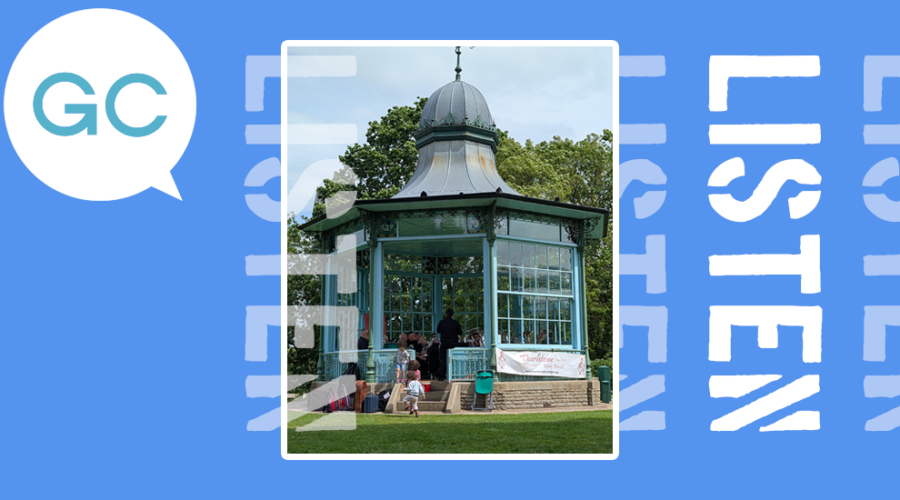
Twice recently, I’ve been lucky enough to be sitting on the grass in the park, watching local brass bands play. There’s definitely something special about the restored-but-usually-locked Victorian bandstand being in use that feels exciting, but the more free and easy brass band in a local Pride parade this year was also absolutely brilliant to watch.
So what is it about brass bands that has given them such enduring popularity?
What makes people go out every Monday evening to rehearse, gather in parks on Sunday afternoons to listen, and instinctively tap their feet or clap their hands in sync with the music?
I grew up in a village that had an annual Walking Day. Walking Day, it turns out, is one of those things that you think is universal but then you leave your hometown and realise nobody else has heard of them.
But every year, always somehow on a sunny day, the local churches and primary school children would get dressed up and parade through the streets (I’m the one with the blonde curls here) accompanied by brass bands and, if memory serves, a giant statue of the Virgin Mary.
Do I just associate brass bands with happy sunny days with young friends?
Do I just love the inherent campness of the sound?
Or is there more to brass bands’ appeal than that?
Born in industry
The modern British brass band grew out of industrial towns in the early 19th century. Brass instruments had become more affordable and soldiers had learned to play them in military bands. Factory and colliery owners quickly saw the value of brass bands for their workers.
Bands like the Black Dyke Mills Band and Besses o’ th’ Barn trace their roots back to the 1810s, and nearly 20,000 brass bands are thought to have existed in the British Isles between 1800 and now.
Coal was central to this story. In mining communities across County Durham, Northumberland, and South Yorkshire, nearly every colliery had its own band, and pit owners often recruited skilled players by offering them steady work underground alongside a guaranteed seat in the ensemble.
The bands were a form of entertainment, of course. But they were also an exercise in “rational recreation,” a Victorian idea that keeping urban working-class men occupied with music would keep them out of pubs and away from labour unrest.
What actually happened was that bands became sources of fierce local pride, with intense rivalries forming between neighbouring pits and mills.
That competitive streak is still baked into the culture. Whit Friday march contests in Pennine villages, where bands race between pubs playing test pieces on the move, remain a firm British institution.
Why brass bands have endured
Part of the appeal is purely about how they sound: a brass band is somehow a wall of sound, which can be soothing or invigorating.
But there’s also the social appeal – a lot of brass bands these days are local people with a hobby who get together to make music. The social and political history of the bands may be a feature of the appeal to them, but they often have a rare, open-to-anyone approach to making music.
You kind of just need to be willing to turn up and try.
That’s also why the demise of traditional industries in the 1980s and 90s didn’t kill the tradition, even though it devastated many towns and cities. Bands like Grimethorpe Colliery kept going without a colliery to speak of, sustained instead by alumni, sponsorship, and the sense that the music belonged to the community, not the employer.
It’s impossible here to talk about brass bands and broken industry without talking about Brassed Off, Mark Herman’s 1996 film starring Pete Postlethwaite, Ewan McGregor, and Tara Fitzgerald.
Set in a fictionalised South Yorkshire village with a pit facing closure, it uses the local colliery band – and Grimethorpe Colliery Band’s own musicians on the soundtrack – to discuss what was lost in areas where pits closed down.
It became a favourite among not only fans of brass bands but also of working-class history and resilience, of trade unions, and just lovers of a good story, well told and well acted.
The subversive brass bands of today
At a Pride parade in my city this year I had the pleasure of watching the Frumptarn Guggenband, an exuberant and exciting brass band that is a step away from the more traditional ways we may expect to see brass music being performed.
When you think about it, there’s a lot of quiet rebellion in the history of brass bands, so it makes complete sense that that continues to this day.
Evolution and exploration are built into the fabric of this kind of music. If you want to hear more, check out:
- Techno brass: Meute, an eleven-piece German “techno marching band” from Hamburg
- Chaos brass: I didn’t really know how to categorise Chav Brass, but don’t let the chav aesthetic shiny tracksuits fool you – these people can play!
- Funk brass: UK groups like The Brass Funkeys and Hackney Colliery Band take the British brass tradition and cross-pollinate it with New Orleans funk
- Bhangra brass: Red Baraat are doing really exciting things merging “hard driving Punjabi rhythms with elements of hip-hop, jazz and raw punk energy”
- Activist street bands: The worldwide HONK! festival movement, is a decentralised “festival of activist street bands“
What ties all of these together is the same thing that made a colliery band worth forming in the 1800s: brass bands are for performing, but also for building community. They rely entirely on some people showing up and playing, and others showing up and listening.
And people do. Still. And I will continue to, because it’s an absolute pleasure.
Image: Philippa Willitts