

Since starting this column I’ve seen some really great book adaptations, but as a rule of thumb I usually find the books to be (even just marginally) better than their film or TV adaptations. Films often need to compress plots, simplify characters and rarely capture the full richness of a novel.
Yet every so often an adaptation comes along that does something altogether rarer – it discovers the story at the core of the novel that was waiting to be told.
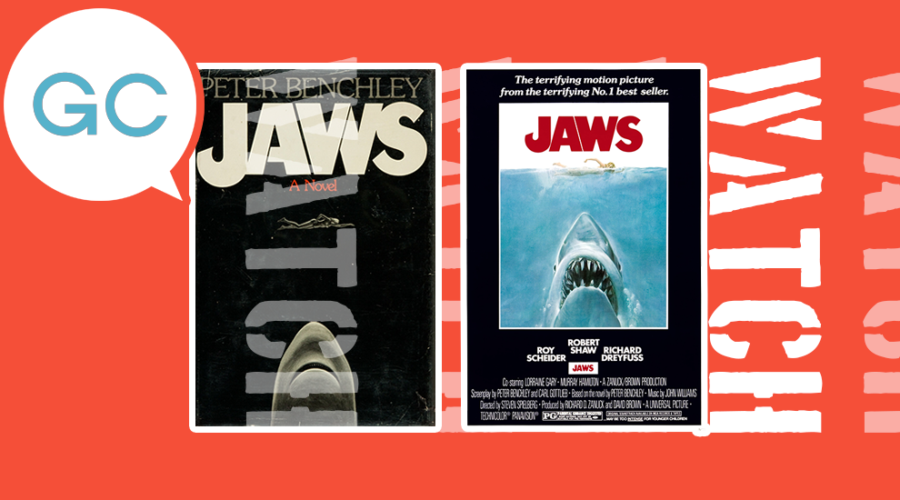
Steven Spielberg’s Jaws (1975) is one of those extraordinary exceptions. Peter Benchley’s bestselling novel of the same name had already captivated readers with an irresistible premise: a seaside community terrorised by a great white shark.
But the film recognised that the novel’s greatest strength was also its simplest aspect. By stripping away unnecessary subplots, deepening its characters and elevating suspense over spectacle, Spielberg transformed a popular thriller into one of the defining films of the twentieth century.
Watching it today, more than fifty years after its release, is a pleasant surprise. So many films of the 1970s now feel unmistakably of their era, yet Jaws remains remarkably fresh. The fashion and the haircuts may occasionally reveal its age, but the storytelling, performances and craftsmanship have scarcely dated at all, and the special effects have stood up brilliantly considering the advances that have been made since.
The novel
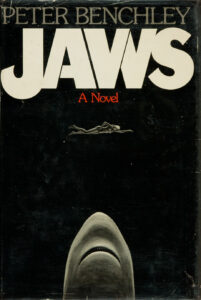 Published in 1974, Jaws begins brilliantly. The opening paragraphs are beautifully written and the first attack is economical, terrifying and beautifully paced, establishing the ocean as an immense, indifferent force beyond human control.
Benchley instinctively understood that what we cannot see is often far more frightening than what we can.
As the novel develops, however, it becomes less certain of its purpose. Alongside the shark story there’s an affair between Ellen Brody and Matt Hooper, a subplot involving local corruption and organised crime, marital dissatisfaction, class tensions and small town politics.
Individually these ideas have potential, but collectively they dilute the central narrative.
The affair is particularly difficult to justify. Rather than enriching the characters, it interrupts the building suspense and ultimately has little impact on the outcome of the story. Likewise, the Mafia subplot feels as though it belongs in an entirely different novel; the local politics does everything that’s needed in terms of explaining why the beaches are initially kept open.
The book also displays an appetite for sensationalism that occasionally undermines its effectiveness. Graphic scenes of violence involving animals, together with repeated descriptions of race and ethnicity that rarely contribute to the narrative, can feel distracting to a modern reader.
Rather than increasing tension, they often draw attention away from the story’s strongest element: the shark itself.
The characters are similarly flawed. Brody is sympathetic but strangely passive, Hooper is arrogant and unlikeable, while Quint is abrasive almost to the point of caricature. Even Ellen Brody remains difficult to warm to. It is a novel populated by believable people, but not particularly engaging company – for readers who like to have a character they can really root for, it might feel flatter and less engaging than it otherwise could.
Yet none of this should diminish Benchley’s achievement. He conceived one of the great thriller premises of modern fiction, and its power remains undeniable.
The film
Spielberg’s adaptation succeeds because it asks a deceptively simple question: what is Jaws really about?
Its answer is fear.
Almost everything that distracts from that central idea disappears from the film. The affair is removed, the Mafia subplot vanishes. What remains is a remarkably lean story in which every scene either builds suspense or develops the relationships between its three central characters.
Roy Scheider’s Chief Brody becomes the emotional heart of the film. Rather than the indecisive everyman of the book, he becomes an ordinary person gradually discovering extraordinary courage. His fear of the water makes him instantly relatable and gives his eventual heroism genuine emotional weight.
Matt Hooper undergoes an equally successful transformation. Richard Dreyfuss replaces the novel’s smug academic with an enthusiastic marine biologist whose curiosity and humour make him immediately likeable.
The greatest reinvention, however, belongs to Quint. Robert Shaw’s unforgettable performance culminates in the USS Indianapolis speech, a scene absent from the novel but now inseparable from the film’s legacy. In a matter of minutes, Quint’s obsession ceases to be mere eccentricity and becomes the tragic consequence of unimaginable trauma.
Perhaps the film’s greatest stroke of luck came from disaster. The mechanical shark, nicknamed Bruce, repeatedly malfunctioned during filming. Forced to rely on it less, Spielberg discovered that unseen terror was infinitely more frightening than any mechanical monster could ever be. John Williams’ two-note score, floating barrels and carefully controlled point of view invite the audience to imagine horrors far greater than anything shown on screen.
The warmth between Brody, Hooper and Quint also gives the film something the novel rarely achieves: genuine affection for its characters. Their conversations aboard the Orca are funny, revealing and deeply human, making the final act all the more affecting.
Sharks, science and fear
One aspect of Jaws has inevitably aged: its science.
Viewed through the lens of modern marine biology, both the novel and the film contain numerous misconceptions about shark behaviour.
The suggestion that menstruation might attract sharks, repeated early in the book, reflected a common belief of the 1970s but is unsupported by modern evidence. Likewise, the film’s great white behaves less like a wild animal than a mythical sea monster – relentlessly hunting humans, pursuing the same victims with apparent intent and displaying a level of determination that real sharks simply do not possess.
The shark functions less as a wildlife documentary subject than as an ancient monster from folklore
Ironically, Peter Benchley himself later acknowledged this. As scientific understanding of sharks improved, he became an outspoken advocate for their conservation, expressing regret that his novel had contributed to the widespread demonisation of an animal that is both vulnerable and ecologically essential. Ultimately though, these scientific inaccuracies matter very little, at least in terms of the story.
Jaws endures not because it is an accurate film about sharks, but because it is an extraordinarily accurate film about fear. The shark functions less as a wildlife documentary subject than as an ancient monster from folklore – an embodiment of everything that lurks beyond our vision and beyond our control. Like the dragon beneath the mountain or the beast beneath the bed, it represents the terror of the unknown rather than the behaviour of a real animal.
Final thoughts
Great adaptations aren’t necessarily the ones that preserve every page of their source material, but rather the ones that recognise what deserves to be preserved. It’s impossible to ever fully replicate the experience of reading a book in film, and the best adaptations don’t try to do that. Instead, they take the original source material and turn it into something that stands on its own merit.
Peter Benchley provided one of the most compelling premises in modern popular fiction: a peaceful seaside community confronted by an unseen predator. Steven Spielberg recognised that this idea needed no embellishment. By removing distractions, enriching its central characters and trusting suspense over sensationalism, he transformed a successful thriller into a cinematic masterpiece.
More than half a century later, Jaws continues to grip audiences, not because it tells us the truth about sharks, but because it tells us the truth about ourselves.
Beneath its surface lies a timeless story about fear, courage and the limits of human control – and that is why it still has the power to make us think twice before stepping into the sea.