

Paris has built much of its cultural identity around books. For literature lovers, wandering its streets and exploring its buildings is pure magic — or at least it was for me.
For centuries, writers, publishers, intellectuals, and artists have found in its streets a place to exchange ideas, publish works, and participate in some of Europe’s most influential literary movements. From the cafés frequented by the authors of the Lost Generation to the small independent bookstores in the Latin Quarter, literature continues to be a part of everyday life in the French capital.
Paris has changed a great deal since the days of Hemingway, Joyce, and the first booksellers along the Seine. However, its libraries and bookstores continue to play an important role in the city’s cultural life. Some preserve copies that are several centuries old; others receive new releases every day or uphold traditions that have endured for generations.
Visiting them is a way to explore Paris’s literary history, but also to see that, even in such a heavily visited city, there’s still room to wander into a bookstore without rushing, discover an unknown author, and spend some time reading.
National Library of France
Location: 5, rue Vivienne, 75002 Paris.
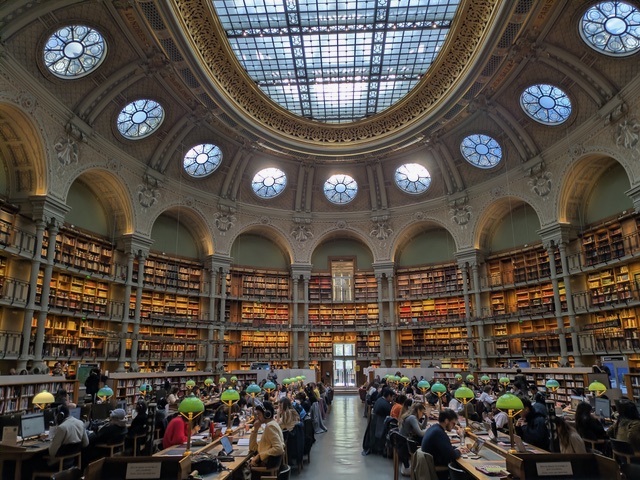 The National Library of France is one of those places that elicits a “wow” reaction the moment you walk in — and it’s no wonder. Its historic headquarters occupies one of Paris’s most remarkable historic buildings.
Its origins are linked to the collections of the kings of France, and its historic headquarters is located in a former 17th-century palace, where the royal library was established in 1721.
The main attraction is the Oval Room, inaugurated in 1936, with a ceiling height of 18 meters, a glass roof, and bookshelves surrounding the space. It currently offers free access to a collection of some 20,000 volumes — a place where any book lover would want to live.
The wonderful thing about this place is that you don’t have to be a researcher or apply for special accreditation to sit down and read. This openness transforms an institution traditionally associated with specialized study into a place where any visitor can enjoy both the books and the architecture at the same time.
The Bouquinistes of the Seine
Location: The banks of the Seine, particularly between the Pont Marie and the Quai du Louvre, and between the Quai de la Tournelle and the Quai Voltaire.
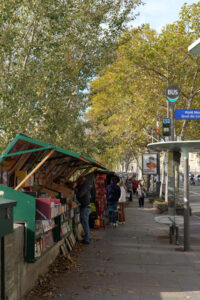 In Paris, not all bookstores have doors or a fixed address. Along the Seine, the bouquinistes sell used books, antique editions, engravings, posters, and publications that are hard to find in conventional stores.
Their characteristic green stalls are part of the city’s landscape and a commercial tradition dating back several centuries. Although they attract numerous tourists today, their history is linked to the circulation of secondhand books and access to publications that, at various times, were not always available in established stores.
What sets the bouquinistes apart is the experience of browsing without a specific title in mind. Among French novels, old photographs, magazines, and illustrated editions, each stall offers a different selection, shaped by the interests and discoveries of its owner.
For collectors, they offer an opportunity to find unique copies; for visitors to Paris, they provide a way to explore the city’s publishing culture off the beaten path.
Shakespeare and Company
Location: 37, rue de la Bûcherie, 75005 Paris.
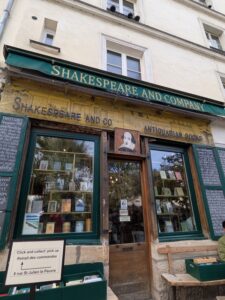 Just a few steps from Notre-Dame lies Shakespeare and Company, one of the world’s most famous independent bookstores and a tourist dream for readers and writers around the globe.
The history of the present-day bookstore began in 1951, when the American George Whitman opened an English-language bookstore initially called Le Mistral. In 1964, it adopted the name of the legendary bookstore founded by Sylvia Beach in 1919, which had been frequented by Ernest Hemingway, James Joyce, and other leading figures of Parisian literary life.
Although they were two different businesses, Whitman wanted to continue the tradition of creating a meeting place for international writers. Figures such as James Baldwin, Anaïs Nin, Allen Ginsberg, and Julio Cortázar passed through his store.
However, one of its most unique stories involves the “tumbleweeds” — young travelers and aspiring writers to whom Whitman offered free lodging inside the bookstore. In exchange, they had to help out for a few hours at the store, read, and write a short autobiography.
It is estimated that more than 30,000 people have spent the night there over the years. Today, the bookstore maintains a vibrant cultural scene with gatherings, readings, and presentations.
Among its bookshelves, small reading nooks, and selection of English-language literature, it retains a character that goes far beyond its reputation as a tourist attraction.
Mazarin Library
Location: 23, quai de Conti, 75006 Paris.
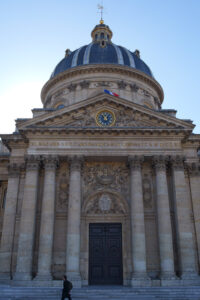 Located within the Institut de France, across from the Seine, the Mazarin Library is recognized as the oldest public library in France. The collection opened its doors to scholars in 1643 and was later moved to the College of the Four Nations.
Among its most valuable holdings is a copy of the Gutenberg Bible, printed around 1455, one of the great works in the history of European printing. The institution also preserves thousands of incunabula—that is, books printed before 1501— along with manuscripts and editions of immense historical interest.
Sainte-Geneviève Library
Location: 10, place du Panthéon, 75005 Paris.
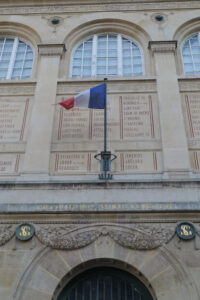 Located across from the Panthéon, in the heart of the Latin Quarter, the Sainte-Geneviève Library is one of the great landmarks of 19th-century library architecture. Its collections trace their origins to the former Abbey of Sainte-Geneviève, but the current building was designed by Henri Labrouste and opened its doors in 1851.
His design was innovative for its time, using an iron framework that allowed for the creation of a spacious reading room with slender columns, metal arches, and large windows that let in plenty of natural light.
Rather than conceiving the library solely as a repository for books, Labrouste placed special emphasis on creating an environment conducive to study and on the comfort of the readers.
Images: Edgary Rodriguez R.