

Waiting with my daughter in the post-industrial foyer of Royal Shakespeare Theatre in Stratford-Upon-Avon, for Game of Thrones: The Mad King to start I contemplated my own relationship to fandom and our want for every narrative detail to be resolved versus the desire for our own unique version of story completion.
The Mad King stage play clearly fills a void left behind by the HBO television series that, for many, concluded in a bombastic mess as the creators David Benioff and DB Weiss outpaced George RR Martin’s Herculean struggle to finish his magnum opus. The further they navigated away from Martin’s safe shores, the more tumultuous the storm of fan disappointment, resentment and incredulity that threatened to drown the show runners in the torrent of their own former success.
For the record, I thoroughly enjoyed the last couple of seasons of Game of Thrones we had rather than the ones some fans wished we had. In the CGI era, modern audiences are spoilt for choice as special effects can conjure the fantastic into reality to the point where the fantastic appears mundane.
We are now an audience that cannot tolerate narrative incompletion no matter what the creative toll exerted on the creator.
Great fantasy films were great because they were like the mythical beasts they portrayed, rare to the point of being fabled, Jason and the Argonauts, Time Bandits, Dragonslayer, Clash of the Titans and Excalibur.
Like many of my age group, Star Wars was my foundational text, the three years between each film of the original trilogy were like an eternity, stretching like the opening crawl of the films between infant, junior, and senior school. Pre internet, the rumours of the prequel episodes were that of legend, garnered from dog-eared magazines, film tie-in books, Marvel comics and annuals, playground gossip, and most importantly playing out my own Star Wars adventures with the action figures and vehicles.
Believe me when I say my own version of the Clone Wars (and no doubt everyone else’s), a throwaway line in Star Wars was far superior to anything George Lucas brought to the screen with his dull prequal trilogy. Be careful what you wish for as those films sullied the memory of the originals as well as the promise of your own imagination when filling in the pertinent blanks of the saga.
All that being said, a second throwaway line about spies dying to retrieve the Death Star plans in Star Wars led to the second-best Star Wars film after The Empire Strikes Back, Rogue One being released and – more importantly – the incredible television series Andor about the creation of The Rebellion and the brutalising effect that fighting fascism has on the combatants.
Martin still hasn’t completed the last two books in the series, The Winds of Winter and The Dreams of Spring, which elicits little sympathy from many fans despite his struggles with the creative process, his battles with mental health, and the most arduous confrontation of all: at 78, the realisation of his own mortality.
We are now an audience that cannot tolerate narrative incompletion no matter what the creative toll exerted on the creator. The fans’ ire is often directed at what they see as Martin’s procrastination away from their own narrative priorities rather than what Martin wants as a writer in the twilight of his career and his life.
How dare Martin not to be as devoted to their fandom as they are to his work?
Life is short and perhaps on seeing Game of Thrones completed as a television series, Martin was more interested in adapting the Targaryen dynasty Fire and Blood into House of the Dragon, or took greater pleasure in the more intimate Tales of Dunk and Egg into the widely acclaimed series, A Knight of the Seven Kingdoms.
So, looking around the theatre I tried to work out why this audience would have travelled far and wide to see a play set some years before the events of Game of Thrones. What narrative fix did they need fulfilled?
There were plenty of goth-adjacent twenty somethings with spidery clothes and fantasy tattoos, adults dressed in Lannister heraldry, or sparky teenagers reeling off their favourite King or Queen’s titles word perfect, “Robert of the house Baratheon, first of his name, king of the Andals, Rhoynar, and the First Men, Lord of the Seven Kingdoms, and Protector of the Realm.”
My own daughter, who recently finished the television series in about a month and had just started reading the books, needed more content, more lore. Like the dragons in the show, she had consumed vast quantities of narrative meat in one sitting and didn’t have the luxury of ruminating, forgetting about, and then becoming excited about Game of Thrones all over again each year between seasons.
She’d had 28 days to digest an 8-course meal. I’d had 8 years.
Being 16, she needed more Thrones and frankly I didn’t, but I did have a professional curiosity to see how Robert’s rebellion against the Mad King would transpire and be staged. Besides, every mutual bonding experience with your children should be fully embraced.
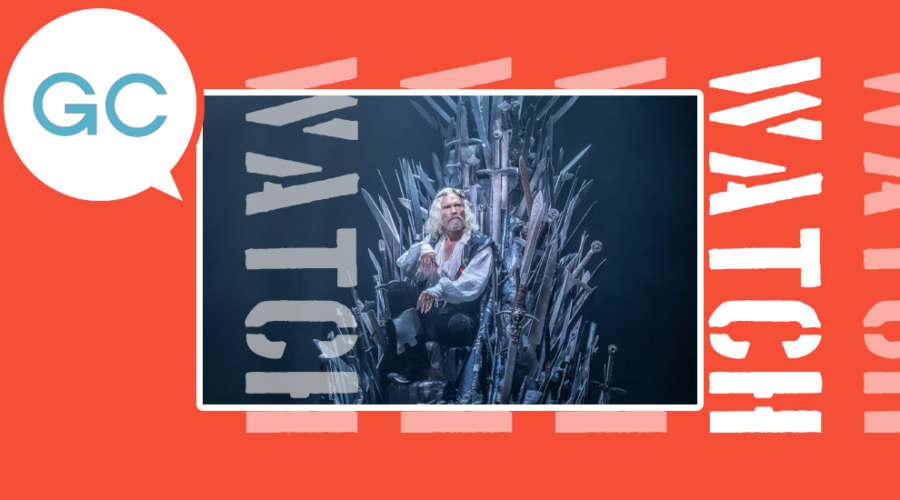
Adapted by Duncan Macmillan and directed by Dominic Cooke, The Mad King features over 30 actors and an ingenious use of puppeteers to bring creatures and action vividly to life. The opening is a solemn, wordless procession of Targaryen pageantry as Crown Prince Rhaegar’s entourage enters Harrenhal. The stage is austere and minimalist, a crucifix on which may characters will be tried, tortured and executed, surrounded by the audience in gladiatorial arena style seating.
The doom and suffering that befall the Starks in years to come is intriguingly set up in The Mad King.
The seeds of the rebellion come from the most unlikely of character sources and the gathering conspiracy that ensues at the tournament in Harrenhal, unravels delicately in the first half of the play where we are introduced to the young, enthusiastic Ned Stark and his retinue, most notably his elder brother Brandon, the heir to Winterfell. The doom and suffering that befall the Starks in years to come is intriguingly set up in The Mad King.
Characters converse in a pseudo-Shakespearean tongue that adds heft and importance to the momentous events we are being set up for, but at times the delivery feels stilted. It is as if The Mad King must adhere to the Bard to attain respectability in the theatre rather than lean into its own credibility.
A key strength of the early Game of Thrones seasons was the masterful blending of the material from the books with televisual dialogue. The word play was dynamic and used to manipulate and manoeuvre other characters into ever more deadly situations.
The Mad King suffers the fate of the later seasons that did not have the books as guidelines, where the dialogue became functional and plot driven, rather than intrinsic to the souls of the characters who spoke the lines.
In contrast, the fight choreography is remarkable and fleet of foot, aided and abetted by dense, atmospheric sound design. If you ever wanted to know what Robert Baratheon was like in his martial prime before his descent into obesity and fathering bastards, The Mad King answers that question in spades: he is an armoured juggernaut wielding his two-handed war hammer like one of Westeros’ old gods, literally knocking opponents out of their armour Matrix style.
It is as if The Mad King must adhere to the Bard to attain respectability in the theatre rather than lean into its own credibility.
And what about the Mad King Aerys II Targaryen himself? Michael Shaeffer portrays him as a psychotic, aged Caligula, capricious, spiteful, and dreadfully cruel. Aerys is the embodiment of the adage about the Targaryen dynasty, “When a Targaryen is born, the gods toss a coin in the air and the whole world holds its breath to see how it will land.”
Did we really need The Mad King? Probably not. The standing ovation given by the audience to what was a thoroughly absorbing three-and-a-half-hour epic would suggest we do. The aching chasm sized hole where the final two books should be is filled… for now.
But for how long a stage play seen by just a few thousand people will quench that insatiable need for story will be anybody’s guess. Expect the clamour around Game of Thrones in all of its incarnations to ramp up very soon indeed.
Image: Johan Persson