

The question of the place for human creativity in today’s algorithm-driven world has become unavoidable. In this context, doubts arise that no longer belong solely to the realms of philosophy or science fiction.
What happens to creativity when a machine can reproduce it? Who truly controls the data that define our digital identity? Does technology expand creative possibilities, or does it ultimately replace the creator?
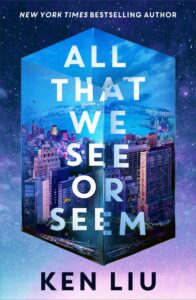
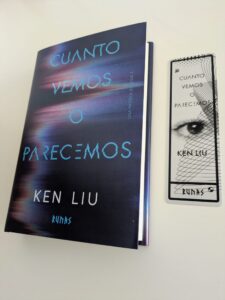 These questions run throughout All That We See or Seem, Ken Liu’s new novel, in which he explores the intersection of technology, culture, and power.
All That We See or Seem places the reader in the middle of these tensions and shows how they affect the people who live in that world. The story revolves around Julia Z, a figure in the field of cybersecurity who, at a very young age, became a brilliant hacker, and whose name became linked to one of the most famous episodes in the digital sphere.
Years later, as she tries to live quietly and stay out of the spotlight, a lawyer contacts her for help. The man’s wife, an artist connected to new forms of digital creation, has disappeared. Her work involved designing collective experiences that combined art, technology, and exploration of the mind.
The search for the missing artist becomes a broader exploration of control over information. Julia moves among researchers, programmers, executives, and activists — each representing a different way of understanding the role of technology in society.
Ken Liu —winner of the Hugo, Nebula, and World Fantasy awards— was already well known before this novel for his ability to combine science fiction, epic fantasy, and cultural reflection. His short story collections and his saga The Dandelion Dynasty have placed him among the most influential authors in the genre over the past decade. In his shorter works he often explores themes such as memory, identity, and the impact of technology on everyday life.
All That We See or Seem continues that interest in the human consequences of technological innovation, though it adopts a form closer to the contemporary thriller. Instead of constructing a distant universe or an imaginary civilization, Liu focuses on an immediate future that seems to emerge directly from current trends in the digital world.
One of the most interesting aspects of the book is the way it approaches the relationship between art and technology. In the novel, art is no longer limited to physical objects or traditional works. Creative experiences can involve entire networks of users and artificial intelligence systems that analyze data in real time.
This context raises queries about who the true author of a work is when algorithms trained on millions of examples are involved.
One of the most interesting aspects of the book is the way it approaches the relationship between art and technology
It also calls into question the freedom of the creator when technological infrastructure is controlled by large corporations. Liu uses the disappearance at the center of the plot to examine these tensions. The characters discuss the ownership of data, the responsibility of programmers, and the possibility of maintaining an individual voice within platforms dominated by automation.
 The presence of artificial intelligence in the novel is not presented as an exaggerated futuristic element. On the contrary, many of the technologies described resemble more advanced versions of tools that already exist.
Systems analyze large amounts of personal information and generate personalized experiences that combine entertainment, art, and emotional manipulation.
This approach makes the world of the novel feel close and recognizable, because it is not a completely transformed society. It is rather a logical extension of the present digital landscape. Technology companies wield considerable power, personal data circulate constantly, and algorithms take part in decisions that once depended on human judgment.
Despite this reflective background, the novel also works as a technological thriller with a steady pace. Julia must decipher codes, infiltrate protected systems, and follow clues that lead her through different corners of the technological world. The result is a narrative that maintains tension while continuing to examine the social implications of technology.
Another notable element is the way the novel portrays digital communities. Throughout the investigation, forums, networks of programmers, and groups of activists appear, sharing information and developing their own tools. These spaces reflect a diverse technological culture that is not limited to large corporations. Liu shows both the collaborative potential of these communities and the conflicts that arise when different interests collide.
The book also spends time exploring Julia Z’s identity. Her past as a well-known hacker shapes the way other characters perceive her.
For some, she is an expert capable of solving impossible problems. For others, she represents a risk because of her history.
This ambiguity adds tension to the story. Julia must decide how far she is willing to expose herself again in an environment where every move can be recorded and analyzed.
All That We See or Seem offers a clear reflection on the technological present. Liu does not draw an apocalyptic scenario; instead, he presents a complex system in which innovation generates opportunities and risks at the same time.
It is a book especially recommended for readers interested in stories where technology occupies a central place in the plot. It will appeal to those who enjoy artificial intelligence as a narrative theme, moderate cyberpunk, technological thrillers, and novels that reflect on digital identity in an era dominated by data.
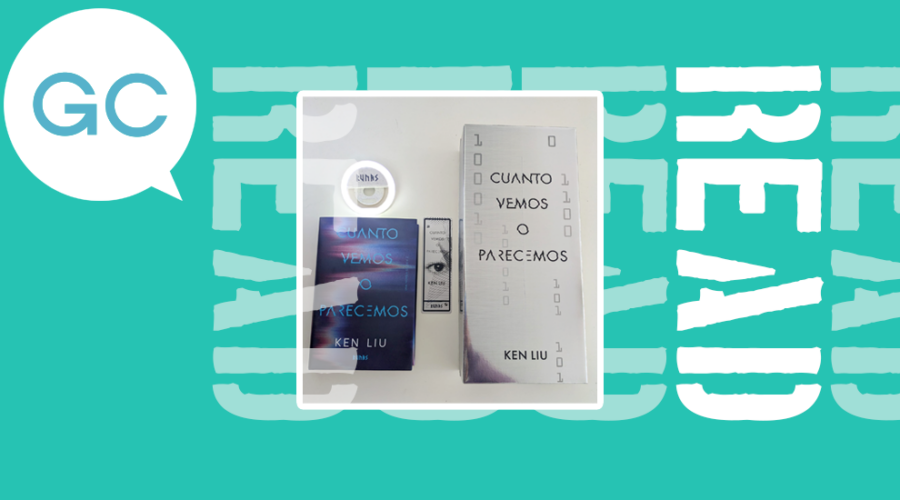
The Spanish edition sent to me, along with some amazing collectors’ items, by Alianza Editorial, part of the Runas collection, preserves the tone of the original and offers a fluid translation that maintains the novel’s narrative clarity and technical vocabulary.