

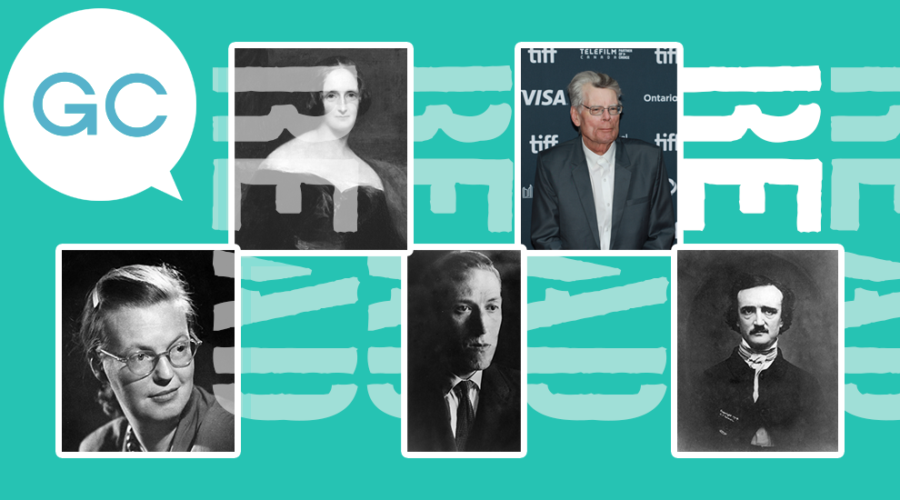
Fear was present in literature long before Edgar Allan Poe heard a heart beating beneath the floorboards, before H. P. Lovecraft gazed out into the cosmos, or before Stephen King turned an empty hotel into one of the most unsettling places in fiction. But each of these writers helped shape what we know today.
A great way to explore the history of horror is through its writers and our fears — beyond the monsters.
Edgar Allan Poe: the human mind in a haunted house
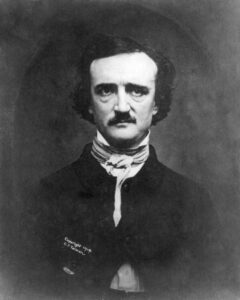 Edgar Allan Poe’s life seems all too fitting for a horror writer. But much of that image of the cursed writer has been exaggerated over time.
It would be too simplistic to say that Poe wrote about death because he was surrounded by it. What is truly groundbreaking is what he did with fear in his writing. In many of his stories, horror doesn’t need to come from outside.
There is one final, very Poe-like irony in his own death; it remains without a definitive explanation.
In 1849, he disappeared for several days and was found in Baltimore, delirious and dressed in clothes that apparently were not his own. He died four days later. Numerous explanations have been proposed, but none has been definitively proven.
H. P. Lovecraft: the universe as the monster
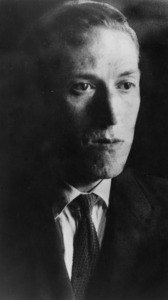 Something has happened with H. P. Lovecraft that has happened to many artists: his posthumous fame is far greater than the fame he enjoyed during his lifetime.
He died in 1937 without imagining that Cthulhu would end up appearing in novels, comics, and movies, or that his name would come to define an entire genre of horror: “Lovecraftian.”
His childhood does contain elements that shed light on his imagination. His father was institutionalized when Lovecraft was a child and died years later. His maternal grandfather fueled his fascination with the strange by telling him improvised Gothic stories.
Science was a defining passion in his life. Lovecraft took a keen interest in chemistry and, above all, in astronomy; he even published popular science articles on astronomy.
Shirley Jackson: you don’t have to leave the neighborhood to find horror
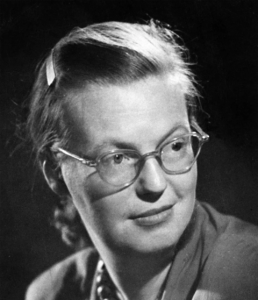 Shirley Jackson’s great talent lay in making the everyday seem suspicious, because the familiar can be far more unsettling than the unknown.
In other words, you don’t need a medieval castle — a house will do. That’s why Jackson’s houses are so powerful. They aren’t simply buildings haunted by ghosts; they can be both refuges and prisons at the same time.
That explains the extraordinary effectiveness of The Lottery. We’re in a seemingly normal community, carrying out a tradition accepted by normal people.
And therein lies the monster: a society’s ability to normalize something monstrous simply because “it’s always been done that way.”
The Haunting of Hill House took that idea to an extraordinary level. The reader never has a completely clear boundary between a supernatural house and Eleanor’s psychological experience.
Stephen King: he turned Horror into everyday life

Stephen King isn’t just known for selling a massive number of books. His contribution lies in repeatedly demonstrating that a horror novel can function simultaneously as a scary story and a social portrait.
King places horror in recognizable settings, such as a school, and then introduces something impossible into them. But his monsters often conceal very human problems. Carrie also deals with bullying, The Shining with addiction and domestic violence, Pet Sematary with grief and our inability to accept death.
His career was on the verge of beginning very differently. While writing Carrie, King discarded the pages and threw them in the trash. His wife, the writer Tabitha King, retrieved them, read them, and encouraged him to continue. Carrie became his first published novel and ultimately allowed him to leave his job as a teacher to devote himself to writing.
And then there’s his extraordinary relationship with film. Carrie, The Shining, Misery, It, Pet Sematary, The Dead Zone, Stand by Me, The Shawshank Redemption, and The Green Mile are just a fraction of a body of work that has been constantly adapted.
For this reason, there are people who are familiar with Stephen King’s stories without even realizing they’re seeing Stephen King’s stories.
Mary Shelley: she created a monster, and popular culture created another
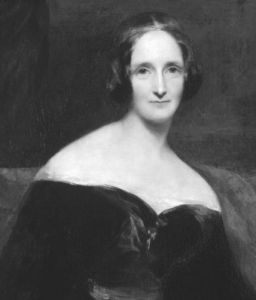 The story of Mary Shelley and Frankenstein is probably one of the greatest origin stories in literature. In 1816, Mary Godwin — who had not yet married Percy Bysshe Shelley — was staying near Lake Geneva with Percy, Lord Byron, John Polidori, and Claire Clairmont.
Byron suggested that each of them write a ghost story.
After listening to conversations about the nature of life and the possibility of reanimating matter, she had what she would later describe as a kind of “daydream.” That vision became the seed of Frankenstein.
The original creature is very different from the monster that later took root in popular culture. Shelley did not simply create a clumsy, growling corpse. Her creature learns to speak, reasons, reads, feels rejection, and craves affection.
The work transcended the Gothic genre. By combining scientific speculation with a question about the consequences of creating life, Frankenstein is commonly regarded as a precursor to modern science fiction.
Image credits: Drgn1900, Kevin Payravi / WikiPortraits, Eric Hartmann, R. H. Barlow, Library of Congress


