

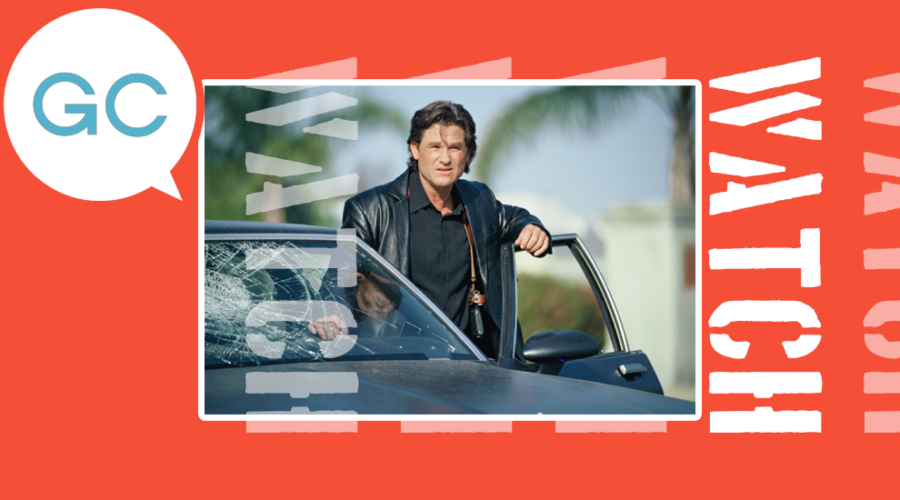
Kurt Russell’s eyes are wired. Those baby blues are ringed with red, the Disney child paranoid, sweating booze and armed to the teeth. Those jump cuts are making us anxious from the off.
We’re back in the early 90s and that Rodney King beating doesn’t get any better with age. Kurt is Sgt Eldon Perry a corrupt foot soldier of the LAPD, one of those hard-nosed racist bastards that so often populate the writing of James Elroy and David Ayer, the West Coast equivalents of Sidney Lumet, “The choke hold saved lives, but, ah, nobody ever got elected saying that, I suppose.”
Five days earlier and Perry is breezing through a police shooting board with his rookie partner Bobby Keough. As two of LA’s finest scumbags cheat the system, two ex-cons, Orchard and Sidwell, are executing a growing pile of victims in the Jack O’Hearts convenience store robbery, Eazy motherfucking E blaring on the soundtrack.
Their casual disregard for life is staggering and perhaps violent thugs like Eldon Perry are just what The City of Angels needs to take on this repugnant pair of homicidal psychopaths.
However, Perry, Bobby, Sidwell and Orchard are merely pawns in a civil war that threatens to split the department. Commander Jack Van Meter pulls the strings, judge, jury and executioner, “I’m a performer of unpleasant tasks so that the majority of people are free to perform pleasant ones.” Van Meter’s feud is with the black Assistant Chief
Holland and the internecine conflict is sharply divided down racial lines, exacerbated by the impending verdict of the four officers charged with the Rodney King beating.
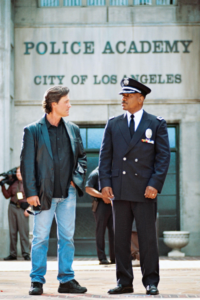
Holland isn’t prepared to take Van Meter’s shit lying down, the two hulking bruisers barely squeezing into a lift, Ving Rhames delivering dialogue in his own inimitable style, “I know how you fight, I’m ready for you. We can handle this like gentlemen, or we can get into some nigger shit. So, you do whatever it is you feel you have to do.”

The problem is nobody on the force is squeaky clean – not even Holland. Dark Blue’s moral high ground only presents its audience with varying shades of corruption and infidelity, making an ethical platform from which to take on the system as safe as placing dynamite under the very foundations on which you stand.
As Van Meter dispatches Perry and Bobby to investigate Jack O’Hearts, the partners start to climb out of their own cesspool of lies, falsified evidence and cold-blooded murder. Their redemption will never be complete as their crimes are too great; Perry knows the writing is on the wall when the Rodney King officers are acquitted, “If the city is starting to burn, Jack, it’s partly because of guys like you and me.”
All he can do is hunt down Orchard and Sidwell through the apocalyptic riots; the rage at the injustice felt at the Rodney King verdict threatening to spill out of the screen and yank you right out of your chair so you can taste a mouthful of concrete and ash.
 Dark Blue is a blistering movie once again made chillingly relevant by the largely underreported spate of hangings of black residents in Mississippi, the suspicious death of Nolan Wells, not to mention the long-awaited murder trial for the 1996 killing of Tupac Shakur in Las Vegas. Former gang leader Duane “Keffe D” Davis faces charges for orchestrating the fatal drive-by shooting which led to the murder of Biggie Smalls, often linked to Rampart LA Police corruption scandal.
Director Ron Shelton ratchets up the tension one scene at a time, each metallic click leading one bloody step closer to the inevitable catastrophe of the LA riots where 54 people died. Ellroy originally set the film against the backdrop of the 1965 Watts riots but the decade between the end of the riots and Dark Blue’s release in 2002 gives the film remarkable heft.
The frantic, claustrophobic tone is aided by a gloriously retro early 90s score by Terence Blanchard and music by LA’s finest rappers, NWA, The D.O.C., M.C. Ren, Tone Loc not to mention the epic Streets on Fire credits track by Porno for Pyros featuring Kurupt.
The dialogue carries more punch than a Tyson uppercut chewed and spat out with relish by Scott Speedman, Brendan Gleeson, Ving Rhames, Kurupt, Dash Mihok and Michael Michele.
But at the very cankered heart of Dark Blue is a mesmerizing performance by Kurt Russell as Perry, “I was raised up to be a gunfighter by a family of gunfighters.” Stinking of booze and blood but with a twinkle in his eye that only a child actor whose name was the last words spoken by Walt Disney on his deathbed could pull off.
Eldon Perry’s downfall is even more problematic because we love Kurt Russell so much; the left-wing direct descendent of John Wayne and Clint Eastwood punctures those stoic stereotypes repeatedly, whether as Snake Plissken in Escape from New York or as RJ MacReady in The Thing.
Those characters exist in the world adjacent to this one, Eldon Perry is a character that exists in the real world, and the Eldon Perry’s of today under Trump’s regime seem irredeemable.