

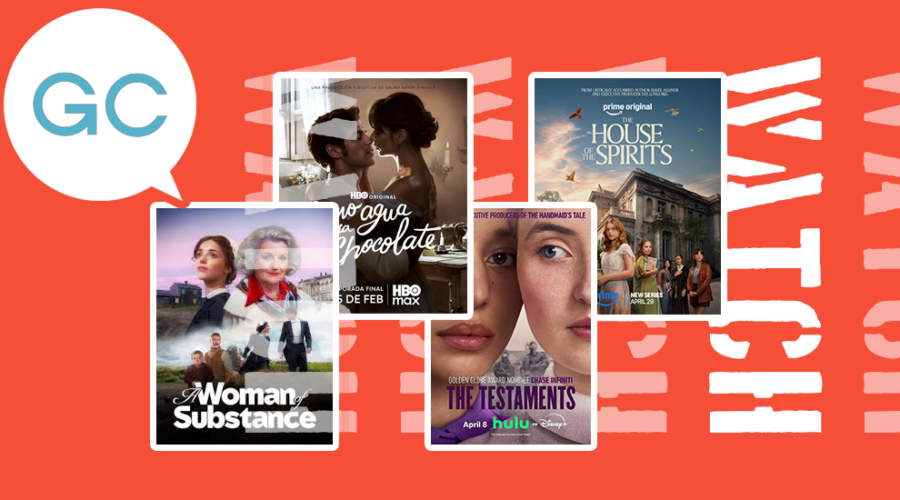
Four of the most talked-about literary adaptations of the moment share one key trait: they were born from the imaginations of women. A Woman of Substance, The House of the Spirits, Like Water for Chocolate, and The Testaments have all recently arrived on television in ambitious new productions that feel deeply connected to current conversations about power, autonomy, and memory.
This trend has an impact that goes far beyond entertainment.
For the publishing industry, it gives new life to books that, in some cases, were first released decades ago. Reissues return to bookstore shelves, sales climb, and new generations discover authors whose work has long been essential.
There is also a symbolic effect. These adaptations reinforce the idea that literature written by women does not belong to a niche category, it sits at the center of the cultural conversation. What was once dismissed as “women’s fiction” is now fueling some of the most significant television series in the global market.
These adaptations reinforce the idea that literature written by women sits at the center of the cultural conversation
The most recent example is A Woman of Substance, which premiered on Channel 4 in March 2026. Based on Barbara Taylor Bradford’s 1979 novel, the series tells the story of Emma Harte, a young maid from Yorkshire who, after being betrayed and cast out when she becomes pregnant, builds a business empire and rises to become one of the most powerful women in the world. The novel sold more than 30 million copies and became an international publishing phenomenon.
The new adaptation preserves the spirit of the book while updating its themes for contemporary audiences. Beyond being a classic rags-to-riches heroine, Emma embodies a broader reflection on inequality and the difficulty women face when trying to wield power without paying a personal price.
Nearly 50 years after it was published, the story remains relevant because it asks a timeless question: how hard does a woman have to fight for her ambition to be seen as legitimate?
That same dialogue between past and present runs through The House of the Spirits, which premiered on Prime Video in April. Isabel Allende’s 1982 novel follows the Trueba family across multiple generations, weaving intimate family stories with Chile’s sweeping political transformations.
Allende turned magical realism into a powerful way of depicting women’s experiences. Clara del Valle’s visions, spirits, and journals are not ornamental devices but tools for preserving voices that those in power try to erase.
The series embraces that perspective, underscoring the idea that memory — so often safeguarded by women — is itself a form of resistance.
Like Water for Chocolate (HBO Max), based on Laura Esquivel’s celebrated novel, deepens this connection between the intimate and the fantastical. Tita de la Garza, forbidden by family tradition from pursuing love so she can care for her mother, transforms cooking into a form of emotional and political expression. Each recipe conveys desires and dreams that social expectations prevent her from putting into words.
The television adaptation retains that emotional force. Magical realism appears in the effects Tita’s dishes have on those who eat them, but the true conflict lies in her struggle to claim authority over her own body and her own future.
The series shows that themes such as family obligation, sexuality, and personal autonomy continue to resonate with modern audiences. Esquivel wrote a story that is profoundly Mexican and, at the same time, universal.
Finally, The Testaments brings this conversation into dystopian territory. Margaret Atwood published her novel of the same name in 2019 as a sequel to The Handmaid’s Tale. The Hulu series, which premiered in April 2026, returns to the world of Gilead through the perspectives of three young women who begin to question the system that shaped them.
Atwood has long emphasized that her fiction does not invent forms of oppression; it reorganizes them from historical and contemporary realities. The Testaments follows that same logic.
The series explores how power is passed down, how indoctrination works, and what role solidarity among women can play when institutions seek to control their lives. Its success confirms that stories written by women do more than place female protagonists at the center — they also offer powerful narrative frameworks for making sense of the present.
Women writers have been creating complex, contradictory, and deeply human characters for decades
What unites Emma Harte, Clara del Valle, Tita de la Garza, and the young women of Gilead is their determination to carve out space for themselves within systems designed to limit their choices.
Their stories speak to money, power, love, politics, family, and freedom.
They also remind us that women writers have been creating complex, contradictory, and deeply human characters for decades. Television is finally giving these voices the visibility — and the scale — they have always deserved.