

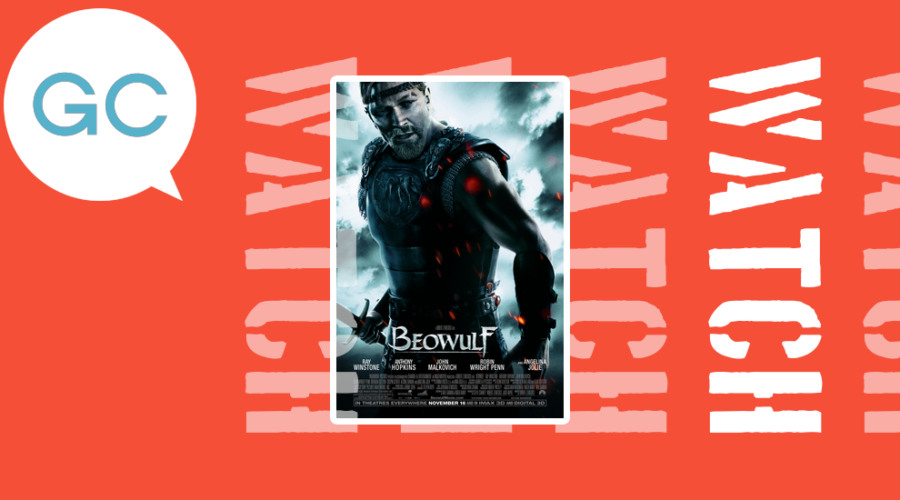
This month over at Five Books For I’ve been looking at classics in translation, and while there are plenty of options from around the world to explore, one that is closer to home – for me at least – is Beowulf.
 It’s an Old English epic, composed more than a millennium ago and preserved in a single surviving manuscript – which means that for most of us, it only really exists through translation. What we read is always, in some sense, an interpretation: a voice speaking across time, deciding how this story of monsters, heroes, and mortality should sound now.
My first encounter with Beowulf was via Seamus Heaney’s translation. One of my favourite poets, Heaney doesn’t try to modernise the poem itself, so much as to make space for it in modern English, preserving its music and mystery rather than explaining them away.
I particularly love how his translation sounds like it’s intended to be read aloud, given that the poem would have historically been shared through oral storytelling.
His language manages that rare trick of feeling both ancient and immediate, as though the poem has simply been waiting for a voice that wouldn’t overexplain it.
There is music in it, but also restraint.
The monsters are not metaphors waiting to be decoded; they are simply there, vast and threatening, part of a world in which danger is not always rational and never fully containable.
And then there is the 2007 film adaptation, with an all-star cast that includes Anthony Hopkins, Ray Winstone, Angelina Jolie and John Malkovich.
I came to it expecting spectacle – and to be fair, it delivers. The action sequences are tightly choreographed and genuinely enjoyable, with a muscularity that feels oddly ahead of its time. There’s a confidence to the staging of violence, a sense that the filmmakers understand how to make bodies move through space in a way that’s exciting to watch.
What becomes clear though – and quickly – is that the film is not really adapting Beowulf so much as arguing with it. The most obvious shift is in what the story is actually about; a pretty fundamental question.
In Heaney’s translation, Beowulf is not uncomplicated, but he is legible within his world. He seeks glory because glory is the currency of meaning. He faces monsters because monsters exist, and because someone must.
The poem does not ask us to psychoanalyse him; it asks us to witness him. His final battle with the dragon is not a reckoning with personal failure, so much as an encounter with inevitability.
Death comes, reputation remains: that’s the bargain.
The film, by contrast, is deeply interested in motivation. It wants to know why Beowulf does what he does – and more than that, it wants those reasons to feel recognisably modern: ego, desire, insecurity, the need to be seen as more than one is.
Heroism becomes performance. Legacy becomes something closer to a carefully maintained illusion.
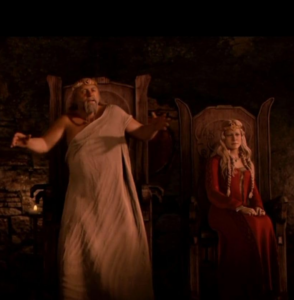
This is most clearly embodied in its reimagining of Grendel’s mother. In the poem, she is a figure of pure otherness – a force of vengeance, grief, and rage. In the film, she is something else entirely: seductive, persuasive, and, crucially, explanatory. She offers a reason for the chaos, a narrative that ties everything together in a neat, if rather lurid, bow.
This is where the film’s argument with the poem becomes unmistakable. By turning the central conflict into a cycle of temptation and compromise, it replaces the poem’s sense of the unknowable and ineffable with something far more familiar, and indeed more boring.
Monsters are no longer external threats, but the consequences of human weakness. Kings are not brought low by fate, but by poor decisions. It is a shift from myth to psychology, from the elemental to the personal.
There could have been something interesting in this; I could imagine a version of Beowulf that interrogates heroism in precisely this way – exposing the gap between reputation and reality, asking whether greatness is ever as clean as it appears.
There are moments when the film seems to be reaching for this, particularly in its later sections, when age and legacy begin to weigh more heavily. Unfortunately, it just doesn’t land.
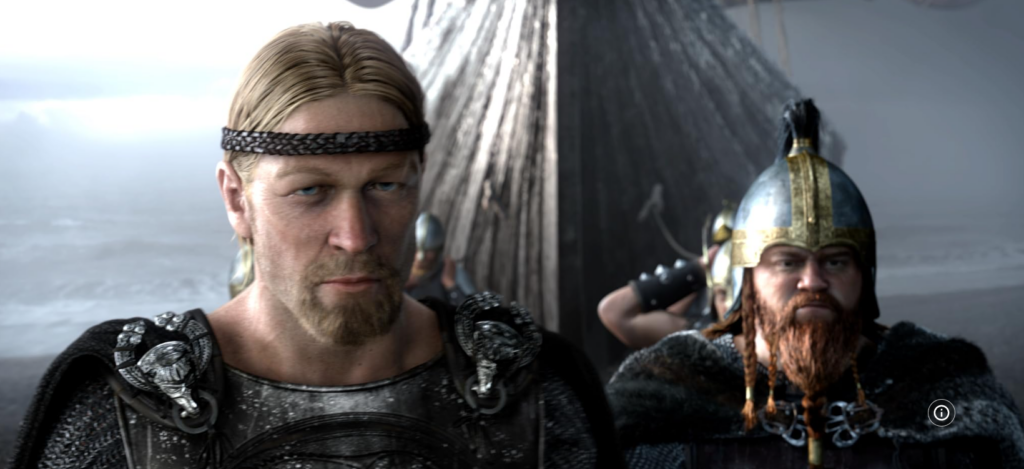
 Part of the problem is tonal. The film’s hyper-real animation, with its tendency towards the uncanny, creates a strange distance. It is too detailed to feel mythic, too artificial to feel fully human.
The result is a world that looks tangible but rarely feels it, a stage on which grand ideas are played out without quite settling.
But, for me, the more significant issue lay elsewhere. For all its interest in desire and temptation, the film handles its female characters with a bluntness that undercuts any claim to complexity.
Women are reduced to functions: temptresses, rewards, background decoration. The only female character who isn’t either simpering or sex-obsessed is Queen Wealtheow, and she is offered up as a reward by her husband, inherited by Beowulf for slaying Grendel.
The court scenes are laced with a persistent, adolescent innuendo that sits uneasily alongside the film’s more serious ambitions. Where the poem offers women as political actors, embedded within a fragile web of alliances and obligations, the film flattens them into symbols of male anxiety.
It is, ultimately, a reduction – and poorer for it, especially given the richness of the source material. It reveals the limits of the adaptation itself.
In seeking to modernise Beowulf, the film fails to deepen its themes and ends up redirecting them into something shallower and more trite.
The existential weight of the poem – its preoccupation with mortality, memory, and the limits of human control – is traded for something more immediate but less enduring: the drama of individual choice, the spectacle of personal failure.
It is too detailed to feel mythic, too artificial to feel fully human
In contrast, Heaney’s Beowulf feels as though it is in conversation with time itself, aware of the long arc of history and the smallness of any single life within it. The film, for all its visual grandeur, feels narrower, circling repeatedly around the same questions of pride and oversimplified male desire.
Perhaps the most useful way to approach it is less as a failed translation, but rather as an argument. The film proposes that heroes are not shaped by fate but by their flaws, that monsters are not external but generated, that legacy is not earned but constructed. These are recognisably modern ideas, and not without interest. Set against the steady, resonant clarity of Heaney’s translation, however, they feel, if not trivial, then at least diminished.
Returning to the poem is a reminder of what made the story endure in the first place. Its power lies not in explanation but in presence, not in psychological detail but in atmosphere and inevitability. It does not ask us to agree with its hero, or even to like him. It asks only that we stand beside him, for a while, as he faces something larger than himself.
And that, it turns out, is more than enough.