


Some books sound like they just shouldn’t work, and those have been the focus of this month’s book selection over at Five Books For. A boy stranded in the Pacific Ocean with a Bengal tiger? It’s an absurd premise, really. And yet Life of Pi, Yann Martel’s 2001 novel, manages to turn it into not just a compelling adventure story, but also a meditation on faith and survival, as well as a clever reflection on the nature of storytelling.
Rather than watching the movie, I thought it would be interesting to explore the National Theatre at Home recording of the stage adaptation, and I’m glad I did; I thought it was brilliant. Not simply because the production is technically impressive, although it certainly is, but because it understands something fundamental about the book: this is a story about the power of imagination, and what it means to believe in something.
The story
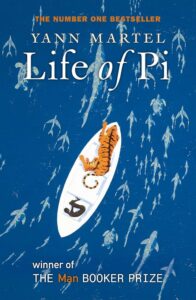 Piscine Molitor Patel, known as Pi, grows up in India, where his family runs a zoo. He develops an interest in religion, exploring Hinduism, Christianity and Islam with an open-mindedness that baffles the adults around him. His childhood also gives him an unusual familiarity with animals, something that will prove rather more useful than his religious studies when his life takes an unexpected turn.
Pi’s family emigrates to Canada aboard a Japanese cargo ship, taking some of the zoo animals with them. The ship sinks, leaving Pi stranded in a lifeboat in the Pacific Ocean. His companions include a zebra, an orangutan, a hyena and a Bengal tiger incongruously named Richard Parker. The other animals don’t survive for long, leaving Pi alone with the tiger.
What follows is a remarkable tale of survival. Pi has to find food and water, protect himself from the elements and, above all, work out how to coexist with an animal that could kill him at any moment.
Pi’s survival depends on understanding the tiger on its own terms, rather than hoping that it will behave like a person.
Martel makes this extraordinary situation convincing through a combination of practical detail, knowledge of animal behaviour and sheer narrative ingenuity. But the novel’s most interesting trick comes towards the end, when Pi is finally rescued and asked to explain what happened to him.
His account is met with disbelief, so he tells a second story. This time, the animals are replaced by human beings, and the adventure becomes a tale of harrowing violence and cruelty. The basic structure is similar, but the emotional effect is entirely different.
Which version is true? Martel never tells us.
The alternative human story is horribly persuasive. It is also, in its own way, more straightforward: we understand how human beings can behave brutally towards one another, even if we would rather not think about it.
The story with the animals is harder to accept as a literal account, but that doesn’t make it any less compelling.
Pi asks his listeners which story they prefer. It’s a question that neatly draws the reader into the novel’s central dilemma. If we cannot establish exactly what happened, does that mean one story is as good as another? Can a story offer us something meaningful even when we cannot be certain of its literal truth?
I don’t think Martel is suggesting that facts don’t matter. Rather, he is interested in what happens when the facts of an experience are so terrible that we struggle to make sense of them.
Perhaps the stories we tell are not simply ways of recording what happened, but ways of living with it.
The novel’s interest in religion comes into sharper focus here, too. Pi is drawn to different faiths partly because he finds value in the ways they help people understand the world. The book leaves us with a similar question about storytelling: might there be more than one way to approach a truth that is too complicated, or too painful, to fit neatly into a single account?
Making a tiger
Adapting Life of Pi for the stage presents an obvious problem: how on earth do you put a Bengal tiger in a theatre?
The stage production, adapted by Lolita Chakrabarti and directed by Max Webster, solves this through puppetry, movement, lighting and sound. The animals are created by performers working together, and Richard Parker is an extraordinary piece of theatrical invention. He has the physical presence and menace of a real tiger, yet we can see the people bringing him to life.
That last point is important. The production doesn’t try to conceal the artifice.
We can see how the tiger is made, and yet he’s spellbindingly believable.
This is what I found so effective about the show. The puppetry is spectacular in its own right (as well as artistically beautiful), but it also feels entirely appropriate to the story. Life of Pi is asking us to believe in something extraordinary while keeping open the possibility that it may not have happened quite as we imagine.
The theatre does something similar: it presents us with an obvious construction and invites us to experience it as real.
The ocean is another challenge. Much of the novel takes place in the vastness of the Pacific, a setting that could easily become monotonous on stage. Instead, the production uses its theatrical resources to create a world that shifts between beauty and terror. The lifeboat is a tiny, precarious refuge in an immense and indifferent environment, and the changing atmosphere of the sea becomes part of Pi’s ordeal.
But the most impressive thing is that the spectacle never feels like an end in itself. The technical ingenuity serves the story rather than distracting from it. We are not simply watching clever puppetry; we are watching Pi’s world being created before our eyes.
And because we can see the people doing the creating, we are reminded that this is what theatre does. A group of performers, some ingenious puppets, a few lights and carefully designed sounds become an ocean, a lifeboat and a tiger. We willingly participate in the illusion, and the fact that we know it is an illusion doesn’t prevent us from being moved by it.
What makes a story true?
The relationship between Pi and Richard Parker is at the heart of both the novel and the production. The tiger is a source of constant danger, but he also gives Pi a reason to keep going. Pi can’t afford to give up, because he has to feed himself, maintain his territory within the boat, and stay alert to the animal’s movements. He is forced to pay attention to the world around him in a way that might not otherwise have been possible.
It would be easy to turn this into a conventional story about an unlikely friendship, but Martel resists that temptation. Richard Parker doesn’t need to love Pi, or even understand him, for their relationship to matter. The tiger remains an animal, utterly separate from Pi’s human world, and that is part of what makes their coexistence so fascinating.
It also means that the story’s emotional force doesn’t depend entirely on whether the animal version of events is literally true. If Richard Parker represents something Pi needed to survive, that doesn’t make the experience meaningless.
Equally, if the tiger was real, their relationship remains powerful precisely because it is not a sentimental one.
The stage adaptation brings this question to life in a way that feels almost inseparable from its medium. We know that Richard Parker is a puppet – we can see the performers operating him – but when he moves, watches Pi or threatens him, we respond to him as a living presence. Ultimately, we don’t need to be fooled into thinking the tiger is real in order to believe in him. The artifice is right there in front of us, and the emotional experience is real all the same.
That, to me, is the great achievement of this adaptation. It doesn’t merely reproduce the events of Martel’s novel. It finds a way to express its central idea through the act of putting on a show. The book asks us to consider the relationship between truth and the stories we tell; the production lets us experience that relationship for ourselves.
I loved the National Theatre’s Life of Pi. It is visually inventive, emotionally engaging and a terrific demonstration of what theatre can do that other art forms cannot. A novel about the power of imagination becomes a performance that depends on our willingness to imagine, and reminds us that sometimes the most convincing magic is the kind we can see being made.