

When everything around us falls apart, love allows us to see what is lost, what endures, and what changes. Love stories set against the backdrop of war, repression, or social collapse represent a crack in the midst of the damage, rather than an attempt at escapism.
There, love does not come with a promise of salvation. These fragile experiences show how this spark survives in the world’s harshest corners, humanizing conflict.
We are living in a moment of profound global upheaval. Spaces that once seemed safe no longer are. And although it may sometimes appear that humanity continues to bet on war, conflict, and hatred, it is necessary to recognize that even in the darkest places, love still exists.
For Whom the Bell Tolls by Ernest Hemingway
 Set during the Spanish Civil War, For Whom the Bell Tolls follows Robert Jordan, an American who joins the International Brigades with the mission of blowing up a strategic bridge.
Hemingway portrays war as a landscape riddled with deep moral contradictions, where the conflict is also internal.
Within this extreme context, the relationship between Robert and María emerges as a brief romance marked by urgency.
Both understand that time is borrowed and that loving in the midst of war means accepting loss as an immediate possibility.
The Unbearable Lightness of Being by Milan Kundera
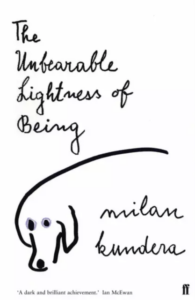 Milan Kundera’s The Unbearable Lightness of Being intertwines politics and personal decisions during Czechoslovakia’s Prague Spring and the subsequent Soviet invasion.
The author shows how an oppressive regime controls both public space and private life, shaping every relationship through fear.
The bond between Tomáš and Tereza is neither ideal nor stable. It is full of tension, infidelity, and doubt, but also of an emotional dependence that is difficult to break.
The novel’s interest lies not in whether love triumphs, but in how it is transformed under historical pressure.
A Thousand Splendid Suns by Khaled Hosseini
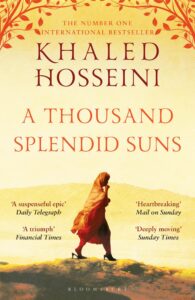 A Thousand Splendid Suns spans several decades of Afghanistan’s recent history, through invasions, civil war, and the Taliban regime.
Khaled Hosseini focuses on how these conflicts affect everyday life, especially that of women, upon whom violence is inflicted through forced marriages and extreme restrictions.
At the heart of the book is the relationship between Mariam and Laila. This is not a traditional romance, but a form of love built on solidarity and survival.
They aren’t a couple; their love goes beyond all that, proving that all forms of love and support can lift us up and sustain us.
It is a harsh story, yet also profoundly human, where love carries real weight and tangible consequences.
Exit West by Mohsin Hamid
Mohsin Hamid sets the story of Exit West in an unnamed city gradually sinking into violence. War appears progressively, until threat becomes routine.
The fantastical element of doors that allow people to migrate to other countries makes the drama more universal, where anyone can become a refugee.
The relationship between Saeed and Nadia evolves as they cross borders and lose their points of reference. The novel shows how love can change without anyone being at fault, eroded by trauma and by the need to adapt to new realities.
Suite Française by Irène Némirovsky
Suite Française by Irène Némirovsky portrays various characters confronted with the German advance during the Nazi occupation of France. Némirovsky examines how war alters social hierarchies, behaviors, and loyalties, setting aside heroes to focus instead on fear and opportunism.
The stories are permeated by this moral ambiguity. Relationships between occupiers and occupied, desires that clash with guilt, affections that arise where they should not, as conflict tests both ethics and intimacy.
Half of a Yellow Sun by Chimamanda Ngozi Adichie
This is a novel set during the Biafran War, a conflict rarely explored in Western fiction. Political history and private lives intertwine in Half of a Yellow Sun by Chimamanda Ngozi Adichie, showing how war reshapes personal relationships.
Both romantic and non-romantic bonds are crossed by the conflict and forced to reorder their priorities.
Half of a Yellow Sun presents love as another site of tension, where betrayal, exhaustion, and difficult decisions also take place.
Never Let Me Go by Kazuo Ishiguro
 Set in an alternative England, Never Let Me Go gradually reveals a system that uses certain individuals as organ donors.
The lives of Kathy, Tommy, and Ruth unfold within this oppressive framework. Kazuo Ishiguro shows how even when the future is sealed, people continue to love, make mistakes, and hope.
It is a dystopia built on normality and on the acceptance of a fate from which there is no escape.
The English Patient by Michael Ondaatje
The English Patient brings together several characters in an Italian villa destroyed at the end of the Second World War. The conflict appears as a force that has disordered identities and erased borders.
Far from idealization, the love that runs through the story is intense and marked by obsession and guilt.
In The English Patient, there is no heroic love; it can be as devastating as war, leaving scars that are not always visible.