

£23 billion of food goes to landfill in the UK every year, and this presents massive environmental problems. Plus, at a time when many people are struggling to make ends meet, that waste of money is not insignificant, either.
70% of that waste is said to come from households, but food and hospitality industries, manufacturers, and the retail industry hold responsibility, too. A UK government report from 2022 that looked into the issue explains,
“Food waste contributes to climate change and environmental degradation in two ways; through release of gases (such as methane) from its breakdown in landfill and through waste of the energy and resources required to produce wasted food. Reducing food waste would mean fewer greenhouse gas emissions.
“WRAP estimated that the greenhouse gas emissions associated with wasted food and drink in the UK accounted for approximately 18 million tonnes of CO2 equivalent in 2021 and 22. The foods that led to the highest greenhouse gas emissions from households were meat and fish, followed by whole meals, fresh vegetables and salads, and dairy and eggs.”
But there’s an app, called Too Good To Go, that has been seeking to reduce food waste – and save us cash – and, I would argue, has made a pretty decent dent in at least some of this issue.
Too Good To Go describes itself as “the world’s largest marketplace for surplus food. We help users rescue good food from going to waste, offering great value for money at local stores, cafes and restaurants.”
The app is available in 21 countries in Europe and North America, and Too Good To Go claims to have saved over “500+ million meals from being wasted, the equivalent of 1.3M tonnes of CO2e avoided”.
Basically, consumers can pay a token amount of money and buy a Too Good To Go “bag”. They turn up at a café or shop or restaurant at the end of the day and get a bag of whatever they have left.
Scrolling back through my own Too Good To Go order history, I can see I have placed over 30 orders over the last four years, so I feel reasonably well positioned to talk about what works brilliantly – and maybe less brilliantly – in terms of the consumer side of this pretty ingenious app.
What works well about Too Good To Go
It saves you money
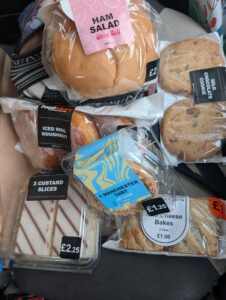
There’s no two ways about it – paying £3.50 for a bag of endless sandwiches, cakes and pies is a bargain.
You don’t know what you’ll get
If you ever get into a rut with food, there can be something quite freeing about your next meal being entirely at the mercy of a random food establishment in your city.
Are we having soup or are we having a big cheese pie? We’ll find out when we pick it up.
However, the risk of picking up a bag where nothing appeals does mean I limit how much I spend on any given TGTG bag. Spending £3 or £4 does not feel like a difficult amount to lose on a punt, but, for me, anything much higher than that would feel pretty awful if I had a sense of having wasted my money.
Your price limits may well be different, but it’s worth thinking through how much you’d be happy to spend with the (albeit probably very small) chance of picking up a bag of stuff that just doesn’t appeal.
You’ll discover new foodie places
I have bakeries and cafes that I go to now that I only discovered through a Too Good To Go order.
This is especially great with little independent businesses, but it feels great to still be finding new places to eat after many years in the same city.
You’re helping to save the world
That’s only overstating it a little, to be honest. I like to think it’s also helping the cafes, restaurants and shops, too.
What might be a little less brilliant

You don’t know what you’ll get
Eagle-eyed readers will have spotted that this heading also appeared in the “pros” section – and with good reason. However, while the randomness can encourage us to try new things, it might also mean there’s nothing in our bag that tickles our fancy.
Having said that, though, out of my 30+ orders, I can only remember one or two (looking at you, Costa Coffee) that felt disappointing.
Vegetarian and vegan options are very limited
And so are gluten-free foods, or meals for people with any other limited dietary requirements. Some restaurants offer specifically vegetarian bags, and some bags come from restaurants that are already exclusively vegan or veggie, but otherwise, people with limitations on what they can eat might find few options that suit them.
Having said that, as an occasional meat eater, it does strike me that this has to be the most ethical way to consume meat. After all, if I don’t eat it, it will very literally end up in a bin.
Orders are sometimes cancelled at the last minute
The nature of the app is that it is for leftover food, so it stands to reason that sometimes they just don’t have anything left.
Logically, that tracks. But it’s so disappointing to have an order cancelled at the last minute, and did stop me using the app for a while in the early days.
There can sometimes be more food than you know what to do with
I know, that sounds like a good problem to have, right? However, occasionally I end up with so much – and it usually has to be eaten the same day – that I wonder if I’m now just disposing of the waste that the premises I got the bag from would otherwise have disposed of.
Overall, yes, a good problem to have in difficult times. But it’s worth pondering, regardless, whether the food waste disposal has actually been passed onto you.
Images: Philippa Willitts