

The world has become a very fast place to live. I think I was roughly plodding along pretty well with the internet as it was, but the speed of AI has frightened me.
 Not the speed of its widespread adoption – though that is arguably terrifying in itself.
Instead, it’s the fact that if people want to know the answer to a question, they don’t even have to wade through Google results any more. Which was already far quicker than my parents’ “Wait til we go to the library on Saturday” when I had a question they couldn’t answer.
Now, clicking a few links and parsing an article for ourselves is apparently too slow moving, and we need a robot to do that for us.
I can see the appeal, but it scares me that we are outsourcing our very thinking.
Now, I’m not advocating going off grid and communing with moss, though I can definitely see the appeal. I’d be lost without my phone, I google about 1000 things a day, I mostly read on a Kindle, and some of my very favourite people live in WhatsApp and Instagram.
Yet the rush rush rush of this new instancy is making me want to pull back and regather. Reacquaint myself with slowness. Wait for things.
What are zines anyway?
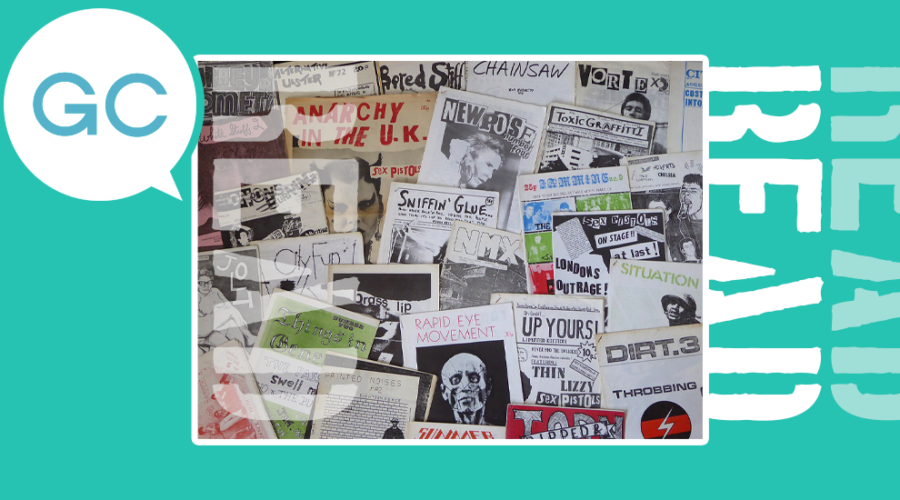
Zines, often called fanzines in the early days, are self-published pamphlets that people print and distribute themselves. Often photocopied in black and white, they are cheap, they are historically put together by hand, and they are sent by post.
I’ve made many zines and I’ve read many zines, and I’m finding myself revisiting them as a medium more and more.
While I love my Kindle because it is easier on my hands than larger books are, holding paper that someone folded and stapled and put in an envelope decorated with stickers and doodles carries a particular magic that Bezos’s devices never could. I chose the Kindle I use because it does nothing other than show me books – I’ve no idea how people read on one that is essentially an all-functioning tablet – and the reduced distraction helps me to focus on actually reading.
But god, I miss paper books. I sometimes indulge regardless, but it’s not always practical, disability wise.
Zines, though, are not bulky, they are not heavy, and they are created with love and thought. Some are very scrappy, others incredibly professional looking. Some are outpourings of emotion, others a deep dive into a niche topic.
And boy do I love a deep dive into a niche topic in particular.
A quick search on Etsy shows me zines about folklore, goth culture, birds, social housing, recipes, religion, cats and queer history. Plus, as they’re often a few dozen pages at most, it’s not a huge commitment like starting a traditionally published tome can be.
Even if you think you’re not interested in Nosferatu or red pandas or autism, you could surely read a few pages on them and learn something.
Why zines?
Zines are mini works of passion, produced slowly in a world that might feel like it’s hurtling at breakneck speed. They are made by people who love creating and want to express themselves, and they are sent in the post, which means something coming through your letterbox that is for once not a final demand from the electricity company.
When you make a zine, you give people a little insight into your world. When you buy or swap a zine, you get a little insight into somebody else’s.
You let them know that somebody does want to peek into that world, that somebody is interested in what they want to say, and that somebody is willing to wait a few weeks to read it. Slowly.
Images: Magpieturtle, 1970s fanzines

.jpg)