

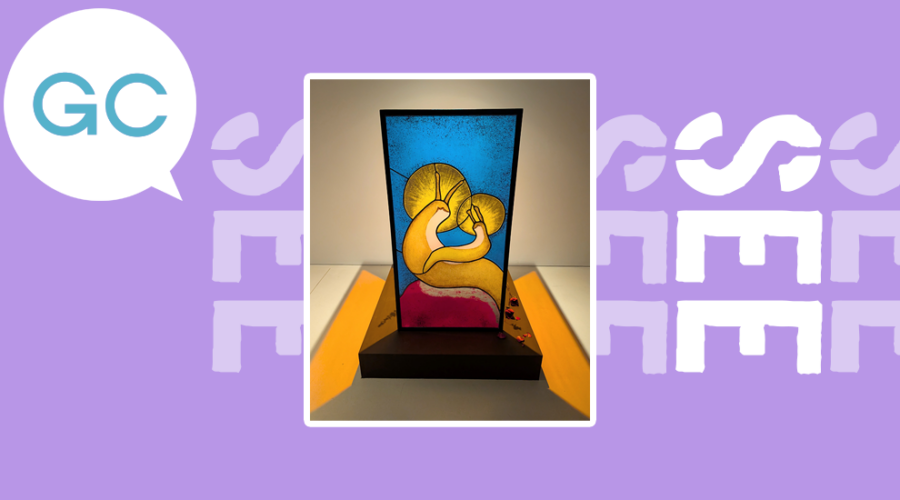
People don’t generally have a very positive association with slugs. They’re slimy in a way that’s considered gross, and people blame them for eating food they plant.
So seeing Slime Mother, a solo exhibition by artist Abi Palmer, at the Site Gallery in Sheffield was quite a revelation. More accurately, a series of revelations.
While Palmer has written, in black on white walls, that slugs are morally neutral, what follows is a series of artworks that celebrate, destigmatise, and present us with an entirely new lens on these gastropods.
Catholic iconography is employed in a way that is genuinely beautiful. The stained glass Madonna and Child, in particular, is remarkable, and the exhibits being presented in a quiet, low-light environment is certainly reminiscent of a church.
 Presenting slugs – and their associated slime – as creatures and substances to be worshipped is, of course, jarring, but Palmer quietly and consistently makes a good argument for doing so,
Or, at the very least, for not hating them.
Because, after all, who said that the ground we plant our cabbages in belongs to us? Who says that food grown in the soil is not theirs to share?
A film starring Megan Dalton as the Holy Mother of Slime (and also, delightfully, with “so many slugs” as co-stars in the end credits) shows slugs and their slime in a way that is astonishing.
Their slow movements, their shape shifting, and their soft wetness are displayed as utterly beautiful, and I started to learn just how strong that slime is, holding them up in the air rather than being simply the lubrication I had imagined it to be. (I went on to spend at least three hours reading about slug slime that evening as a result.)
A large display in the centre of the room was, for me, surprisingly emotionally confronting. Above boards where visitors could add their own clay marks were the words “Have no shame for the marks of your wetness”.
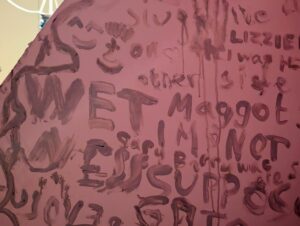 The juxtaposition of a statement challenging shame against such Catholic iconography – a religion often deeply associated with shame – felt jarring. But this thought-provoking discomfort was no bad thing.
Joining in by adding my own marks of wet clay was satisfying, and I enjoyed the very living nature of an exhibit that changes, according to what gallery visitors contribute, by the hour.
Then, as if Palmer had not done enough challenging of my assumptions about slugs by presenting them as at once neutral, to be worshipped, and beautiful, we entered the slug disco, where they become erotic creatures.
Two entwined leopard slugs above a glittering disco ball represent the frankly bonkers way leopard slugs reproduce, and the spinning lights made the room unsettling and disorienting.
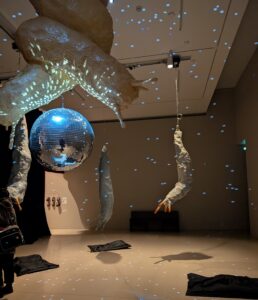
Putting on the headphones provided and immediately hearing Serge Gainsbourg and Jane Birkin making erotic noises did nothing to reduce how strange and disconcerting this section of Slime Mother was.
But, once again, I enjoyed how challenging this felt.
Slime Mother is all about questioning our biases about slugs. But, in creating it, Abi Palmer succeeds in making us question other aspects of shame and judgement as well.
In being asked to celebrate these reviled creatures, we are also challenged to recognise the glory in marginalised bodies.
In the exhibition’s advocacy for looking at the world from a different angle, we are encouraged to look for beauty in the things deemed revolting and disgusting.
And in witnessing the celebration of sex that is slimy and subversive and surprising, we are gently being asked to celebrate ourselves, our bodies, and the world around us in a similarly slimy, subversive and surprising way.
Images: Philippa Willitts