

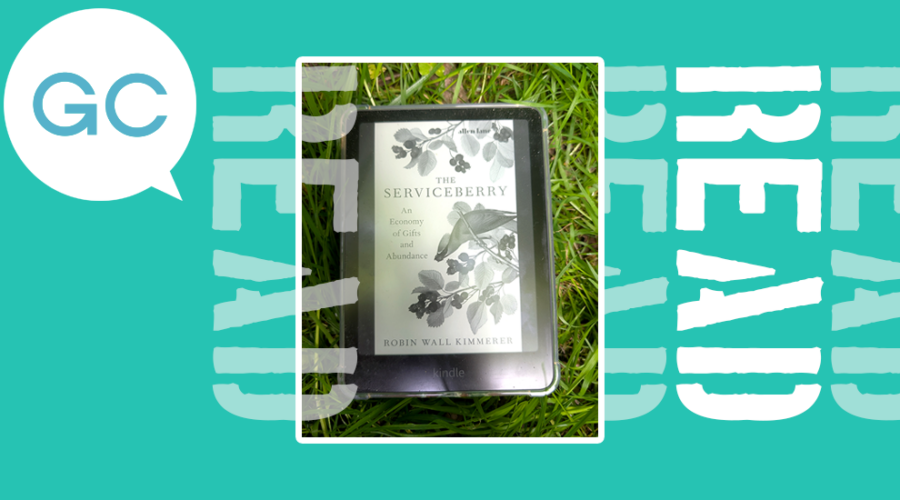
The Serviceberry: An Economy of Gifts and Abundance by botanist Robin Wall Kimmerer is a passionate and beautifully written call, not so much to action, but to a shift in the ways we interact with each other and the world around us.
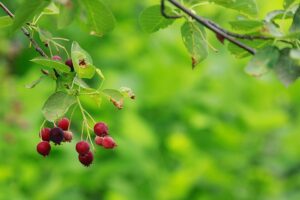
Using the shadbush – the berry she knows as the serviceberry – as an example, Kimmerer shows us a different way to go about our lives and participate in our communities.
 With a focus on reciprocity rather than scarcity, and by presenting the world around us as abundant – as long as we take the time to understand it and treat it with respect – Kimmerer presents us with an approach that is not intimidating, despite its boldness.
In The Serviceberry, Robin Wall Kimmerer tackles not only issues central to the climate crisis but also addresses the scourge of individualism and the widespread isolation that many people feel.
The Serviceberry is a short text, but every word in it matters.
We are abusing the world we live in, and this will only be to our detriment. Kimmerer presents alternative ways of living that could (and, in fact, already do) run alongside the dominant, extractive models of economics. These are modelled on the ways the natural world survives and thrives itself.
This is an empowering idea. Kimmerer makes absolutely clear that we do not live alongside the natural world – we rely on it, and we are part of it. It is arrogant to assume dominance over nature – when we look at it to learn, to show it respect and gratitude, our relationship with it changes. And so can our relationships with our communities.
Many books about nature and climate are all about disaster. And it is not inaccurate to state that we are facing unprecedented climate crises.
However, while The Serviceberry does not sugarcoat that, this is also a work of profound optimism.
Kimmerer, rather than just teaching us to live alongside and not abuse the natural world around us, shows us how we can model ourselves and our behaviour on that very natural world. And how we will all benefit if we do so.
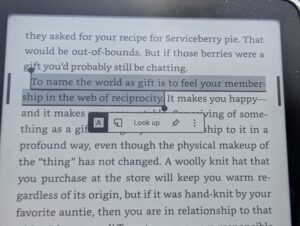 I don’t think I’ve ever highlighted as many passengers in one book as I did with this one. Every paragraph felt vital, every idea felt revolutionary.
Yet, in many ways, they are neither – they should be common sense.
One of the things I found encouraging about this book was that the world she is describing, and the actions she is advocating for, are things I, like many, have already been trying to incorporate into my life. Kimmerer, in this book, has provided me with some of the language for these values and concepts that I did not have before.
The Serviceberry gave me words and names for the principles that have already been a core aspect of my values system for years. Every time I did guerrilla seed planting or left menstrual products in a public toilet or gave books to a Free Little Library, when I left a vase of flowers in a communal spot and put a bird feeder in a shared space, it was part of a gift economy. I just didn’t know that that was what that was called.
Even better, the book helped me to understand precisely how actions like these don’t just mean we help each other in a practical way, they also change the ways we exist as interconnected communities.
One year, I grew too many tomatoes. I went round to all of my neighbours and gave them each a bowl of fresh tomatoes. This was primarily for my own benefit, really.
A few days later, one of those neighbours knocked on my door with a bowl of Turkish food she had made.
We connected over a gift that benefited us both. And we continued to connect from then on, despite not speaking the same language.
I have told so many people to read The Serviceberry, including a stranger in a café, because it feels so essential for anyone who is despairing at the state of the world or simply wants a better model of living than the one we are currently working with.
We may not be able to overthrow capitalism tomorrow. But there’s no reason we can’t create our own reciprocal economies that are more respectful to people and the natural world – even while the capitalists continue capitalising.
Images: Melissa McMasters and Philippa Willitts
.jpg)