

I was a very girly-girl when I was small. I grew up on fairy tales, usually read to me by my dad, and imagined myself as every princess I heard about.
I adored those stories, and it was only as an adult that I saw just how dark and disturbing many of them are. These stories we tell children are full of messy tropes about gender roles, constant assumptions that girls’ only dream of marrying a prince, and more explicitly fucked-up messaging about consent, parenting, and love.
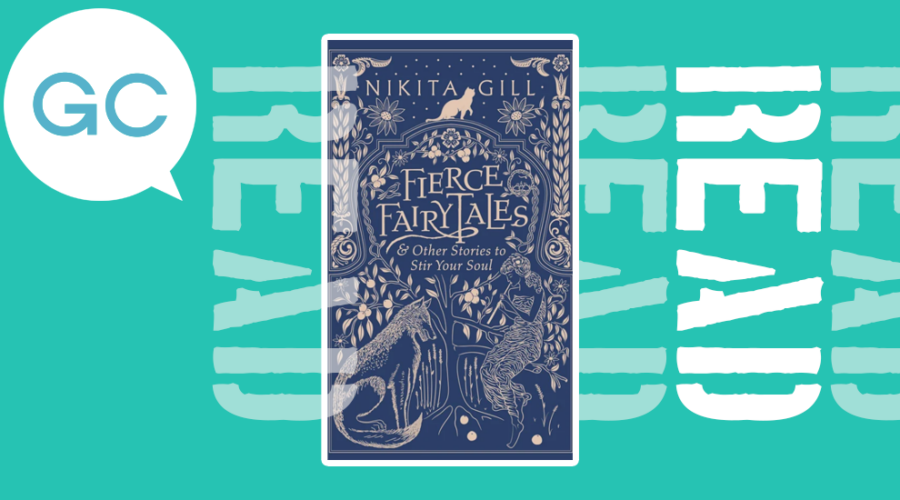
As a result, I’m really fascinated by fairy tales and folk tales – whether traditional or modern – and was keen to read Fierce Fairytales: & Other Stories to Stir Your Soul by poet Nikita Gill.
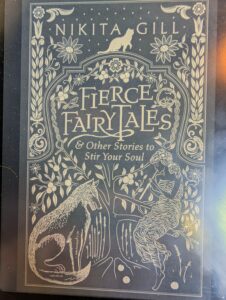
Fierce Fairytales is a feminist re-imagining of traditional folklore, blending poetry, stories, and minimalist line art to dismantle centuries of passive damsel tropes and make us rethink those we have always thought of as villains.
Gender and heteronormativity
 Traditional fairy tales have probably always functioned as cultural scripts, enforcing restrictive gender roles and heteronormative expectations.
As a girl who turned out to be gay, this was more than a little confusing.
Folklore, typically, conditions us to view women and girls as either helpless, submissive maidens awaiting salvation (in the form of a husband, obv), or as wicked, jealous hags.
Simultaneously, they position heterosexual romance as the sole metric for a woman’s fulfilment and the only possible “happily ever after”.
Men are rewarded with kingdoms. Women are rewarded with men.
Nikita Gill subverts this harmful framing beautifully. She decouples a woman’s worth from male validation and marriage, giving us unexpected motivations, surprising goals, and stories that veer meaningfully from the tales my dad read to me before prayers at bedtime.
Her stories challenge the idea that women’s power is villainous or that women’s survival requires male rescue. Incorporating queer romance, self-love, and deep platonic solidarity, Fierce Fairytales dismantles the rigid heterosexual assumptions of classic lore, offering a far more inclusive vision of human connection.
I mean, what if Sleeping Beauty could rescue herself? Read the book and you’ll find out.
Girls in Gill’s stories are stripped of their reliance on being rescued. Instead, we get stories centred on inner strength and boundary-setting, toxic relationships, vulnerability, and self-worth.
Humanising the villain
One of the most remarkable aspects of Nikita Gill’s Fierce Fairytales is the way she tells familiar stories from an unfamiliar angle.
What if the woman in the gingerbread house was not the evil witch we all know and fear in Hansel and Gretel? What if the numerous wicked stepmothers were not actually trying to destroy their stepdaughters?
Beyond reclaiming the heroines, the thing this book does beautifully is shift how we perceive villains. Nikita Gill replaces one-dimensional evil with complex stories of survival and abuse and alters our perception of the characters that, as children, we saw as bad or good.
Refusing to settle for an easy plot device, Gill shows us “baddies” who are, in reality, complex figures whose cruelty or isolation stems from trauma, injustice, or self-defence.
I had never really considered that we don’t get to hear the internal voice of these antagonists, but in Fierce Fairytales, Gill forces us to question who gets to write stories and who decides who is a villain.
In life, we know that monstrosity does not occur in isolation. Societies, families and communities can all play a part in creating monsters – so why would that not also be the case in folk tales?
This book provides, therefore, a long-overdue reframe in which villainy can be a result of misunderstanding, failure to hear, or self-protective armour.
Cross-generational appeal
 Fierce Fairytales is primarily marketed toward young adults and adult readers, with themes of trauma, healing, and self-discovery.
However, its emotional resonance extends far beyond a single demographic. Teenagers navigating identity and social pressure will find its messages of self-acceptance empowering, while adult readers who grew up internalising classic fairy-tale tropes may, like me, experience the book as a process of unlearning.
When we read a story we’ve heard 1000 times from the perspective of somebody whose voice we are normally only told about by others, it does not only shift our perception of Hansel’s father, or Cinderella’s mother. It makes us question who else we do not usually hear from, and ask ourselves what they might have to say if they could be heard.
Gill grants agency to archetypes traditionally written off as malicious.
Instead, we hear of wild, unapologetic survival, and trauma and self-preservation. We may even end up rooting for somebody who was a monster in our childhood nightmares.
Strengths and style
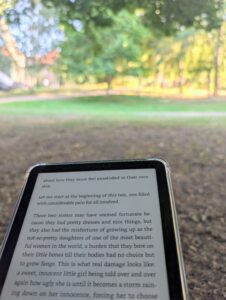 Fierce Fairytales is evocative and delivers an emotional impact. Gill’s background in poetry translates into remarkably apposite phrasing that resonates, and the book’s visual presentation is beautiful.
There are times when it feels like Gill is slamming the point home a little too hard, but then I remember that, for teenagers, this sometimes needs to be the case in what they read.
The benefits I gained from reading this book more than made up for the odd slightly heavy-handed delivery of messages that are, after all, so important for young people to hear.
Overall, Fierce Fairytales is vibrant and accessible anthology, turning outdated, disempowering, and oppressive tropes into tales of hope and self-reliance.
It does not shy away from feminism and politics, and uses thoughtful intersectional themes to tell stories that speak in new and revolutionary ways.
I would recommend it to anybody who is interested in mythology and folklore with elements that will challenge your expectations on every page.
Images: Philippa Willitts