


Intriguingly Backrooms, directed by 20-year-old Kane Parsons adapting his original liminal space web series into his debut feature for A24, shares the DNA with the unlikeliest of sources. The endless corridors, infernal and mundane stretch and weave through our cinematic subconscious, The Shining, Brazil, Twin Peaks, Being John Malcovich, Us, Severance, the recent Exit 8 are familiar touchstones, as is Mark Z. Danielewski’s novel House of Leaves. But Alan Clarke’s experimental short film Elephant? Not so much.
1990. Divorced alcoholic Clark is a seething mass of resentment living and working in a fading furniture store. A failed architect, Clark’s antipathy towards his ex-wife spews forth during his therapy sessions with Dr. Mary Kline, who uses role play as a path to Clark’s ever-diminishing chance of catharsis.
Mary has her own trauma, the fractured memories of her schizophrenic mother and the demolition of her childhood home to make way for the modernism of Crest Ridge Towers.
Clark’s world expands exponentially when he discovers the labyrinth Backrooms of the title, hidden Narnia-like behind a wall in the furniture store. The corridors are mostly monotonous corporate yellow, Alice in Wonderland rendered dull and humdrum by suspended ceilings and fluorescent tubes radiating incessant ambient sound.
Here, Backrooms – like the wider creepypasta horror genre that spawned it – leans into the late Mark Fisher’s 2016 book The Weird and the Eerie. The Backrooms are simultaneously achingly familiar and jarringly off kilter in their construction – much like our understanding of the Trumpian decade when viewed through post-truth politics and the rapid colonisation of social media by the baron robbers of the billionaire class.
Fisher argues that the weird and the eerie are triggered in two distinct ways, through the failure of absence when something is present when there should be nothing, and through the failure of presence, when nothing is present where there should be something.
Think of the Trump Administration’s doublespeak over their Iranian catastrophe.
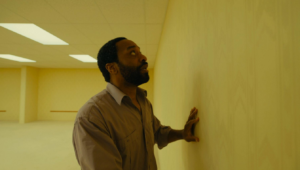
Parson’s assured direction within the huge practical sets, coupled with his monstrous sound design created in tandem with Edo Van Breeman, transports us concurrently between the terror of Fisher’s two distinct aesthetic modes of failure, a netherworld of empty spaces sometimes littered with discarded clothes, sunken furniture, and lurking creatures.
The liminal spaces of Backrooms represent the transition of relationships between people and architecture during and post COVID-19 pandemic and the psychological transition of Clark from married man and budding architect to accepting his lot in life as a divorcee and manager of a second-rate furniture store that fails even to furnish the dreary interiors of The Backrooms.
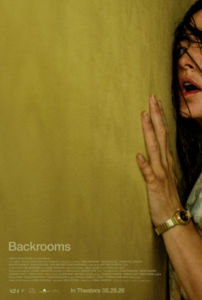 Occasionally we are privy to Mary’s self-help cassettes, The Window Within, which echo and haunt the soundtrack, flowing through corridors or Clark’s subconscious. Here The Backrooms are a metaphor for the rabbit hole, the self-induced purgatory of social media that Clark and others descend voluntarily into seeking answers in all the wrong places, encountering the language of trauma we don’t fully understand but blindly use to justify our own faults and failings.
The Backrooms serve as echo chambers of dissent, greedily consuming our integrity and dignity one dead end at a time.
No matter how far we descend into The Backrooms of the internet, the only truth we will discover is that truth is dead online, the promise of the “town square” coined by Bill Gates in the 1990s and adopted by Twitter has been usurped by the minotaur of extremism butchering the young sacrifices in their droves.
Eventually the minotaur was slain with the help of a thread so Theseus could navigate the labyrinth. Today’s thread of hope could yet unspool through the corridors of The Backrooms as tech giants Meta and Google face their big tobacco moment as lawsuits over child safety, addictive platform design, and misleading information start to bite and nations like Australia, France, and the UK rethink their social media strategy for under 16s.
Which brings this review back to Alan Clarke’s Elephant. Clarke’s film about sectarian killings in Northern Ireland filmed at the height of The Troubles exorcises all traditional elements of narrative cinema. No dialogue, plot, character development or music. Just 18 relentless sequences of murder captured in unnerving Steadicam tracking shots against the backdrop of factories, car parks, service stations, and residential homes.
The title Elephant refers to Bernard MacLaverty’s description of The Troubles as “the elephant in our living room” a reference to the collective denial of the underlying social problems of Northern Ireland. The final murder takes place in a gargantuan warehouse empty of everything accept two men forever walking under the cigarette yellow walls and lights of the liminal space, with only their footsteps as company.
Clarke’s sequence is excruciating in its length and patience until the two men, completely in lockstep encounter a third man alone and strange in the space. One of the men calmly face the wall, resigned to his fate, when the third man steps forward and executes him. The camera lingers on the wall as we are forced to look at his blood and brains for an eternity.
The promise of the “town square” has been usurped by the minotaur of extremism butchering the young sacrifices in their droves
The liminal space in the warehouse of Elephant like in The Backrooms could fit countless elephants, countless polemics. But the absence of elephants, the absence of critical thought makes these spaces absurd and mechanical, the epidemic of The Troubles in 1989 and the present-day social media pandemic both devoid of solutions from the government structures supposed to keep us safe from harm.
But what if Elephant and Backrooms shared the same liminal space? Were in dialogue with one another? That grim warehouse from 1989 a conduit to the bleak Backrooms of Clark’s furniture store? What if Alan Clarke, that bold visionary who died at the age of 54 in 1990 was trying to communicate with wunderkind Kane Parsons in 2026? Or what if Kane Parsons was knocking back through time on that warehouse wall to learn from Clarke?
Backrooms may collapse under the weight of its third act but that doesn’t really matter when the first two acts are so self-assured.
What really matters is, what if Gen Z were in communication and lockstep with the Baby Boomers rather than being divided by the algorithms present in The Backrooms?
Maybe we would find our way back, find cooperation, find a solution, share the thread, and slay the minotaur once and for all.