

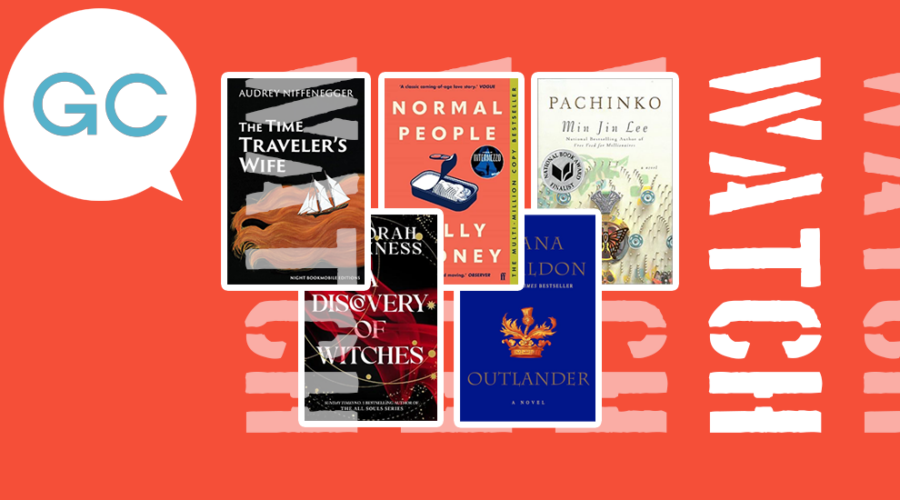
The boom in TV series that are based on romantic novels has not happened by accident. Readers have spent years longing for adaptations that honor the emotional pulse of the stories and don’t reduce relationships to pointless scenes.
Television, with its ability to explore slower rhythms and more detailed characters, offers the ideal space for these narratives to breathe.
The following list brings together titles that made that transition with confidence. These works treat romance not as a decorative element but as the axis that organizes the plot and sustains entire seasons without losing coherence.
Each one proves that an audiovisual adaptation is an opportunity to broaden the conversation and bring the story to new audiences.
Outlander, Diana Gabaldon
All of us who’ve read Outlander (a ten-book series) are devoted fans of Claire and Jamie Fraser’s relationship. Diana Gabaldon builds this epic love through the cultural and emotional clash that unfolds when Claire, a 20th-century woman, is forced to survive in 18th-century Scotland.
That collision of contexts allows the romance to move forward with constant tension and a political backdrop that shapes the characters’ decisions and the credibility of the bond they build.
That literary foundation made the transition to television feel natural. The Star+ series picks up the essential components of the book — anchored in Claire and Jamie’s relationship, the weight of the historical environment, and the way time travel affects their emotional dynamics.
Pachinko, Min Jin Lee
The novel Pachinko follows Sunja and several generations of her family, with a romantic thread shaped by decisions that determine entire destinies. Min Jin Lee presents these relationships with a clarity that helps us understand how love, responsibility, and individual consequences intertwine with the historical context experienced by the Korean community in Japan.
The Apple TV+ series embraces that intergenerational structure, organizing the different timelines more compactly but without losing the essence of the emotional development among Sunja, Hansu, and Isak — and how those decisions echo through the generations that follow.
Normal People, Sally Rooney
No one can read about Marianne Sheridan and Connell Waldron’s relationship and remain indifferent. It’s that heartbreaking.
Sally Rooney offers a clear portrait of two young people trying to define who they are while grappling with an attraction that never fades and, at times, demands more than they’re ready to give. Each page of Normal People shows how class differences, personal insecurity, and emotional dependence shape every stage of their bond.
That intimate, character-driven structure made the leap to the screen more than fitting. The series preserves the emotional dynamic of the book and translates it with a rhythm faithful to the way Rooney explores both closeness and distance between Marianne and Connell.
The Time Traveler’s Wife, Audrey Niffenegger
Anyone who loves time-travel stories sighs over this relationship written by Audrey Niffenegger. The Time Traveler’s Wife presents the bond between Clare and Henry, shaped by a genetic disorder that causes his involuntary time jumps. That condition disrupts daily life and defines how they build their relationship, with encounters that take place at different ages and force constant negotiation of identity and expectations.
This narrative foundation made the HBO Max adaptation easier, as it offers material where romantic tension coexists with a clear temporal barrier. The series picks up the book’s nonlinear chronology and turns it into episodes that respect the emotional evolution of the protagonists, showing how their younger and older versions influence the dynamics of the relationship.
A Discovery of Witches, Deborah Harkness
You really can’t ask for more from author Deborah Harkness here: romance, supernatural characters, magic, time travel, and immortality.
A Discovery of Witches follows the relationship between Diana Bishop, a historian trying to stay away from magic, and Matthew Clairmont, a vampire geneticist whose life intersects with hers after the discovery of a manuscript that stirs conflict among various supernatural communities.
The TV series embraces this mix and brings it into a format that takes advantage of the visual richness of Harkness’s world. The adaptation preserves the tension between Diana and Matthew, as well as the significance of the manuscript’s search in their lives, and arranges the fantasy elements in a way that’s accessible to viewers.