


We’ve encountered Hollywood’s Motion Picture Production Code in previous articles, not least when considering the increasingly overt sexuality of Cleopatra (1963), made towards the end of its life.
For more than three decades, the Code governed what could and couldn’t be shown on screen. Introduced in 1930 and rigorously enforced from 1934, it prohibited or restricted everything from explicit sexual content and excessive violence to the sympathetic portrayal of criminals. Adultery couldn’t be presented as an amusing adventure, sexual relationships outside marriage were subject to strict limitations, and even a glimpse of a woman’s body could provoke objections.
But by the 1950s, the rules were beginning to buckle. Filmmakers were finding increasingly ingenious ways to work around the restrictions, while others were challenging its authority more directly.
The three films I watched this month demonstrate rather different approaches to the problem, and help explain how a system that had governed Hollywood for so long eventually became impossible to sustain.
The Seven Year Itch (1955)
Billy Wilder’s The Seven Year Itch is perhaps best remembered for one image: Marilyn Monroe standing over a subway grate as the air blows her white dress upwards.
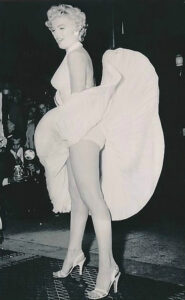 It’s an image that has become so familiar that it’s easy to forget just how much controversy surrounded it at the time.
The Seven Year Itch follows Richard Sherman (Tom Ewell), a married New Yorker whose wife and son leave the city for the summer. When an attractive young woman (Monroe), known simply as the Girl, moves into the apartment above him, Richard begins entertaining elaborate fantasies of infidelity.
He flirts, fantasises and imagines himself as a much more successful seducer than he is in reality.
The premise was already a problem for the censors. The original Broadway play by George Axelrod included an actual affair, but the Production Code Administration had declared that adultery could never be treated as a subject for comedy or laughter.
The film therefore had to replace the affair with a succession of fantasies and near-misses, allowing Richard’s desires to flourish without his ever quite acting on them. The finished film was still required to undergo cuts, including the removal of one of the three shots of Monroe’s skirt blowing upwards. The American Film Institute’s records document the negotiations and the subsequent controversy.
What makes the film interesting today is the gap between its restrictions and its intentions. There’s plenty of sexual innuendo: the Girl appears apparently naked behind the plants on her balcony; she keeps her underwear in the ice box; and Richard furtively examines a provocative photograph of her before pretending he hasn’t seen it. The famous skirt scene is simply the most iconic example of a film built around the promise of seeing something that mustn’t quite be seen.
In that respect, it reminded me of the British Carry On films, which similarly found comedy in sexual suggestion, embarrassment and the gap between respectable appearances and less respectable thoughts. The Code may have shaped the film’s particular style of sauciness, but the underlying humour is familiar enough.
I also found the film rather thinner than its reputation might suggest. Much of the comedy rests on the assumption that male sexual desire is an amusing, universal predicament, while the women who inspire it exist largely as objects of fantasy. The Girl has little interior life beyond her cheerful innocence and sexual attractiveness. Richard’s eventual return to his family restores domestic order, but doesn’t require much reflection on his behaviour.
His wife, Helen, is particularly revealing in this respect. Throughout the film, Richard imagines conversations with her in which she is invariably kind, understanding and gently teasing. On the surface, this presents an appealing ideal of marriage: a relationship secure enough to accommodate human weaknesses without jealousy or recrimination. But there’s something rather less appealing beneath the surface. Helen is allowed to be understanding of Richard’s desires, but never to have feelings of her own that might inconvenience him. She can tease him, but never genuinely challenge him; she can acknowledge his attraction to other women without making him uncomfortable about it.
Of course, these conversations take place entirely in Richard’s imagination. He is effectively writing both sides of the dialogue, giving Helen precisely the responses he needs. If she were a real person, she might reasonably find his obsessive fantasies about another woman hurtful. Yet the overall effect is a feeling that the film’s ideal wife is one who accommodates her husband’s sexual appetite without demanding that he confront its implications.
Richard’s fantasy of marital understanding is also a fantasy of freedom from consequences. He wants the security of marriage and the excitement of sexual novelty, but he doesn’t want to experience the conflict between them. Ironically, the Production Code’s restrictions help preserve this arrangement: because the adultery never takes place, the marriage is never seriously tested, and Helen never gets the opportunity to respond to a genuine betrayal.
The film is historically significant, but I wouldn’t call it especially radical. Its sexual provocation is largely contained within conventional assumptions about marriage and masculinity. Indeed, its treatment of adultery is precisely what the censors wanted: desire may be entertaining, provided it isn’t acted upon. The apparent celebration of marital understanding conceals a rather one-sided arrangement in which the husband gets to be complicated, while the wife must be endlessly accommodating.
Perhaps that’s the central irony. The Code could regulate what appeared on screen, but it couldn’t eliminate the audience’s enjoyment of the very material it sought to suppress. And in preserving the appearance of moral respectability, it also helped preserve some decidedly unequal ideas about relationships.
Some Like It Hot (1959)
Four years later, Wilder produced a comedy that I found considerably more accomplished – and arguably more subversive. Some Like It Hot follows two struggling musicians, Joe (Tony Curtis) and Jerry (Jack Lemmon), who witness a gangland massacre and escape by disguising themselves as women. They join an all-female band travelling to Florida, where Joe falls for the band’s singer, Sugar Kane (Monroe), while Jerry finds himself being courted by a wealthy older man.
The premise gives Wilder an almost inexhaustible supply of comic possibilities. The writing is wonderfully economical, full of double meanings, reversals and escalating complications. But beneath the farce is a more interesting exploration of gender, sexuality and social convention than The Seven Year Itch ever attempts.
Joe and Jerry’s disguises force them to negotiate the expectations placed on women. They discover how much effort goes into their appearance, how differently men treat them, and how difficult it can be to navigate unwanted attention. At one point, they reflect on how hard it is to be a woman when men are constantly harassing you. The observation is played for laughs, but it also suggests that inhabiting another social role can reveal something about the experience of others.
The film doesn’t turn this into a manifesto. The men’s experience is temporary, and they can ultimately return to their previous lives. Nevertheless, the comedy depends on more than the audience recognising two men beneath their disguises: it also exposes the absurdity of some of the conventions surrounding masculinity and femininity.
Monroe’s Sugar is another important difference. Unlike The Girl in The Seven Year Itch, she has a history, ambitions and a recognisable emotional life. She dreams of finding a wealthy man who won’t cheat on her, having repeatedly fallen for musicians who treat her badly. She has even reinvented herself, changing her surname from Kowalczyk to Kane in pursuit of a more glamorous life. When Joe presents himself as a wealthy heir, Sugar improvises a suitably aristocratic background of her own.
Her story is partly a comic performance, but it also reflects her desire for security and a different future. Monroe gives Sugar a warmth and vulnerability that make her much more than just an object of male desire.
The film’s other great strength is the friendship between Joe and Jerry. They irritate one another, criticise each other’s decisions and frequently find themselves in ridiculous situations, but their loyalty is never seriously in doubt. They don’t have to approve of each other’s behaviour to support each other. Their affection is expressed through their actions, giving the farce an unexpectedly touching emotional centre.
It’s hardly surprising that the film proved troublesome for the censors. Its cross-dressing, sexual ambiguity and suggestive humour challenged conventions that the Code was designed to uphold. United Artists released it without the Production Code seal, a significant indication of the system’s weakening authority.
Unlike The Seven Year Itch, this film doesn’t merely exploit forbidden subjects for titillation. It uses them to generate comedy that questions the conventions themselves.
Its famous final line, “Nobody’s perfect!”, is a fitting conclusion to a film in which appearances, identities and romantic expectations have all proved considerably more flexible than anyone anticipated.
Psycho (1960)
If Wilder used comedy to work around the Code, Alfred Hitchcock used suspense and horror to push at its boundaries. Psycho begins with Marion Crane (Janet Leigh), a woman who steals money from her employer and flees Phoenix in the hope of building a future with her boyfriend.
She checks into the remote Bates Motel, where she meets its shy, apparently harmless proprietor, Norman Bates (Anthony Perkins).
The film’s most famous sequence is, of course, the shower murder. In roughly 45 seconds of rapid editing, Hitchcock constructs an attack that seems brutally explicit while showing remarkably little. We see the knife, Marion’s face, the shower curtain, water running over her body and blood swirling towards the drain, but never an unequivocal image of the knife penetrating her flesh. The violence is assembled from fragments, with editing and sound doing much of the work.
The Production Code Administration objected to the sequence, along with the opening bedroom scene, Norman’s voyeurism and the suggestion of an incestuous relationship with his mother. Hitchcock negotiated various changes, including the removal of a shot that might have shown Marion’s bare buttocks, while retaining other material that had previously been considered unacceptable. The AFI’s account of the film’s censorship history illustrates just how contentious the finished film was.
The shower scene is a remarkable example of constraints becoming a source of creativity. Hitchcock couldn’t simply show what he wanted, so he developed a visual language that made the audience imagine more than it actually saw. The result is one of cinema’s most disturbing sequences.
But the film’s transgression goes beyond violence and nudity. When Norman watches Marion undress through a spyhole, the camera places us in his position. We know his behaviour is invasive, yet Hitchcock makes us participants in his voyeurism. The scene is uncomfortable not simply because of what Norman does, but because the film encourages us to look alongside him.
Norman himself is fascinating. He’s shy and approachable rather than conspicuously sinister, and Marion has no reason to suspect the danger she is in. Perkins’s performance makes the character’s apparent harmlessness and hidden violence difficult to reconcile, although I found the film’s eventual capture scene rather overplayed. The final shot, by contrast, is chillingly restrained.
I was less convinced by the psychiatrist’s closing explanation, which reduces Norman’s behaviour to a rather pat psychological account. Its portrayal of mental illness is dated, and its association of cross-dressing with monstrosity reflects assumptions that have not aged well. The film is much more unsettling when it allows us to observe Norman than when it explains him.
That tension is revealing. Hitchcock’s images, editing and sound create ambiguity and unease; the final speech take the opposite approach of trying to make the horror comprehensible.
It’s a shame, because for me the film’s greatest achievement lies in the former, and the attempt at explaining everything neatly feels both unnecessary and slightly patronising.
A code that could no longer contain cinema
Each of this month’s films demonstrate different ways of pushing against the same restrictions. The Seven Year Itch uses sexual innuendo to make desire permissible as long as it remains imaginary. Some Like It Hot turns gender ambiguity and sexual convention into the engine of a sophisticated comedy. Psycho uses visual suggestion and psychological horror to make the audience experience what the Code sought to keep off screen.
None of them, by itself, brought down the Production Code. Its decline had many causes, including changing social attitudes, the growing importance of television, competition from foreign cinema and the emergence of alternative distribution arrangements. But these films illustrate why the system was becoming increasingly difficult to sustain.
The Code was built on the assumption that controlling what appeared on screen could control what audiences experienced. Yet Wilder and Hitchcock demonstrated, in very different ways, that the imagination could not be regulated so easily. A glimpse of a woman’s skirt in the wind could be more provocative than nudity; a man in a dress could expose the instability of gender conventions; a murder assembled from fragments could be more disturbing than explicit violence.
The paradox is that censorship sometimes encouraged filmmakers to become more inventive. But it also exposed the limitations of a system that tried to police images without being able to control their meaning.
By the time the Production Code was replaced by the film-rating system in 1968, the question was no longer simply what Hollywood was permitted to show. It was whether any single set of rules could adequately define what audiences were allowed to see – or what they might make of it.