

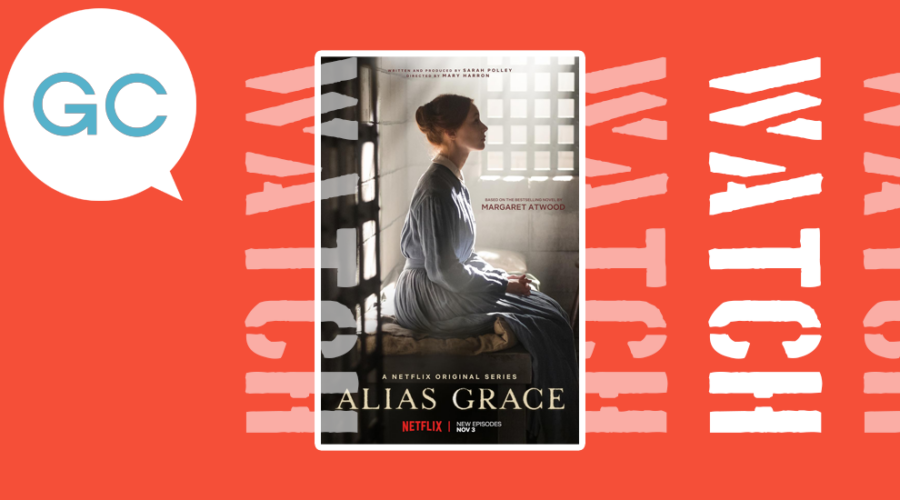
This month, over at Five Books For, we’ve been looking at books that reimagine the Victorians – a selection of modern novels that revisit the nineteenth century from fresh and often unexpected perspectives.
Rather than presenting the polished, familiar images of the Victorian era that were accustomed to, these stories uncover hidden lives, challenge long-held assumptions and remind us that history is rarely as neat as we like to imagine. It’s a fascinating theme, and one that naturally lends itself to adaptation.
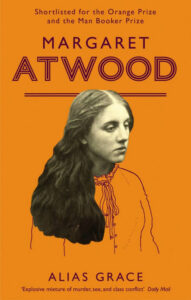 For this month’s adaptation, I’ve chosen Margaret Atwood’s Alias Grace and its superb 2017 television adaptation – a compelling blend of historical fiction, psychological mystery and true crime that leaves just enough unanswered to linger long after the final page – or final episode.
Atwood has never been interested in making life easy for her readers. Throughout her career she has delighted in blurring the line between history and myth, truth and invention, and certainty and ambiguity.
Alias Grace, first published in 1996, brings all of these elements together beautifully. Based on the true story of Grace Marks, a nineteenth-century servant convicted of the murders of her employer Thomas Kinnear and his housekeeper Nancy Montgomery in 1843, the book is both an engrossing historical mystery and a meditation on how stories are created.
In 2017, the novel was adapted into a six-part miniseries written by Sarah Polley and directed by Mary Harron.
Rather than attempting to “improve” Atwood’s novel, the adaptation embraces its ambiguity, resulting in one of the most intelligent literary adaptations of recent years.
Atwood has never been interested in making life easy for her readers
The story begins years after the murders, with Grace (played on screen by the wonderful Sarah Gadon) imprisoned but now working as a servant in the governor’s household. Dr Simon Jordan, an ambitious young physician fascinated by the emerging field of mental illness, is invited to interview Grace in the hope of determining whether she is truly guilty, or merely an unfortunate victim of circumstance.
From this deceptively simple premise unfolds a layered narrative in which Grace recounts her childhood, immigration to Canada, years in domestic service and the events leading up to the murders. Yet neither Simon nor the audience can ever be entirely certain whether Grace is revealing the truth, protecting herself, or unconsciously reshaping her own memories. This uncertainty is the novel’s – and the series’ – greatest strength.
Historical fiction often promises to transport us into the past, filling in the gaps left by historians. Fascinatingly, Alias Grace does almost the opposite. Atwood carefully reminds us that history itself is incomplete. The real Grace Marks left behind contradictory testimonies, sensational newspaper reports and conflicting witness accounts. Rather than pretending these uncertainties can be resolved, Atwood builds the whole novel around them.
The television series wisely resists the temptation to step in and provide definitive answers. Many modern adaptations feel obliged to explain every mystery, but Sarah Polley’s screenplay seems to understand that the ambiguity is the point. By preserving the novel’s unanswered questions, the series respects both its source material and its audience.
Sarah Gadon delivers an extraordinary performance in the title role. Grace is polite, intelligent and quietly humorous, yet remains fundamentally unknowable. Gadon constantly invites us to reassess our assumptions. Is Grace manipulative? Traumatised? Innocent? Guilty? All of these possibilities seem plausible, sometimes within the same scene.
Sarah Polley’s screenplay seems to understand that the ambiguity is the point
Opposite her, Edward Holcroft portrays Simon Jordan as a man whose scientific confidence slowly unravels. Initially believing he can diagnose Grace through rational observation, he instead becomes increasingly obsessed with her story and frustrated by its contradictions. His gradual loss of certainty mirrors our own experience as viewers.
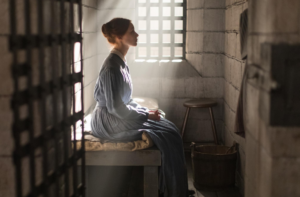
One area where the adaptation particularly excels is its visual storytelling. Victorian Canada is presented not as a world of elegant drawing rooms and lavish costumes but as a place of relentless physical labour, harsh winters and rigid social hierarchies. Domestic service was exhausting, insecure and often dangerous for young women with few alternatives. The series never romanticises this reality.
It’s also a pleasure visually – the use of colour is especially striking. Cool blues and muted greys dominate much of the series, reflecting both Grace’s emotional restraint and the austere environment she inhabits. Moments of warmth are rare and therefore all the more powerful. The careful pacing also allows silence to become meaningful; long pauses often communicate more than pages of dialogue could.
Both novel and series explore themes that feel surprisingly modern. Grace is constantly judged by others according to whatever story best suits their needs. To some she is an innocent victim, to others a calculating murderess, a fallen woman, a religious curiosity or a medical case study.
Very few people take the time to ask who Grace herself might wish to be.
This fascination with controlling women’s narratives resonates strongly with contemporary audiences. The Victorian setting may be historical, but the questions Atwood asks about gender, power and public perception remain remarkably current.
One of the adaptation’s boldest challenges lies in its handling of the novel’s supernatural elements. Without revealing too much, for anyone unfamiliar with the story, a late sequence involving hypnosis and apparent spirit possession could easily appear ridiculous, whether on page or screen. Atwood can pull it off, of course, and Harron’s direction walks a careful line, presenting the events with complete seriousness while refusing to tell us whether we are witnessing psychological trauma, deliberate performance or something genuinely supernatural.
The result is unsettling precisely because certainty remains impossible.
Some mysteries endure because the evidence itself is incomplete
I found it refreshing that the series trusted viewers to reach their own conclusions when so many modern dramas insist on neat explanations.
Alias Grace – in both forms – recognises that some mysteries endure because the evidence itself is incomplete.
If there is one criticism to be made, it is that the adaptation’s faithfulness occasionally comes at the expense of momentum. At just over five hours, the series unfolds deliberately, sometimes lingering over conversations that might have been tightened without sacrificing their emotional impact. Viewers expecting a conventional murder mystery may find its measured pace challenging. However, I found this restraint to be one of its virtues. It’s less about solving a crime than it’s about examining why we are so desperate for certainty in the first place.
Ultimately, both novel and adaptation ask whether objective truth is ever fully accessible. Every character constructs a different version of Grace Marks, shaped by personal prejudice, ambition or desire. Even Grace herself may no longer know where memory ends and invention begins.
Rather than frustrating the audience, this ambiguity becomes the work’s central achievement.
In an era when true crime dominates television (not to mention podcasting, publishing… and all the rest) and every mystery is expected to end with a definitive revelation, Alias Grace feels quietly radical. It reminds us that real history is rarely tidy, that human beings are endlessly contradictory, and that the stories we tell often reveal as much about ourselves as they do about the people we seek to understand.
Book or adaptation?
This is one of those rare occasions where choosing feels almost impossible. Atwood’s novel offers richer psychological depth and greater insight into Grace’s inner voice, while the television series translates its atmosphere, performances and visual symbolism with remarkable intelligence.
If pressed, I would still recommend reading the novel first – always a good general rule – but the adaptation stands proudly alongside it. Not as a replacement, but as one of the finest examples of how literature can be translated to the screen without losing its soul.