

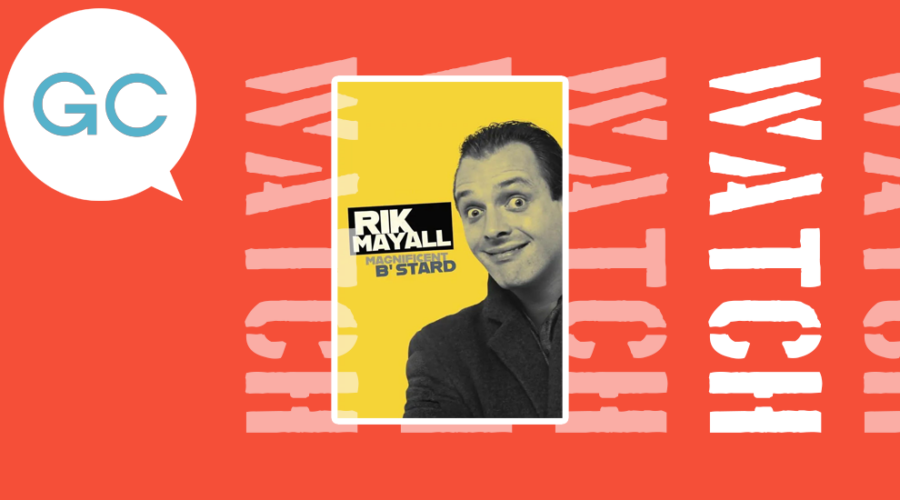
To watch Sky Documentaries’ Rik Mayall: Magnificent B’Stard is to plug your wet brain directly into a high-voltage socket of pure, unadulterated 1980s chaos, only to realise with a sickening jolt that modern culture has completely lost its stomach for the grotesque – unless you count our rancid far-right politicians.
We exist in an era of hyper-sanitized, algorithmic content where star personas are meticulously focus-grouped to avoid friction, or they are dipped in a vat of toxic racist hyperbole and unleashed on a public too exhausted to resist the digital onslaught.
Into this polarised wasteland, director Todd Austin drops a 90-minute incendiary device, a screaming reminder of a time when comedy was a visceral, sweating, analogue assault on the central nervous system. For those of us who mutated under the radioactive glow of British television in the 80s, Mayall was not merely a comedian; he was a manic, rubber-faced shaman who completely rewired our teenage synapses.
My own psychological derailment began with Kevin Turvey on A Kick Up the Eighties, that beautifully pathetic, anorak-wearing investigative journalist who turned mundane, localised delusion into a cringeworthy torrent of social awkwardness.
But Turvey was merely the spark traveling down the fuse. When The Young Ones exploded onto our screens, it felt less like a sitcom and more like a bricks-and-mortar home invasion, a sensory overload where Rik-the self-proclaimed anarchist and Marxist poet, embodied every agonizing, performative hypocrisy of youth with the kinetic violence of a cartoon character escaping a burning frame.
Alongside the cinematic, reality-bending brilliance of The Comic Strip Presents…, and the kamikaze Dangerous Brothers, Mayall didn’t just challenge the television establishment; he grabbed it by the bollocks and atomised it into pure static.
Nowhere is this cultural warfare more potent than in the film’s memory of The New Statesman, where Mayall’s performance as the depraved, ultra-Thatcherite Tory MP Alan B’Stard achieved a terrifying kind of political prophecy. He didn’t just satirise Westminster greed; he turned it into a literal, physical pantomime of demonic ambition, stretching his face into a terrifying grin that mirrored the dark soul of the decade.
Looking at B’Stard through the post-Brexit lens, the tragedy is not that the satire has aged, but that modern political reality has completely broken through the screen and outpaced the caricature. Mayall’s fictional monster looks quaint, a harmless cartoon villain compared to the unvarnished, shameless absurdity of today’s ruling class, proving that the documentary’s sharpest asset is its ability to track how Mayall shifted from mocking the political machine from the outside to embodying its very rot from within.
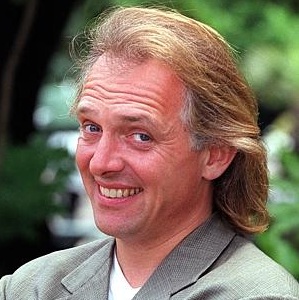 Yet, the true, bleeding, neon heart of this film lies in its frantic unmasking of the man behind the sneer, exposing the psychological architecture of a performer whose entire existence was a high-wire act of perpetual motion.
Mayall stood taller, puffed out his chest, and generated his own gravity the second an audience appeared, but the documentary shows that the gravitational pull eventually threatens to collapse the star.
The testimony of his children functions as a sad deconstruction of celebrity culture, painting a portrait of a man trapped inside his own manic creation and plagued by a profound, echoing anxiety that if he wasn’t being universally adored, he simply wasn’t real.
The film does not shy away from the dark, heavy realities of his later years, cataloguing the profound professional wound left when Stephen Fry fled their 1995 West End play Cell Mates, the near-fatal 1998 quad bike accident that fundamentally altered his physiology like a cruel cosmic prank, and the slow, tragic descent into solitary drinking that ultimately fractured his legendary double-act with Adrian Edmondson.
Where Magnificent B’Stard slightly falters is in its structural reliance on the traditional broadcaster retrospective format, occasionally trying to cage a wild animal inside a polite television studio. At times, the talking-head contributions threaten to smooth over Mayall’s sharpest, most jagged edges, filtering an engine of pure, unbridled chaos through safe, cozy, sentimental recollections that feel antithetical to his post punk-rock ethos. Imagine if Adam Curtis had got his hands on this.
Yet, whenever the documentary lets the archival footage breathe, Mayall’s raw, dangerous genius annihilates the frame. Watching him and Edmondson perform in Bottom (I was in the audience for the recording of the very first episode) screaming, bleeding, and assaulting each other with a feverish ferocity that felt less like a traditional sitcom and more like Samuel Beckett on crack, you realize how small, timid, and claustrophobic our current cultural imagination has become.
Ultimately, Rik Mayall: Magnificent B’Stard is an essential, if pedestrian, archive of a lost cultural evolution that left an indelible scar on the landscape of British comedy and switched a whole generation on, politically. For anyone who cut their teeth on the alternative comedy of the 80s, it forces us to investigate the past not to wallow in cheap, comfortable nostalgia, but to realise exactly what we have sacrificed on the altar of tasteful, safe entertainment.
Mayall was a magnificent bastard precisely because he refused to let us look away, standing as a towering, screaming testament to the power of pure, uncompromised energy.
And my own mum never forgave me for imitating his sneer in every family photo she took in the decade when Rik Mayall was the centre of the universe.
