

This month over at Five Books For, I’ve been looking at books where education is either a key theme or setting in the story.
The book: Never Let Me Go by Kazuo Ishiguro
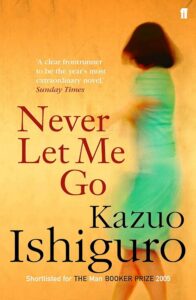 Never Let Me Go spends a fair bit of time in the school setting of Hailsham, a residential school where we meet our narrator, Kathy, and her friends Tommy and Ruth. Like much of Ishiguro’s work, it resists urgency; we only gradually realise that the world Kathy lives in is not quite the same as ours.
Kathy is a carer, looking after donors. I believe the book is well known enough now that the premise won’t be spoiled for most people if I say that she is part of a generation of clones created for the sole purpose of providing organs for the original population.
At Hailsham, Kathy and her cohort were raised in relative comfort, encouraged to make art, to study, to believe they had futures.
But the truth – as always in Ishiguro’s work – arrives slowly, like a fog slowly lifting to reveal something sinister and deadly underneath.
The book moves between three stages of Kathy’s life: childhood at Hailsham, early adulthood at a place called The Cottages, and her later working life as a carer.
What gives the story its emotional force isn’t plot per se, but the accumulation of small details – a lost cassette tape, a rumour about “deferrals”, a painting held up for judgement – and the way in which all these things begin to form a pattern that is quietly devastating. This isn’t the kind of dystopian story where the characters are fighting their fate, rising up in rebellion to overthrow the regime; instead, they are learning to live inside it, which is somehow much more upsetting, and gives the book real emotional depth and philosophical heft.
One of the things that hit me the hardest as a reader is how normal everything feels for Kathy and her friends. They fall in love, they quarrel, they make assumptions about the future in the same way anyone else might.
The tragedy is not only what is done to them, but how long it takes them to fully understand what has been done.
The film: Never Let Me Go
The 2010 film adaptation of the same name, directed by Mark Romanek, approaches the same material with a different set of tools. Where the novel leans into interiority and hindsight, the film is forced to externalise. And it does so with a kind of restrained elegance that mirrors the book’s emotional temperature rather than its narrative form.
Carey Mulligan plays Kathy, with Keira Knightley as Ruth and Andrew Garfield as Tommy. The casting is almost too perfect in retrospect – not because they resemble how you might imagine the characters, but because they embody a very specific kind of controlled emotional exposure. These are characters who feel things deeply but have learned not to show it too openly, even to themselves.
The film streamlines the story significantly. Hailsham is more compressed, the Cottages less sprawling, the timeline more linear. Some of the novel’s philosophical digressions are reduced or removed entirely.
In exchange, what the film provides in abundance is atmosphere: misty landscapes, soft lighting and, above all, a sense that the world is always slightly out of focus, as though seen through glass, a clever way of mirroring the experience of the characters themselves as they grow up not realising that the reality they inhabit is so different to the rest of the population.
The book forces you to discover; the film makes you sit with what you already suspect
One of the most notable departures from the book is the handling of information. In the book, the reader learns the truth about what’s happening gradually, almost incidentally, through Kathy’s recollections. In the film, the revelation is more explicit, more front-loaded in its implications.
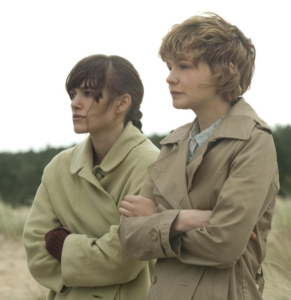 This changes the emotional rhythm. The book forces you to discover; the film makes you sit with what you already suspect.
The film doesn’t dispense with implication altogether: there’s a particularly heartbreaking scene involving a sale at Hailsham which leaves the viewer to infer the outside world’s perceptions of the students from the items that are donated, and this subtlety is one of the strengths of the film, which feels almost contemplative at times.
There is also a difference in how memory functions across the two formats. Ishiguro’s Kathy is unreliable not because she lies, but because she selects. She drifts. She returns to certain moments again and again, as though circling something she cannot quite touch.
In the film, memory is less fluid. It is structured, sequenced, anchored to scenes we can see and hear. That is both its strength and its limitation.
Another thing the film does exceptionally well is creating intimacy between the characters and the viewer. A glance between Kathy and Tommy carries what pages of internal narration do in the book. There is a scene in which Ruth, increasingly unwell, attempts to make amends by orchestrating a reunion between Kathy and Tommy. It is understated, almost awkwardly so, and yet it lands with enormous emotional weight.
The performances do a great deal of the lifting here, where the novel relies on quiet philosophical inevitability.
But the novel has something the film can never fully replicate: the slow accretion of understanding. Reading Never Let Me Go is like being gently trained to notice what is missing. You begin with innocence, and end with a kind of retrospective dread.
The horror, when it comes, is not a shock – it is a recognition, and in a way it feels more intense as a result.
There is also the question of voice. Kathy’s narration in the book is famously understated. She rarely comments on the moral horror of her situation directly, but instead she describes, remembers, observes. This displaces the emotional impact onto the reader, who is left to supply the outrage that Kathy herself never fully articulates. It is a clever, slightly cruel narrative strategy, and a very literary one.
The film, by contrast, cannot sustain that level of internal withholding. By the nature of the format, it has to show and explain more, and anchor the emotion in performance rather than implication.
And yet, to its credit, it never overstates. Romanek avoids melodrama. There is no swelling music where it would feel unearned, no attempt to force catharsis where the story resists it.
To me, watching this adaptation of the work of one of my favourite authors, I was impressed at how well Romanek created the feeling of the novel despite the limitations of the format (and perhaps also because of them, to some degree).
So what are we left with when we place the two side by side?
The novel is more conceptually expansive. It asks more of the reader, and gives less away willingly. It is about memory, acceptance, and the quiet ways in which people adapt to systems that should be unbearable.
It lingers in the mind long after reading, not only because of the themes and the emotional weight but also because Ishiguro’s prose is always so beautiful.
The film does not replace the book; it echoes it
The film, on the other hand, is more immediate. It translates emotional ambiguity into visual language with restraint and clarity. It is less interested in the philosophical architecture of the world, and more in the human cost of living inside it.
It is, in some ways, more accessible – but also more bounded by what can be shown.
Neither version cancels the other out. In fact, they sit unusually well together. The film does not replace the book; it echoes it. And the book, in turn, gains a kind of visual afterlife through the film’s imagery.
It’s rare that I’m so deeply impressed by a film adaptation of a beloved novel but in this case I couldn’t take my eyes off the screen, and I felt the emotional impact just as heavily as I did when reading the book. To me, that is truly a great adaptation.