

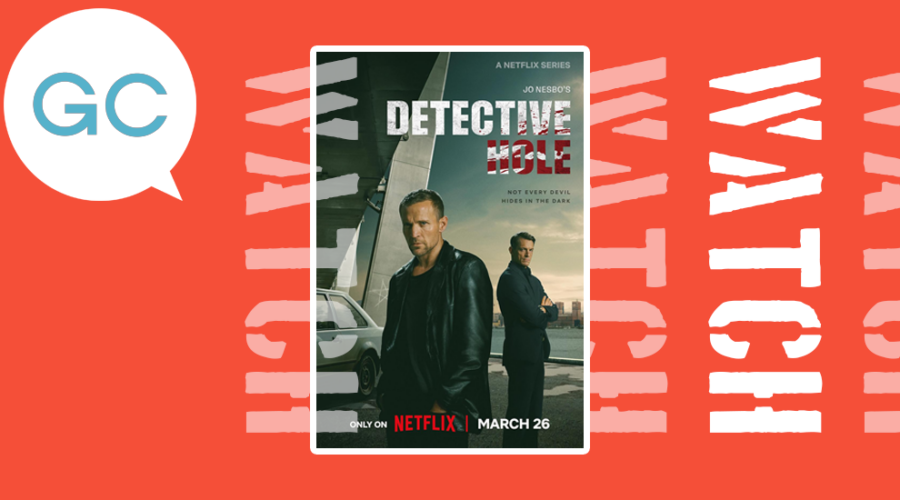
One of the most highly anticipated European television premieres of 2026 is the series adaptation of the popular Harry Hole books, officially titled Jo Nesbø’s Detective Hole. The Netflix production has become one of the great successes of Nordic Noir — a Scandinavian crime genre characterised by dark atmospheres, realistic plots and tormented protagonists — within the platform.
Harry Hole already has a dozen books to his name and has been a staple of these addictive mysteries ever since the author published his first novel in 1997. Following the widely panned 2017 film adaptation, The Snowman — starring Michael Fassbender — this new production aims to redeem the franchise. To ensure this, Nesbø himself wrote all the scripts for this first season, which is based on the fifth book in the series, The Devil’s Star, originally published in Norway in 2003.
In its premiere, the series follows the obsessive but flawed titular detective and his team as they try to track down a serial killer lurking in the streets of Oslo, all while navigating corruption within their own police force.
The official synopsis of the series reads:
“Created by one of the finest storytellers in crime fiction, Jo Nesbø’s Detective Hole is a whodunnit-style serial-killer mystery led by the famous antihero Harry Hole. Beneath the surface, this series is a nuanced character drama about two police officers—and supposed colleagues—operating on opposite sides of the law. Throughout the first season, Harry comes face to face with his eternal adversary, the corrupt detective Tom Waaler.”
Behind this dangerous clash of wills, what truly drives the narrative are the protagonist’s profound flaws. Halfway through the nine-episode series, a female character defines Harry and his chaotic inner world with a phrase as ironic as it is accurate: “You’re a living cliché.”
Far from taking offense, the detective accepts it with complete clarity.
To tell the truth, he fits the profile of the solitary investigator to a T: brilliant at piecing together forensic clues, but incapable of managing his time, communicating with others, or breaking free from his addictions.
The big difference in this story is that Harry decides to confront his own toxicity, fighting his obsessions, guilt, and emotional fears through therapy and abstinence.
He knows full well that if he relapses, he will destroy his budding relationship with Rakel Fauke (Pia Tjelta) and condemn himself to permanent isolation.
However, Harry’s fragile stability collapses when a personal tragedy shatters his mental health, coinciding with the emergence of a serial killer — an alarming and rare phenomenon in Norway. Each corpse is found in a brutal, fetishistic scene, pointing to occult rituals and religious fanaticism.
To further complicate matters, behind this web of intertwined mysteries operates a shadowy secret society determined to “clean up” the country. This clandestine network, which has infiltrated the highest echelons of the judicial and political spheres, uses the guise of the law to justify brutal social purges.
With few options and under time pressure, Harry is forced to collaborate directly with Tom Waaler (Joel Kinnaman), the “impeccable” colleague he deeply despises. This forced alliance drives the series to its climax, as the detective operates under the lingering suspicion that Waaler is leading the corruption network from the shadows.
Caught between the threat of the serial killer and the impunity of his own partner, the protagonist embarks on a desperate hunt to solve the case and unmask his lethal rival before it’s too late.
Cast and direction
In the tradition of film noir, the urban setting becomes a living entity
The cornerstone of this production lies in the dramatic weight of its protagonists and the talent of its actors. Santelmann (Kon-Tiki, In Order of Disappearance) brings great depth to Hole, portraying him perfectly as a brilliant investigator broken by his own demons. The perfect counterpart to this game of cat and mouse is Kinnaman (Suicide Squad, RoboCop), whose on-screen charisma and coldness create a relentless Waaler, heightening the tension in every scene.
Directed by Øystein Karlsen and Anna Zackrisson, the series was filmed on an unprecedented scale, masterfully capturing the essence of the Norwegian capital.
In the tradition of film noir, the urban setting becomes a living entity. Director of photography Ronald Plante imbues Oslo with a vivid atmosphere that evokes the protagonist’s fragile psyche and enriches the plot’s ethical dilemmas.
A mesmerizing soundscape
This visual aspect is enhanced by its spectacular sound design. The soundtrack, composed by Nick Cave and Warren Ellis, intensifies the visceral horror of the ritual crimes.
Far from being mere background noise, the harsh, raw, and melancholic melodies envelop every corner of the city.
The music perfectly captures Harry’s inner torment and the constant threat of his surroundings, transforming the experience into a sonic journey that plunges the viewer into a state of absolute alertness.
Fidelity to the source material
Unlike the missteps of the past, this production stands out for its unwavering fidelity to the original material. This success is no accident; it stems from the decision to grant total creative control to the mind that conceived this universe.
Jo Nesbø expands the literary plot without diluting its essence. This allows the story to breathe and take the time needed to build its oppressive atmosphere.
By not toning down the explicit brutality of the ritual murders or altering the complex, self-destructive psychology of its characters, the production remains true to its roots. It is an adaptation that respects both the viewer and the reader alike.
Viewers are warned that the production does not shy away from graphic content or bloody scenes due to the nature of the ritual murders, which may be disturbing to more sensitive viewers.
About Jo Nesbø: the master of Nordic suspense
Behind this gripping story is Jo Nesbø, one of the most versatile and brilliant minds in contemporary literature. Before establishing himself as a writer, Nesbø was a soccer player, an economist, and the frontman of the successful Norwegian rock band Di Derre.
Today, he is part of the select club of Scandinavian writers — alongside greats such as Maj Sjöwall and Per Wahlöö (The Laughing Policeman), Henning Mankell (Faceless Killers), Stieg Larsson (The Girl with the Dragon Tattoo), and Camilla Läckberg (The Ice Princess)—that has established the region’s crime fiction as a global benchmark.
With over 50 million copies sold and translated into dozens of languages, Nesbø has turned the Harry Hole series into a stark portrait of human obsessions.
Our verdict
Jo Nesbø’s Detective Hole is a raw, magnetic, and morally ambiguous journey that no lover of a good crime thriller should miss.
The series’ true triumph lies in the seamless interplay of its strengths: a suffocating conspiracy plot that stays true to its source material, the overwhelming psychological complexity of its main characters, a mesmerizing soundtrack, and evocative cinematography that transforms the landscape of Oslo into the perfect reflection of its protagonist’s troubled psyche.
Let’s keep our fingers crossed for a second season.