

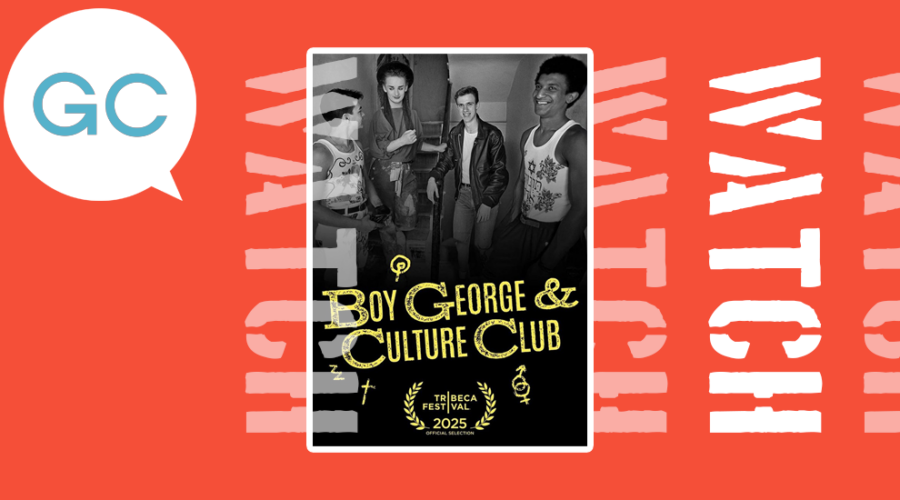
Admittedly, despite having grown up with the chart-topping pop band Culture Club a ubiquitous presence on the airwaves of my youth, I’m not the target nostalgia audience for Alison Ellwood’s Boy George & Culture Club, a film whose subject is apparent to anyone familiar with such prefabricated 80s tunes as “Karma Chameleon” and “Miss Me Blind.” Indeed, for likeminded new wave aficionados, the band’s tired mainstream sound always undercut any rebellious bonafides its theatrically-clad titular singer may have had. (Music snob queer kids much preferred the gender-bending vocals of Bronski Beat’s Jimmy Somerville and Yaz’s Alison Moyet.)
Which is why it felt so refreshingly self-aware to hear George himself candidly stress from the start, “We were never cool.” (This after noting that the aforementioned 1983 hit “Karma Chameleon” was supposedly the “nail in our cool coffin.”)
It’s this wink-and-a-nod approach by the forever glamorous frontman that makes Boy George & Culture Club so surprisingly fun — and thankfully free of the tortured artist trope. The doc’s a swift-moving chronicle of the British act through contemporary (separate) interviews with all its members; along with a dizzying array of archival material and, of course, an earworm-laden soundtrack.
But it’s the magnetic and still highly stylized singer, whose penchant for bon mots is both fierce and endearing, who ultimately runs away with the film. Unsurprisingly, as George’s show-stealing played a big part in Culture Club’s dissolution.
That said, he seems to have been an uneasy fit from the get-go. “I’m a goth that accidentally ended up in a pop band,” the singer sighs after expressing his adoration for Siouxsie and the Banshees. “It’s very upsetting.”
In fact, it was uber cool vocalists Siouxsie Sioux, Ari of the Slits and Poly Styrene who the frontman looked to for inspiration. “I love spending the entire day turning myself into someone else,” he also confesses.

Nevertheless, it can be rather disorienting when your meticulously crafted persona provokes both curiosity and outrage. George recalls how, after the punk Svengali Malcolm McLaren recruited him into Bow Wow Wow “just to piss off (lead singer) Annabella,” he was fired for attacking a booing crowd with his mic. Though that turned out to be a blessing in disguise, since the incident prompted bassist Mikey Craig to seek George out as a musical collaborator.
Always up for experimenting, he immediately signed on. “I’m very magpie-like when it comes to culture,” George explains at one point.
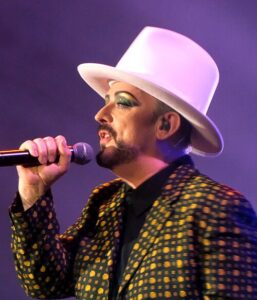 Alas, it was this boundary-busting spirit that ultimately poisoned the band from the very start — which is when George and drummer Jon Moss began their doomed romantic relationship. Cue the feuds, the drugs, the breakup, and eventually George’s made-for-the-tabloids arrest for falsely imprisoning a male escort.
It was the inevitable culmination of the frontman’s sacrificing of his own emotional wellbeing for the sake of a rock star career. “Fame becomes its own job,” the singer laments.
More than his years-long addiction to heroin, George’s intoxication with the spotlight — and his love of controversy — proved harder to shake. “No one wants to dress up and go unnoticed,” he cheekily quips when asked about the homophobic protestors at many Culture Club gigs. As for the hate from fellow (cisgender) gays, who were often as uncomfortable with George’s flamboyant appearance as the close-minded heteros, he chalks it up to pure self-interest: “Why are you spoiling our bid for assimilation?” (A sentiment undoubtedly echoed by every trans and nonbinary individual since Stonewall.)
Unfortunately, the singer’s survivalist defiance seemed to likewise take its toll on everyone around him. Reflecting on one of the last music videos that Culture Club produced, George expresses regret that, “The other three felt like they’d been dragged into a gay circus.”
Which isn’t to say that he’d necessarily go back and straighten the trajectory. Or give up the notoriety.
“I stumbled into it,” George proclaims about fame, then waits a beat before adding, “Because I fancied the drama!” (Followed by a raucous laugh and a loud clap of the hands.)
For the self-effacing notion that this eternal showman’s rise could ever be an accident is disingenuous — and he knows it. And he knows we know it.
While the high culture press might have been dismissive or baffled, it appears Culture Club and its fans were always in on the joke.
Images: Paul Carless and Boy George & Culture Club
