

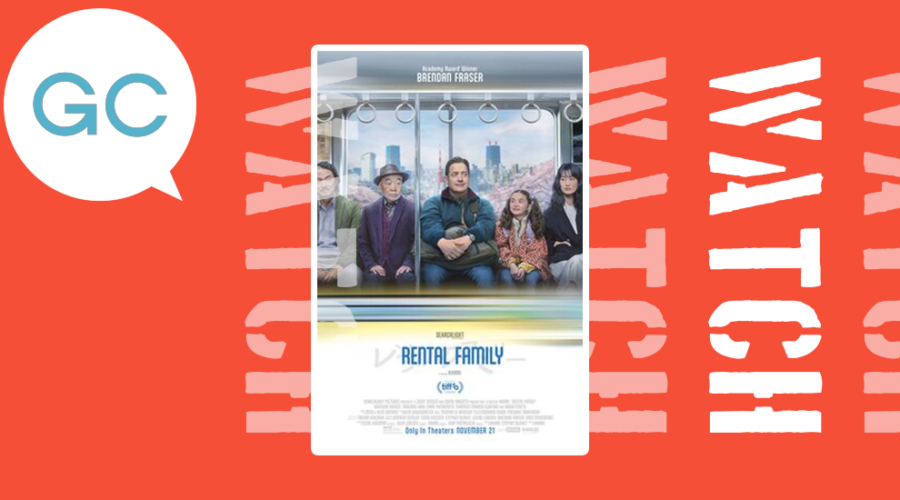
When people hear about Rental Family (Disney Plus), the new film starring Brendan Fraser, it is easy to assume its premise belongs to the realm of far-fetched fiction. An actor who gets paid to play the role of a father, husband, friend, or family member for complete strangers sounds like an idea designed to grab attention. Yet the reality behind the film is far more complex.
In Japan, an entire industry has existed for years around exactly that concept: companies offer rental companions and stand-in family members to fill emotional gaps, ease loneliness, or help people navigate difficult social situations.
The film draws from that reality to raise a question that extends well beyond Japan’s borders. What does it mean to feel connected when companionship has become a service that can be purchased?
Directed by Hikari, Rental Family follows Phillip, an American actor living in Tokyo who takes a job with an agency that provides people to fill various roles in the lives of its clients.
As he becomes involved in these experiences, the line between performance and genuine emotional connection begins to blur. The story, inspired by this real industry operating in Japan, is more than a film about an unusual profession. Rental Family is a reflection on the emotional needs that persist even in highly connected and technologically advanced societies.
The phenomenon portrayed in the film is part of a broader trend that some observers have described as the “companionship economy.” These services respond to emotional needs that were once met within families, friendships, or close-knit communities.
In Japan, where an aging population, shrinking family sizes, and changing living arrangements have reshaped social relationships, these businesses have found fertile ground.
Among the best-known examples are agencies that provide stand-in relatives for weddings, gatherings, and celebrations. Some people hire someone to play the role of an absent parent during an important ceremony. Others seek additional guests for events where they fear attendance may be low. There are also rental friend services that accompany clients to concerts, restaurants, or everyday activities.
While these arrangements may appear to be little more than performances from the outside, those who use them often describe experiences tied to very real needs. The search for emotional support, the desire to avoid isolation, or the pressure to meet certain social expectations.
 Within this same world are services that have attracted international attention because of their uniqueness. One example is the so-called ikemeso, men who are hired to accompany people who want to cry during a movie screening or in sessions specifically organized as emotional release experiences. Their role is to provide support and companionship during moments of vulnerability.
As unusual as the concept may seem, it relates directly to the questions raised by Rental Family. The need it addresses is not very different from the one driving the characters in the film. In both cases, people are searching for a human presence capable of offering comfort, even if that presence has been hired.
What makes Rental Family particularly compelling is that it avoids judging those who turn to these services. The film does not portray its characters as people incapable of forming relationships. Instead, it presents them as individuals facing specific circumstances. Some are coping with loss. Others live alone. Some are trying to reclaim a sense of normalcy they feel they have lost. That perspective is especially important if the phenomenon is to be understood through a human lens rather than as a social oddity.
The deeper question is not whether these relationships are authentic or artificial. What truly matters is understanding why there is growing demand for this kind of companionship.
Numerous studies have shown that loneliness is becoming an increasing concern across many countries. Aging populations, long working hours, geographic mobility, and changing family structures have reduced some of the traditional spaces where people once built and maintained social connections. Many individuals now have hundreds of digital contacts while simultaneously experiencing a persistent sense of disconnection.
That is why the story told in Rental Family feels so relevant beyond Japan. While the country is often viewed as a unique case, some of the conditions that contributed to the rise of these services are beginning to emerge elsewhere. Around the world, new initiatives have appeared that offer companionship for older adults, support for everyday activities, or services specifically designed to combat social isolation.
The form may differ, but the need they address is remarkably similar.
The film also arrives at a time when conversations about loneliness are taking on new dimensions. The rise of virtual assistants, AI-powered digital companions, and applications designed to provide emotional interaction has sparked debate about the many ways people seek connection.
Against that backdrop, Rental Family focuses on something essential; even when a relationship begins as a financial transaction, there is still a deeply human need behind it.
What unfolds on screen is not simply a portrait of a peculiar industry or a critique of the commercialization of human relationships. It is a reflection on the importance of human presence in an era increasingly shaped by social fragmentation. Phillip’s story, and the stories of those who seek out his services, serve as a reminder that the need for connection remains one of the most fundamental constants of the human experience.