

“Writers are unfilmable.”
I forgot who told me this years ago, but while there are exceptions to this rule, the rule is there for a reason. Writing, for example, is probably the most important and also the most visually boring part of my life. You’d much rather see me doing something much less important, such as chugging lager with the flyboys on a Saturday night – if you’re a normal person, that is.
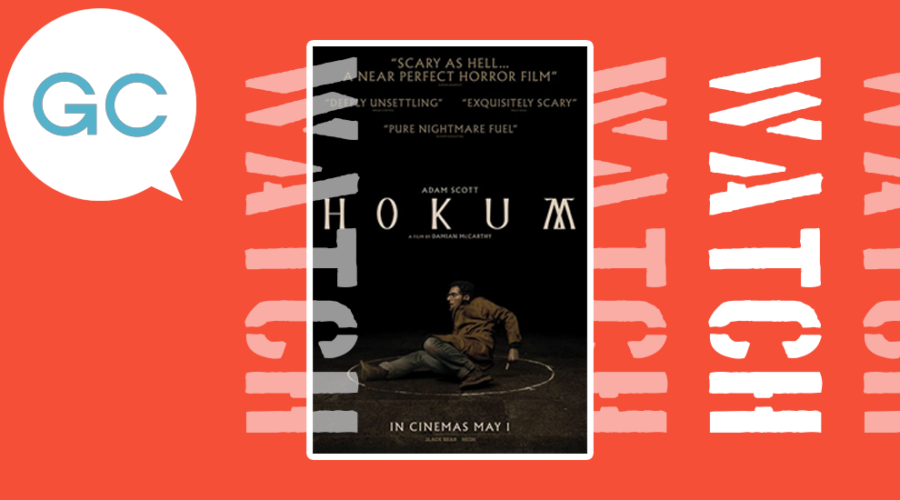
Really getting inside an author’s head – and not being boring and pretentious about it – is one of the many selling points of Hokum, the new horror film from Damian McCarthy, who previously brought us such eerie gems as Oddity.
Writing is probably the most important and also the most visually boring part of my life
Adam Scott is terrific as successful yet completely miserable and even somewhat reprehensible novelist Ohm Bauman. Bauman has traveled to Ireland to scatter his parents’ ashes near the creepy hotel where they inexplicably had their honeymoon.
A witch might be stalking the hotel. Or else Bauman might be going a little insane. Maybe it’s both. Maybe it doesn’t even matter.
McCarthy invites us into Bauman’s head by first dramatizing his fiction. It’s bleak and horrible, and Bauman questions why readers even like it, which means he is extra terrible to his devoted fans.
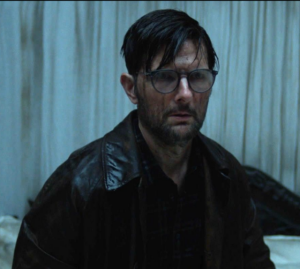 However, there are reasons why Bauman is such a determined killjoy, and both the script and Adam Scott tease them out by imbuing the character with some much-needed vulnerability.
You don’t want to feel sorry for the asshole drunk novelist – until you do.
McCarthy is already famous for his visual language and he dials it up to the max in Hokum. There are dead goats, cherubs with sly, knowing smiles, the Irish woods stabbing upwards into the gathering dark, and even an evil Bunny Man with the panache of a young Mick Jagger (a terrific, small role by Brendan Conroy, who also plays the hotel’s owner, a shanachie who terrifies small children with his stories and pisses off Bauman in the process).
A classic horror story often involves a hero who feels guilty/is traumatized by something. Only by going through hell – the traditional gauntlet of scares and fights and flights – can they potentially emerge on the other side.
Hell can be a very subjective place, however, as a drifter befriended by Bauman reveals. You have to open your mind up to it if you are to both survive and solve its mysteries. Maybe you can do it through drugs, or maybe you can do it through confronting your darkest secrets, but either way you have to strip your hard outer layers first and practice acceptance.
There’s a great metaphor in here for the flexibility of the novel format, and the flexibility of the human mind.
A hotel is a wonderful setting for a story like this, predicated on transience and being a fish out of water. As a prickly guest, Bauman is a great foil for the locals and the weird tales they seem to believe in.
What he will come to realize is that there is both good and bad in these people, and in the terrors that seem to stalk the hotel’s walls.
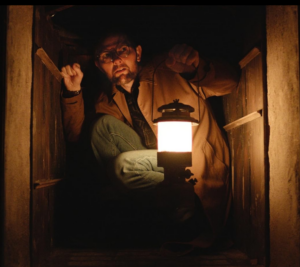
I can confidently say that Hokum is up there with The Shining as far as great hotel horror goes. Not only is it genuinely scary, it’s also a movie that has a great sense of humor about its subject matter. A deadpan script would not have worked nearly as well as a script that can still give you a laugh, even if you’ll pay for it with a good jump scare later.
As a writer and as a man, Ohm Bauman is the flipside of Jack Torrance – kindness is not a costume he wears, instead it’s buried deep inside him, waiting to be stirred awake by events outside his control.
The fact that Hokum is ultimately a story about forgiving yourself is what lends it greatness, however. Nobody can do it for you, the movie tells us.
Certainly nobody can do it for Bauman, even though he’d very much like to take the easy way out at first, abusing himself as much as he abuses his characters.
Unlike Oscar-winning Weapons, the story of the witch is not at the heart of Hokum’s plot, though it serves as a terrific vehicle for the action. Neither is Hokum interested in social commentary, or modern solutions for old curses and hauntings. The hauntings simply are. They make you tremble the way the shadows on the wall made ancient cavemen tremble.
In this sense, Hokum is a more old-fashioned movie, but it’s old-fashioned in ways that are good and right. When darkness falls, and the fire is crackling, and the night grimaces in the windows, it’s time for the shanachie to tell his old tale – and its power is precisely in its familiarity, the way its dread reduces you to being a child again.
Who knows, maybe the dread will ultimately unlock your sad, broken heart, which is, as I would argue, the point of any good ghost story.