

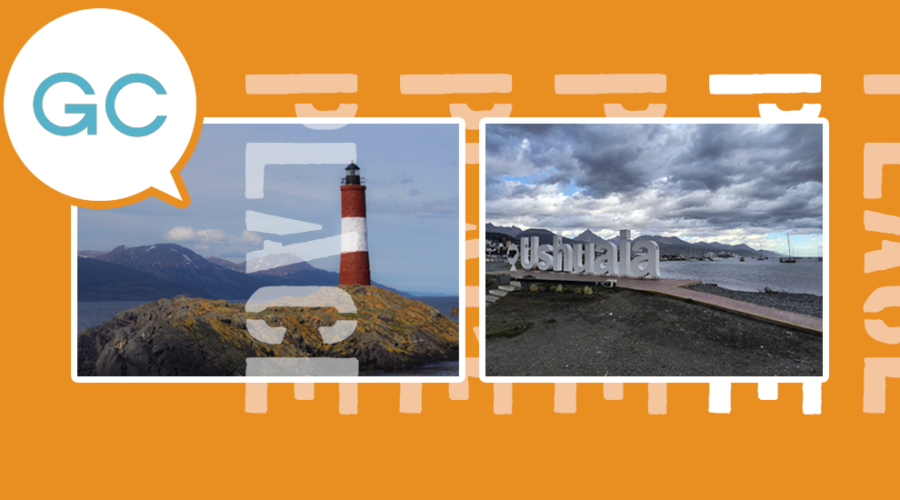
When I flew over Ushuaia in Argentina for the first time, I knew it would become one of my favorite places in the world. However, something changes as soon as Ushuaia begins to fade into the distance while sailing through the Beagle Channel.
From the harbor, the city still seems close and familiar, with its buildings stretching along the coast and the mountains framing the landscape. But as soon as you travel a short distance along the Beagle Channel, the scale changes. The city shrinks, the mountains take up more and more space, and you begin to understand why sailing through here is one of the experiences worth booking during a trip to Tierra del Fuego.

Ushuaia has built much of its tourist identity around its southern location. It lies more than 2,300 kilometers from Buenos Aires as the crow flies, and for most visitors arriving from the Argentine capital, flying is the easiest option. Once there, the Beagle Channel is practically at the city’s doorstep.
Tours depart from the tourist port, located next to downtown Ushuaia. There are various options and durations, ranging from relatively short cruises to trips that reach places like Estancia Harberton or Martillo Island. Depending on the route, you’ll also visit the Bridges Archipelago, sea lion colonies, several bird-watching areas, and the famous Les Éclaireurs Lighthouse.
I would recommend, weather permitting, spending at least part of the trip on the open deck. The catamarans have heated interior spaces and large windows — which are especially appreciated on the way back — but viewing the Beagle through glass doesn’t quite have the same impact.
You have to come prepared. Gloves, a scarf, a good jacket, and several layers of clothing are by no means excessive in these latitudes. On deck, the wind can cause the wind chill to drop rapidly. On the return trip, when the boat picks up speed, staying outside for too long becomes much less pleasant.
Sailing between Argentina and Chile
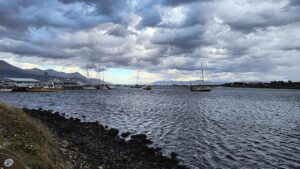
One of the things that interests me most about this tour is its geography. The Beagle Channel separates Argentine and Chilean territories and forms part of an extreme corner of the continent that for centuries was difficult to traverse and map.
From the water, the mountains of Tierra del Fuego accompany much of the voyage. Depending on the time of year, they appear snow-capped or with partially bare slopes. Every now and then, an isolated building can be seen on the coast.
It also helps to know where we are. To the south lie the Chilean islands and, far beyond them, the Drake Passage and Antarctica. Of course, you can’t see the Antarctic continent during a conventional Beagle cruise, but Ushuaia is one of the main departure points for expeditions traveling there.
Sea lions, cormorants, and penguins
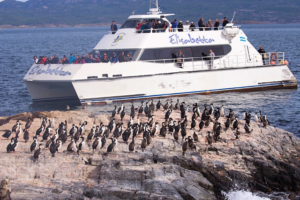
The journey takes a different turn when the animals appear. One of the usual stops is off the islands of the Bridges Archipelago, where colonies of sea lions can be observed.
The boat slows down and remains at a distance while the animals occupy the rocks, enter the water, or simply continue resting. That indifference toward the boats is probably the most interesting aspect of the scene. We’ve traveled thousands of kilometers to see them. They just go about their day.
Birds are another constant presence. At various points along the channel, you can spot seagulls, skuas, cauquenes, black-browed albatrosses, steamer ducks, and various species of cormorants.
For many travelers, however, the penguins are the main attraction. Tours that reach Martillo Island allow visitors to observe colonies of Magellanic penguins and some gentoo penguin during the breeding season.
Not all cruises go that far, so it’s a good idea to check the route before buying a ticket.
The number of visitors has also made it necessary to establish guidelines to reduce the impact of these activities. Since 2005, the Onashaga Commitment has been in place — an initiative linked to responsible tourism in the Beagle Channel that seeks to reconcile excursions with the conservation of the area’s birds and marine mammals.
The lighthouse that isn’t at the end of the world
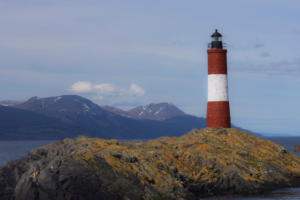
There’s another stop that almost inevitably ends up surrounded by cameras. Perched on a small rocky islet stands the Les Éclaireurs Lighthouse, a brick tower about eleven meters tall, painted with its characteristic red and white stripes.
It was commissioned in 1920 and remains in operation today. It currently runs on solar power and operates automatically.
It’s common to hear that this is the “Lighthouse at the End of the World,” but that identification is incorrect. The lighthouse associated with Jules Verne’s novel The Lighthouse at the End of the World is the one at San Juan de Salvamento, located on Isla de los Estados, quite a distance from here.
The confusion, however, has proven difficult to dispel. Les Éclaireurs is much closer to Ushuaia, appears in practically every photograph from excursions along the channel, and and looks exactly like the kind of lighthouse many travelers expect to find in these latitudes
When the ship finally sets course for home, Ushuaia gradually comes into view again along the coast. After several hours among islets, birds, sea lions, and mountains, the city looks different.
There’s no need to say we’ve conquered the end of the world or turn the trip into a feat. Sailing for a few hours through the Beagle Channel is interesting enough without exaggerating it.
However, you’ll still receive a certificate marking you as one of the relatively few people who have sailed the Beagle Channel.
Images: Edgary Rodriguez R., Vlasta x, Vlasta x again, PLBechly
.jpg)
.jpg)
